
Console Tray vs Console Cover: Which Suits Your EV?
2026-10-13

A console tray and a console cover can look like similar fixes, but they solve different cabin problems. In the console tray vs console cover choice, start with the job: a tray creates an accessible layer inside a storage bin, while a cover sits over a specified surface, such as a console lid or charging area. One helps organise. The other covers a surface.
It’s easy to see why the terms get muddled when all you want is a tidier, better-kept cabin. Choosing by appearance alone, though, could leave you with an accessory that doesn’t address the problem you’re trying to solve.
This guide compares how each option works, where it sits and what it’s designed to do. You’ll see which one suits your habits, whether you need quicker access to small items or want to cover a console surface, and what to check about your vehicle’s make, model, year and interior layout before choosing. That way, you can focus on the accessory that fits your cabin and everyday use.
Key Takeaways
- Use your daily routine to decide whether organising small items or covering a console surface matters more.
- The console tray vs console cover comparison comes down to function first, then how each option suits your cabin layout and habits.
- Inspect your console before choosing: note where storage sits, which surfaces you want covered and whether an accessory could affect access.
- Match the product listing to your vehicle’s exact model and year, as fit can vary between versions.
- Review the current product details before ordering so the accessory’s purpose and stated fitment align with your needs.
Table of Contents
Console tray vs console cover: what does each accessory do?
A console tray adds an organising layer inside a storage compartment, giving smaller everyday items a more accessible place. A console cover sits over or across a specified console surface. It covers that area rather than arranging what you store inside a compartment.
That’s the essential difference in the console tray vs console cover decision: one changes how you use storage, while the other covers a surface. They’re not interchangeable names for one accessory. The exact shape, placement and intended use can vary, so judge each option by its product details and your vehicle’s console layout.
Console design also affects how an accessory works in practice. The position of storage, controls and surfaces reflects choices around interior layout and ergonomics, as outlined in these Automotive design principles. Look at the console in your own vehicle rather than assuming that a familiar-looking accessory will suit it.
What is a console tray?
A console tray is designed to sit within a storage compartment and provide a more accessible place for smaller items, such as a parking card or keys. It can separate frequently used belongings from items stored lower down, so you don’t have to search through the whole compartment each time.
That added layer may also change access to the space beneath it. Depending on the tray’s design and position, you might need to lift or move it to reach lower storage. Check how the product is intended to sit or move, and consider whether you’ll regularly use both levels. Don’t assume every tray has the same sections, mechanism or capacity.
What is a console cover?
A console cover is a layer placed over or across a particular console surface. Depending on its intended use, it may cover an armrest lid, a charging area or another specified section. Its role is surface coverage, not creating a new storage level or sorting loose items inside a bin.
A cover may add a layer between a surface and everyday contact, or change the look or feel of that area. The level of protection depends on the specific product and what it’s designed to cover. Don’t assume that a cover prevents scratches, spills, heat damage or wear unless its product information states this. Check its intended placement, how it attaches and whether it leaves the controls or features you use accessible.
Start with the problem you want to solve. If small belongings get buried in a compartment, consider a tray. If your priority is covering a particular surface, assess a cover designed for that area. Then compare the accessory’s stated purpose and fitment with your vehicle’s console. This simple check helps prevent choosing an item that looks suitable but serves a different function.
How console trays and covers differ in everyday use
A tray changes how you organise items in a storage space; a cover changes which console surface is covered. That difference matters in daily use, because the right choice depends on what you reach for, what you want covered and how your console is laid out.
Compare function before appearance. A tray may make small belongings easier to find, but its position could affect access to storage underneath. A cover may sit over a frequently touched area, but it won’t sort items in a storage compartment. Product shape, attachment method and fit vary, so use the listing details rather than assuming every accessory works the same way. Keep controls and important features accessible, and avoid any placement that could distract you while driving. The NHTSA Human Factors Research provides useful context on how people interact with vehicle environments.
| Comparison | Console tray | Console cover |
|---|---|---|
| Primary purpose | Adds an organising layer within a storage area. | Covers a specified console surface. |
| Everyday use | May give small items a designated place. | May place a layer over an area you regularly touch. |
| Access | Could change how you reach storage below it. | Depends on the surface covered and the product’s design. |
| Check before choosing | Will it suit your storage layout and access habits? | Does it cover the surface you have in mind? |
When a console tray may suit your routine
Think about the small items you carry regularly, such as keys, cards or sunglasses. If they tend to settle at the bottom of a console compartment, a tray may give them a more consistent place. Consider what you store below, too. If you often reach for larger items, check whether the tray lifts, slides or otherwise changes access, as this depends on the product. Choose for your routine, not just the promise of a tidier-looking bin.
When a console cover may suit your priorities
A cover may suit you if you want a layer across a particular surface you touch or use often. First identify the exact area: perhaps it’s the armrest, a lid or another console section. Then compare that need with the product’s stated placement and coverage. Don’t assume a cover will protect against a particular type of damage unless its details say so. A suitable match covers the area you mean to cover without getting in the way of normal use.
Neither option is automatically better. Let your main task decide, then check the accessory’s intended use and fit for your vehicle before ordering. You can browse EV accessories with that distinction in mind.
Console tray vs console cover: which trade-offs matter most?
A tray prioritises access to small items, while a cover prioritises a particular console surface. Neither solves both problems by default, so weigh the trade-offs against how you use your cabin rather than choosing by appearance alone.
Separate category-level differences from product-specific details. In general, a tray is intended to organise storage and a cover is intended to sit over a surface. The exact access, attachment method, shape and coverage depend on the individual design. Those details affect whether an accessory suits your routine, so read its product information before deciding.
What a tray can and cannot solve
A tray may make small items easier to separate from the rest of your console storage. It won’t cover the surrounding console simply by organising the compartment. Its added layer may also change how you reach the space below, depending on how it’s positioned or accessed. Consider what you store underneath and how often you need it. Don’t assume a tray’s capacity or layout without checking its stated specifications.
What a cover can and cannot solve
A cover can place a layer over the surface it’s designed for, but it won’t create organised storage inside a compartment. Nor does the word “cover” guarantee protection from scratches, spills or other damage. Coverage and intended use vary by product. Check which area it’s made to cover, how it attaches and what the product information says about its purpose.
Use these trade-offs to narrow your choice:
- Function: Choose a tray if the main frustration is loose items in a storage area. Consider a cover if you want a layer across a particular console surface.
- Access: Think about whether a tray could make lower storage less convenient. For a cover, consider whether its placement leaves the areas you use accessible.
- Cabin habits: Notice what you reach for during regular trips and which surfaces you handle often. Your own routine is a better guide than a general claim about convenience.
- Main priority: If you want both storage organisation and surface coverage, don’t assume one accessory provides both. Check the stated purpose of each product and decide whether one or more items are appropriate.
These are functional trade-offs, not a quality ranking. A well-matched tray can still be inconvenient if it interferes with how you use the underlying compartment. A cover may suit the intended surface yet leave your storage habits unchanged. The useful question is not which type is better overall, but which compromise you’re comfortable with.
For the console tray vs console cover decision, start with the problem you notice most often, then inspect the relevant part of your cabin. Match that need to the product’s stated purpose, fitment and access details. If those details don’t align, keep comparing rather than expecting the accessory to solve a different problem.
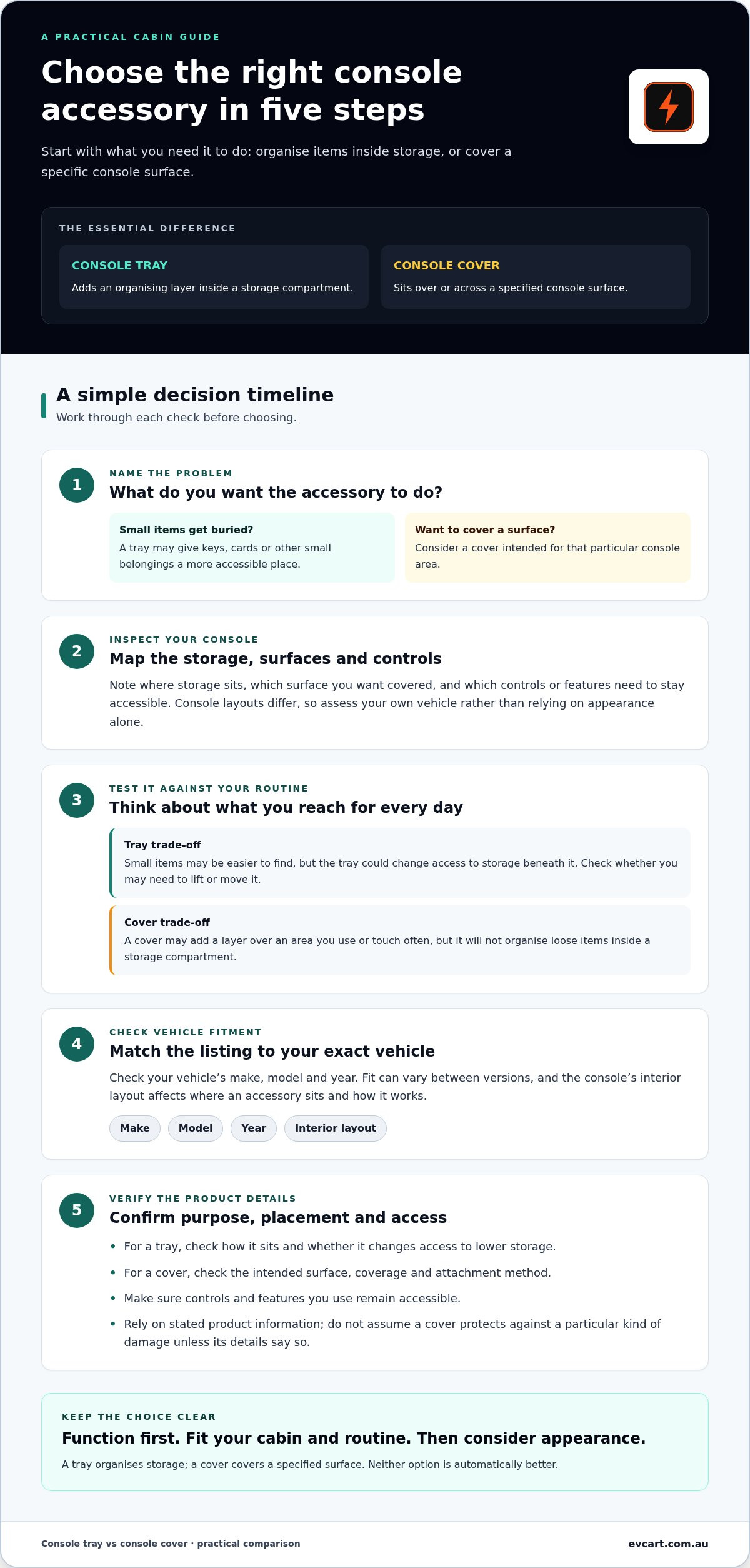
How to choose a console tray or cover for your vehicle
Choose in sequence: identify the problem, inspect the console, then match the product to your vehicle. This keeps the console tray vs console cover choice grounded in how you use the cabin, rather than relying on a product photo or a broad compatibility label.
Start with the problem you want to solve
Notice what causes friction during an ordinary trip. Do small items disappear into a storage space, or is there a console surface you’d prefer to cover? A tray is aimed at organising storage; a cover is intended for a particular surface. Start with the need you want to address most often.
If both matter, compare the actual designs rather than assuming one accessory will do both jobs. Check each product’s stated purpose and where it sits. A tray’s effect on access to storage may depend on its design. A cover’s coverage depends on the surface it’s intended for. Choose only after establishing that the placement suits your routine.
Check the console layout and product fit
Next, inspect your vehicle’s console and compare it with the product information. Match the listed make, model and year to your exact vehicle, including any model-year or cabin-version details specified. A similar-looking console doesn’t establish fit. Use the listing’s compatibility information as your reference, and don’t rely on a generic description alone.
Then consider everyday access. Identify the controls you use, storage areas you open and surfaces you reach for. Check the product’s stated placement and attachment details against those areas. If it could block a control, restrict access to storage or interfere with how you use the console, it may not suit your layout. Use the current product details to resolve those questions before ordering.
A simple check helps keep the decision practical:
- Name the need. Decide whether you’re addressing loose items, a console surface or both.
- Inspect the area. Note where the accessory would sit and what you need to reach around it.
- Match the listing. Compare the stated vehicle fitment with your exact model and year, then review the product’s purpose and placement.
For a console tray, make the fitment check by comparing the product listing with your vehicle’s exact details and the console layout. Keep the listing in view as you assess the specific accessory you’re considering. A careful match matters more than choosing by appearance.
Once you’ve identified the right type and checked the fitment details, browse EV accessories at EV Cart Australia to continue your search.
Next steps: make a confident console accessory choice
Before you order, take a moment to compare the product information with the cabin you use every day. Keep your vehicle’s exact details to hand, review the current listing carefully and make sure you’re comfortable with how the accessory is intended to be used.
A quick decision checklist
Use these final checks to avoid overlooking a detail while comparing options:
- Keep the vehicle details handy. Check the listing against your vehicle’s exact make, model and year.
- Review the full listing. Read the current product information, including any stated use or care guidance.
- Picture everyday use. Consider whether the accessory’s placement will suit the way you use the cabin.
If a detail in the listing doesn’t answer a question that matters to you, pause and compare other options rather than relying on an assumption. A considered choice is easier to make when the vehicle details and product information are clear.
Explore related EV cabin accessories
If your storage needs extend beyond the console, consider how other cabin accessories might suit the way you organise your vehicle. For broader comparisons, focus on the purpose and fitment details of each accessory type.
When you’re ready to compare options, explore EV Cart accessories and use the current product details to guide your selection.
Choose the accessory that fits your next drive
Before deciding, picture the next few trips you’ll take and notice what you want to work better in the cabin. That practical test can help you choose based on your own routine, not on a feature you may rarely use. If a tray is your preferred option, compare the product’s fitment information with your vehicle details and use its placement guidance to assess whether it suits your console.
The right choice should make sense for both your console and the way you use it. Review the product information before ordering, then browse the range at EV Cart when you’re ready to act on your console tray vs console cover decision.
Explore EV Cart accessories and take the next step towards a cabin setup that suits you.
Frequently Asked Questions
What is the difference between a console tray and a console cover?
They’re different accessory categories, not alternate names for the same item. Listings can use similar wording, so look beyond the title: check the images and description to see where the accessory sits and what use is specified. Confirm whether it refers to the storage compartment, a lid or another surface. That extra check helps you avoid ordering based on a broad product label alone.
Is a console tray better than a console cover?
No single type is better for every EV. Compare how each option fits your daily pattern and console arrangement. If what you carry changes from trip to trip, think about how you’ll keep track of those belongings. If a particular console area gets frequent contact, consider what the listing says about its coverage. Judge the options against your own priorities, not a general ranking.
Can you use a console tray and a console cover together?
Sometimes, but only if the products are designed for separate areas and their placement doesn’t conflict. Before buying both, compare their diagrams or photos with the written placement instructions. Check whether fitting one could change how the other sits, attaches or opens. If the descriptions don’t show a clear combined arrangement, treat them as separate options rather than assuming they can be layered.
Will a console tray fit every EV model?
No. A product label that names a make alone may not establish whether it suits every model year or interior version. Read the full compatibility line and any exclusions, not just the headline or product photo. If your vehicle has a changed cabin or refresh, use those identifying details when matching it to the listing. Don’t rely on another owner’s fit report as confirmation.
Does a console cover protect against scratches or spills?
Not automatically. Look for a specific statement about the type of contact or damage the product is intended to address, along with any stated care limits. The word “cover” doesn’t establish spill or scratch resistance. Follow the product’s cleaning guidance as well, since unsuitable methods may affect its material. Treat claims narrowly and don’t infer performance beyond what the listing states.
How do I choose between a console tray and a cover?
Try a quick routine audit: note what you reach for during a typical week, which console areas you touch most and what feels awkward to access. Shortlist accessories whose stated use addresses that issue. Then read the listing alongside your vehicle details and inspect the images for placement clues. If your priorities compete, rank the annoyance you encounter most often first.
Can a console tray block access to the centre console storage?
Possibly, depending on the tray’s position and whether its design moves or lifts. Look for product notes about opening the compartment or retrieving items underneath. Consider anything stored there that you need during a trip, such as documents or a cable. If the access method isn’t described, don’t assume it remains unobstructed; use the available product details to judge whether it suits your routine.