
Electric Car Storage Organiser: Practical Ideas for a Tidy Cabin
2026-10-11

What if the quickest way to tidy your EV cabin is to give every small item a set place? An electric car storage organiser can help keep sunglasses, charging cards and other everyday essentials from spreading across seats and console spaces. When loose items are hard to find, even a short trip can feel less orderly than it needs to.
That frustration is familiar: you want useful items within reach, but you don’t want clutter getting in the way. Start with the storage your car already has, then add an organiser only if it solves a specific problem. Keep items secure and make sure they don’t obstruct your view or access to the controls.
This guide covers what to organise, where small essentials can go and how to choose an approach that fits your vehicle and routine. You’ll find practical ways to compare organiser styles by what they hold, where they sit and how often you use those items. The aim is a cabin that’s easier to use, not just neater to look at.
Key Takeaways
- Use an electric car storage organiser to group small essentials by task, so each item has a predictable place.
- Match your storage approach to what you’re organising, how often you need it and how easily you need to reach it.
- Start with the pockets and compartments already in your car before adding another organiser.
- Sort and prioritise cabin items before assigning them a place to keep the setup simple and uncluttered.
- Build a quick reset into your routine so your storage stays practical from one trip to the next.
Table of Contents
- What an electric car storage organiser does for your cabin
- Electric car storage organiser examples for everyday cabin items
- Compare electric car storage organiser approaches by use
- Set up an electric car storage organiser without adding cabin clutter
- Make your electric car storage organiser routine easy to maintain
What an electric car storage organiser does for your cabin
An electric car storage organiser groups small cabin essentials and gives each item a predictable place. It can make everyday belongings easier to find without adding storage everywhere or changing how you use the car.
The goal is order and access, not filling every available space. Notice which items tend to shift between seats, pockets and compartments. If something already has a practical home, keep it there. An organiser is useful when it gives a frequently used item a more consistent place or keeps related belongings together.
This section focuses on small items carried inside the cabin. Boot storage is better suited to larger loads, while charging cable storage is a separate task. Keeping those needs distinct helps you choose a cabin setup that stays simple and doesn’t take up space without a clear purpose.
Which small items benefit from having a set place?
Choose items based on what you actually carry. A parking card used regularly may deserve a reliable, easy-to-reach spot. Tissues could sit together in a pocket or compartment, while sunglasses are easier to locate when they always go back to the same place after a drive. Keep a reusable shopping bag within reach if you often stop for groceries, or store it elsewhere if you only use it occasionally.
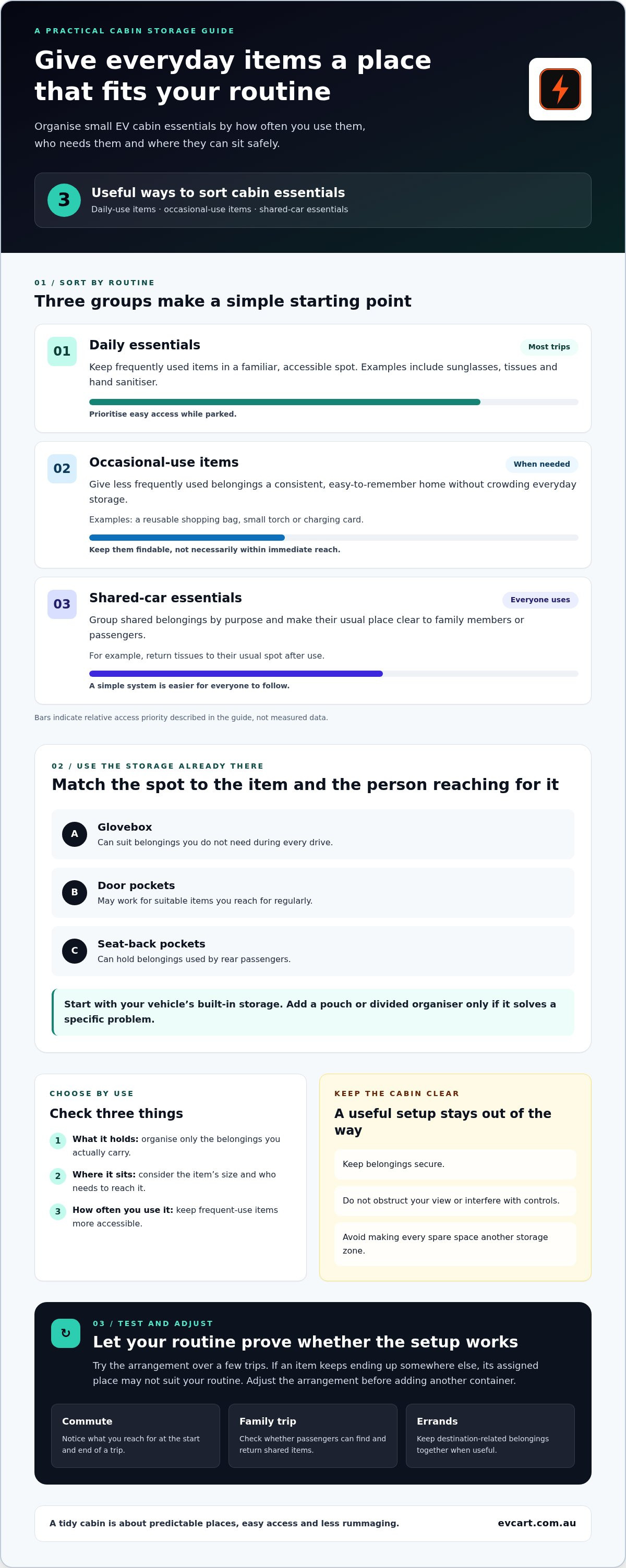
Separate belongings by how often you need them. Items used on most trips should be straightforward to access while the car is parked. Occasional-use belongings can go in a less prominent pocket, provided they’re still easy to find when needed. There’s no standard cabin checklist. Your commute, school run, errands or weekend routine will shape what belongs in the car.
Grouping by task can also help. Keep items used for parking together, for example, rather than spreading them across different spaces. That small decision reduces rummaging and makes it easier to return each item to its place.
Where can small essentials sit within an EV cabin?
Look at the storage built into your vehicle first. The glovebox may suit belongings you don’t need during every drive. Door pockets can work for suitable items you reach regularly, while seat-back pockets can hold belongings used by rear passengers. The best location depends on both the item and who needs to reach it.
Before assigning a spot, consider the item’s size, how often you use it and whether the location makes retrieval straightforward when parked. Avoid placing items where they could obstruct your view, interfere with controls or inconvenience passengers. Keep frequently used belongings accessible without creating a crowded cabin.
Try the arrangement over a few trips. If an item repeatedly ends up somewhere else, its assigned place may not suit your routine. Adjust the setup rather than adding another container by default. A well-chosen electric car storage organiser supports a clear system; it shouldn’t turn every unused space into another storage zone.
Electric car storage organiser examples for everyday cabin items
Organise small belongings around the moments you need them, not simply by where they happen to fit. A commuter may want a clear routine for items used at the start and end of each trip. On a family outing, passengers may need to know where shared essentials go. For errands, it helps to keep the things you’ll use at your destination together.
A clear storage place makes an item easier to retrieve and return. Grouping belongings by purpose also gives everyone a simple cue: parking items stay together, for example, rather than being scattered across the cabin. The aim is to use existing spaces well, not to fill every pocket.
A simple place for daily essentials
Sunglasses, tissues and hand sanitiser are examples of items some drivers reach for regularly. Keep the ones you use most often in a familiar, accessible spot, and group them if they serve the same part of your routine. A commuter might keep sunglasses and tissues together for the daily drive, while another driver may only carry tissues. Build the arrangement around your habits, not a standard list.
A separate home for occasional-use items
Reusable shopping bags, a small torch or a charging card may be useful without needing to sit within easy reach all the time. Give occasional-use belongings a consistent place that’s easy to remember but doesn’t crowd the area you rely on during everyday trips. For errands, a reusable bag can stay with other shopping-related items; a torch can sit elsewhere until it’s needed.
Keep shared-car essentials easy to find
If family members or other passengers use the car, make the arrangement easy for them to follow. Group shared belongings by purpose and agree on where they go after use. For example, passengers can return tissues to their usual spot instead of leaving them on a seat. Keep the system simple and use the spaces already available rather than creating extra places to manage.
Test the setup during a commute, family trip or run to the shops. If an item is regularly left elsewhere, its assigned spot may be inconvenient or hard to remember. Adjust the arrangement to suit the people who use the car. For broader industry context, Knowledge Sourcing Intelligence’s report on automotive interior storage systems covers market trends and forecasts. The same practical thinking applies to choosing an electric car storage organiser: focus on the belongings you carry and the routine you need it to support. To explore other EV accessories for everyday ownership, browse EV Cart Australia’s accessories.
Compare electric car storage organiser approaches by use
The right setup depends on what you carry, how often you reach for it and the storage built into your EV. A pouch, a divided organiser and an existing cabin pocket each solve a different problem. Compare them by purpose before adding anything. Extra compartments help only when they make items easier to manage.
| Approach | Best suited to | Main trade-off |
|---|---|---|
| Loose-item pouch | A few related belongings used together | Simple to use, but items share one space |
| Compartmented organiser | Small items with different purposes | Clear separation, but sections need a practical use |
| Existing vehicle pockets | A small number of essentials with established places | No extra storage item, but space depends on the vehicle layout |
When a simple pouch is enough
A pouch can group a few related items and reduce visual clutter. Its single open compartment suits belongings you use together and can retrieve without sorting through several sections. It’s a straightforward option if separation isn’t important. Consider whether the pouch has a sensible place in your cabin rather than assuming it will suit every vehicle.
When divided storage can be more practical
Separate sections can distinguish items with different purposes, making it easier to return each one to the right place. That can help if you carry several small belongings and want to avoid them mixing together. Divisions are useful only if they match what you actually store. Too many unused sections add complexity without improving access.
When existing cabin pockets may do the job
If you carry only a few essentials, the vehicle’s current pockets may be enough. Keeping items in the glovebox or another suitable built-in space avoids adding a separate storage item. The drawback is that a shared or crowded pocket can make small belongings harder to locate. Consider how your car is laid out and which spaces suit your routine.
Before choosing, consider the size of the items, how regularly you need them and whether you can reach them easily while the vehicle is parked. A pouch groups; divided storage separates; built-in pockets make use of what’s already there. An electric car storage organiser should reduce effort, not create another system to maintain.
Choose the simplest approach that keeps your items accessible. If existing pockets work, keep using them. Add an organiser only when it solves a clear problem for your cabin and everyday routine.
Set up an electric car storage organiser without adding cabin clutter
A tidy setup starts with fewer, better-placed belongings, not another container by default. Focus on small cabin items only. Keep boot contents and charging cables out of this reset so the task stays manageable and your cabin storage plan remains clear.
Work through these steps in order:
- Empty: Take small items out of the cabin pockets and spaces you plan to organise. This gives you a clear view of what’s there.
- Sort: Separate daily essentials, occasional-use belongings and items you no longer need to carry.
- Prioritise: Start with the belongings that regularly go missing or take too long to find.
- Assign places: Give each useful item a practical home, grouping related belongings where it makes sense.
- Review: Check the arrangement after using it and adjust anything that’s awkward to reach or remember.
Sort items before choosing a storage approach
Resist organising everything at once. First remove duplicates and anything that no longer supports your routine. Then focus on the small belongings you repeatedly search for. That gives you a useful starting point and helps show whether your existing cabin spaces are enough or a different organising approach could make retrieval simpler.
Assign each item a practical place
Match frequently used essentials to suitable, reachable cabin storage, and keep related items together so the arrangement is easy to recall. Before making it part of your routine, park the car and check that each item is straightforward to retrieve and return. Keep belongings clear of driving controls and avoid placing them where they could obstruct your view or access to controls.
Review the setup as routines change
Driving needs shift. A regular commute may call for a different selection of cabin essentials than a period of more local errands. Give the setup a brief reset after trips or when your routine changes. Remove items you no longer use, then return the remaining belongings to their assigned places. Clearing out unused items helps preserve usable space without adding more storage.
Keep the test simple: can you find each item, reach it easily while parked and put it back without disrupting the arrangement? If not, change the location or remove what isn’t earning its place. This small-cabin reset can also inform broader EV accessory planning, including the choices covered in an Australian EV accessories buyer’s guide.
Once you know what your cabin routine needs, explore EV accessories for everyday ownership and consider how each choice fits your vehicle and habits.
Make your electric car storage organiser routine easy to maintain
A storage setup only helps if it stays straightforward to use. Keep the routine short: return shared essentials to their usual places, remove rubbish and take out anything that no longer belongs in the cabin. You don’t need a full clean after every trip. A quick reset is enough to stop small items gradually spreading across different spaces.
Whether you use an organiser or rely on the vehicle’s existing storage, aim for a layout that’s easy to maintain. An added organiser can make belongings easier to sort, but it also introduces another item and system to manage. Existing pockets keep things simple when they already suit what you carry. Choose based on the problem you’re trying to solve, not on the idea that every cabin needs more storage.
Build a small reset into your driving routine
After a trip, return shared belongings to their usual places and remove rubbish. If you’ve carried something for a one-off errand, take it out rather than letting it settle into the cabin indefinitely. This brief habit makes the next trip easier to start and helps keep the layout familiar for other people using the car.
Keep it realistic. The aim isn’t to inspect every pocket or reorganise your belongings each time. Focus on what’s visibly out of place and what you’ll want to find on your next drive. A consistent, small reset is easier to repeat than an elaborate routine that takes too much effort.
Choose the next step based on what still feels untidy
Notice which belongings remain difficult to locate. Is the assigned spot awkward, or are unrelated items mixed together? Adjust the layout first. Moving an item to a more suitable existing space or simplifying what you carry may solve the issue without adding anything.
If a clear need remains, consider whether an accessory could address it. Browse with a specific purpose in mind, such as keeping a particular group of small belongings together. The right electric car storage organiser should make the routine easier, not add sections you don’t use or another place to tidy.
A storage system works when items return to their assigned places. Keep that principle in view as your driving needs change. If your current setup is easy to reset and lets you find what you need, it’s doing its job. If it isn’t, make one practical adjustment at a time and see whether it improves the routine.
For a low-pressure next step, explore EV accessories for everyday ownership and consider whether an accessory fits a genuine need in your cabin.
Make your next cabin adjustment count
Your storage needs may change as your driving routine does. Treat untidiness as a useful signal: notice what still gets misplaced, then make one considered adjustment rather than adding storage without a clear purpose. That keeps an electric car storage organiser practical over time and helps your cabin work for the way you use your EV now.
If an accessory could address a specific need, consider how it would fit into your everyday routine and whether it suits your vehicle, rather than choosing on appearance alone. A useful addition should make ownership simpler, not create another system to manage.
Browse EV accessories at EV Cart and explore options for your next practical improvement. Start with what would make a real difference to your drive, then choose with confidence.
Frequently Asked Questions
What should I keep in an electric car cabin organiser?
Keep compact items that support your regular trips, such as a microfibre cloth, a small notepad or reading glasses. Choose contents that fit the way you use the car, rather than treating the organiser as a place for every loose belonging. An electric car storage organiser works best as a limited-use space. Leave out bulky items and anything you rarely need in the cabin.
Can I use a regular car organiser in an electric car?
Yes, if its shape and attachment method suit your vehicle’s layout. EVs differ in cabin design, just as other cars do, so don’t assume an organiser will work equally well across models. Check the vehicle handbook for guidance on accessories near seats or other cabin areas, and consider whether the organiser can be secured without affecting normal use of the car.
How do I stop small items getting lost in my car?
Make frequently misplaced items easier to spot. A pouch in a contrasting colour or a simple tactile marker can help distinguish it from the cabin upholstery and other belongings. If something goes missing, retrace where you last used it before adding another storage item. The cause may be that the item is regularly carried out of the car in a bag or jacket.
Are car organisers easy to move between vehicles?
It depends on how the organiser attaches and how much its use relies on a particular cabin layout. Before transferring it, remove the contents and check the new vehicle’s available space and attachment points. An organiser that sits neatly in one car may be awkward in another. If you regularly switch cars, a simple, portable format may be easier to manage than one with a fixed position.
Where should I store items I need during a drive?
Place trip-specific items in a suitable cabin pocket before setting off. For example, if you’ll need a parking ticket at a boom gate, decide where it belongs before the trip rather than searching for it as you approach. Retrieve items only when the car is safely stopped. Anything needed at your destination can stay packed away until you park.
How often should I reorganise my car interior?
There’s no set timetable. Review the contents when seasonal needs shift, such as swapping a sunshade for wet-weather gear, or after a thorough interior clean. Remove anything that no longer suits the conditions or trips ahead. A targeted check is usually more useful than repeatedly moving items that are already working well for your everyday driving.