
EV accessories: A practical Australian buyer’s guide
2026-10-05

The most useful EV accessories solve a real problem, rather than simply looking like a sensible upgrade. With so many options to compare, it’s easy to buy something that doesn’t suit your vehicle or ends up taking up space.
Start with your driving routine and the issue you want to solve. An accessory that fits one EV may not suit another, and product descriptions can make it difficult to spot the details that matter. Identify your vehicle and check the relevant product information before you buy.
This guide helps you prioritise EV accessories for everyday needs, compare fit and compatibility, and avoid impulse purchases. Use it to decide whether an item will genuinely help with protection, storage or convenience, and whether it fits your vehicle and routine.
Key Takeaways
- Prioritise EV accessories by the recurring issue they address, not by how popular they seem.
- Match your vehicle’s model, year and variant to the accessory’s fit requirements before buying.
- Compare floor protection, cabin storage, screen protection and key protection by purpose, fit and upkeep.
- Factor in passengers, pets, work gear and available cabin space when planning useful additions.
- Use current product information to assess fit and specifications before exploring EV Cart’s accessories.
Table of Contents
EV accessories: start with the ownership problem you want to solve
EV accessories are optional items that support vehicle protection, organisation, comfort or practical everyday use. Their value depends on your vehicle, routine and journeys, not on how popular an item appears.
Some needs are practical and recurring. You might want to keep loose belongings organised, protect a surface from regular dirt or wear, or make a familiar task more convenient. Other purchases are personal preferences, such as changing the cabin’s appearance. Either can be worthwhile, but identify your reason before comparing products.
Accessories also vary in how they relate to the vehicle. Some are used inside the cabin, while others connect with vehicle systems. A general overview of electric vehicle components can help explain how an EV’s systems work together. For any accessory, follow the product information and vehicle guidance that apply to it.
Which everyday ownership needs can accessories address?
Start with the job to be done. Cabin organisation can help keep everyday belongings in order; surface protection can help limit exposure to routine dirt or wear; and convenience items can make repeated tasks easier. These are broad categories, so check whether a particular product suits your vehicle and intended use.
Your routine helps set the priority. Regular passengers may make tidy storage more useful. Pets or work equipment can increase the need to protect or organise the cabin. Longer trips may make it more important to keep essentials accessible. Think about what actually happens in your vehicle, then consider which type of accessory could help.
How do you separate useful upgrades from impulse buys?
Name the recurring inconvenience first. Is something often loose, difficult to keep clean or awkward to reach? If you can describe the issue clearly, you can judge whether an accessory addresses it. If the need is mainly appearance, consider whether that preference is worth the space, upkeep and purchase cost.
Think about how often you’ll use the item, where it will be stored and what care it needs. An occasional-use accessory may take up space between uses, while a frequently handled item may need regular cleaning. Check the product’s fit and intended use before deciding it is a must-have.
An accessory earns its place when it solves a clear ownership problem often enough to justify its space and upkeep.
How to check EV accessory compatibility before you buy
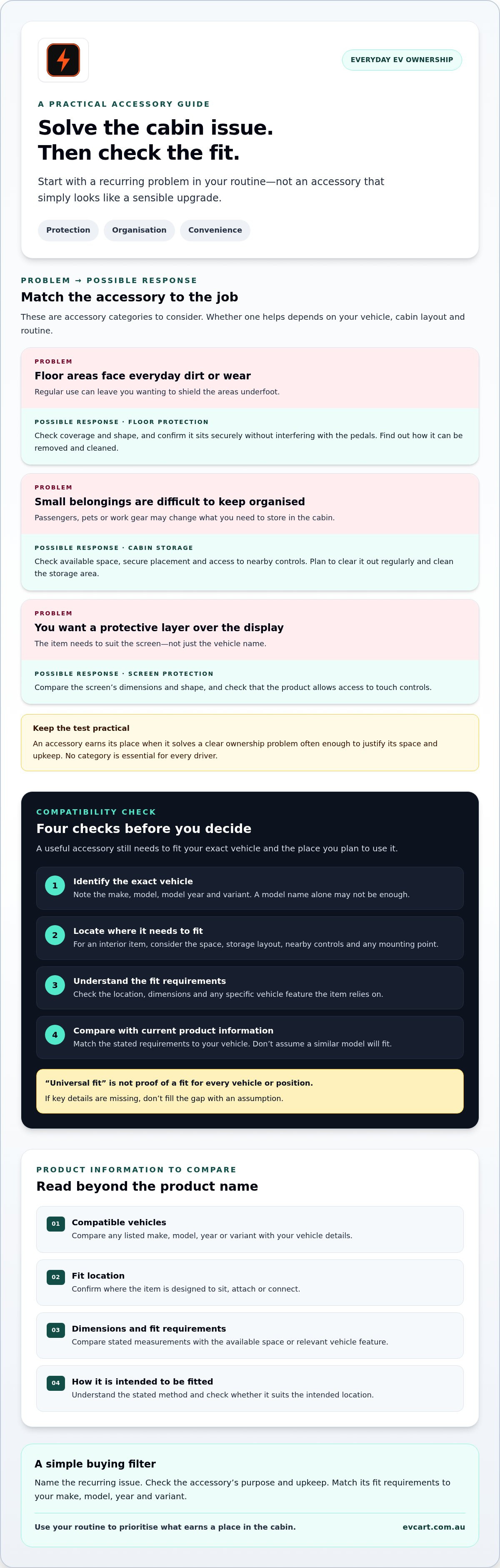
A useful accessory still needs to fit your vehicle and the place you plan to use it. Work through four checks: identify the exact vehicle, note where the accessory will sit or connect, understand the fit requirements, then compare them with the product information.
Check vehicle-specific fit against the exact product information, rather than assuming an accessory suits your car because it fits a similar model. Vehicles with similar names or body shapes can have different cabin layouts, dimensions, controls or attachment points. Those differences can affect whether an item sits correctly or leaves controls accessible.
Which vehicle details matter when checking fit?
Record the vehicle’s make, model, model year and variant. A model name alone may not be enough if the vehicle changed between years or has different trim configurations. Use the details in your vehicle documents or owner information when comparing fit.
Next, identify where the accessory needs to fit. For an interior item, compare the relevant space, nearby controls, storage layout and any mounting point. For a charging-related accessory, check the connection type and the specific requirements stated for the product. Transport for NSW explains Australian EV plug types, including Type 2 and CCS2 connectors.
What product information should buyers compare?
Read the complete product details and look for four things:
- Compatible vehicles: Check whether the description identifies a make, model, year or variant, then compare each detail with your vehicle.
- Fit location: Confirm where the item is designed to sit, attach or connect.
- Dimensions and fit requirements: Compare stated measurements with the available space or relevant vehicle feature.
- Installation method: Understand how the item is intended to be fitted and whether that method suits the location.
Read “universal fit” as a broad description, not proof that an item suits every vehicle or position. A vehicle-specific claim should clearly identify the applicable fit. If key details are missing, don’t fill the gap with an assumption. Compare the current product information before deciding.
Once you’ve noted your vehicle and fit requirements, browse EV accessories at EV Cart with those details in mind. Use them to compare relevant product information instead of relying on appearance or a broad model match alone.
Compare EV accessory types by fit, function and upkeep
Compare EV accessories using the same practical questions: what do they do, where must they fit, and what care will they need? The right choice depends on your cabin layout and routine. No category is essential for every driver.
Use the table as a starting point. Each example is a category, so check the requirements for the specific item you’re considering.
| Category | Main purpose | Fit checks | Routine care |
|---|---|---|---|
| Floor protection | Help shield floor areas from everyday dirt and wear | Coverage, shape and whether it sits securely without interfering with pedals | Check how it can be removed and cleaned |
| Cabin storage | Keep small belongings or essentials organised | Available space, secure placement and access to nearby controls | Clear out regularly and clean the storage area |
| Screen protection | Provide a protective layer over a display | Screen dimensions, shape and access to touch controls | Clean the surface without compromising visibility or usability |
| Key protection | Cover or organise a vehicle key | Key shape, button access and the fit of the cover | Keep it clean and check that buttons remain easy to use |
How should you compare protection and organisation accessories?
Start with coverage and placement. A floor-protection option needs to suit the relevant footwell and stay clear of the pedals. A storage accessory should hold items securely without blocking controls or making essentials harder to reach. Your cabin layout and intended use affect the right shape and position.
Then consider cleaning and upkeep. More coverage or storage can be useful, but may add surfaces and corners to maintain. Read the care guidance for the item and decide whether that routine works for you.
When are display and key accessories worth considering?
Screen and key protection are personal choices shaped by how often and how carefully you handle them. Compare fit, ease of cleaning and everyday usability. A screen cover should not obstruct your view or make controls awkward to use; a key cover should allow straightforward access to the buttons.
Consider how much handling the item will get and whether its care needs suit your routine. Choose a category because it addresses a concern or preference, not because it seems like a standard addition.
Build a practical EV accessories plan for everyday driving
A useful setup follows a clear order: identify a recurring problem, find a compatible solution, decide where it will live, then consider the care it needs. This keeps your choices focused and helps prevent the cabin filling with items that rarely get used.
Make space part of the decision. Passengers, pets and work equipment all compete for room, so assess what you usually carry before adding storage or protection. An accessory that suits a regularly occupied family car may be unnecessary in a vehicle used mainly for solo commuting.
What should you prioritise for commuting, family trips or work use?
Let your routine set the priority. A commuter who carries a few essentials may value easy-to-reach storage. Family trips can make cabin organisation and surface protection more relevant, while someone transporting work gear may need to keep equipment contained without taking up space needed by passengers.
These are starting points, not fixed setups. Think about what goes in the vehicle, how often it travels with you and where it can be stored without blocking access or reducing usable room. Add an item only if it fits the vehicle and solves a real part of your routine.
How can you care for accessories and keep the cabin organised?
Follow the care instructions supplied for each item. Materials and finishes may need different treatment, so don’t assume one cleaning method suits everything. Use the product guidance as your reference.
Review your setup periodically. Check that items remain clean, securely placed and easy to use. Ask whether each one still earns its space. If an accessory is awkward to store, rarely used or no longer solves a problem, remove it and reassess what your everyday driving requires.
A short review helps keep the cabin practical as routines change. Passengers, pets or work needs may shift, so adjust the setup rather than holding on to accessories out of habit. Explore EV accessories at EV Cart once you’ve identified what would make a useful addition to your vehicle.
Choose EV accessories with a clear plan, then explore EV Cart
A considered choice follows a simple sequence: define the need, identify the exact vehicle, compare the accessory's fit and think through its care. This keeps your decision grounded in how you use your EV, rather than trends or broad claims.
Before placing an order, use this checklist:
- Define the need: Name the recurring problem or preference the accessory should address.
- Identify your vehicle: Record its make, model, model year and variant where relevant.
- Compare fit: Match the product's stated fit and location requirements to your vehicle.
- Consider everyday use: Check whether the accessory suits your routine, available space and the people or items you carry.
- Review care: Read the product's care instructions and decide whether they're practical for you.
Use the current product information to assess specifications and fitment. Don't assume an item suits your vehicle based on a similar model name or appearance. A careful comparison helps you choose an accessory that fits your needs.
How can readers continue researching EV accessories?
Keep the same needs-first approach as you explore. Use your vehicle details and intended use to guide comparisons, and read each item's information rather than relying on general category labels. Product details can change, so refer to the current information when making your selection.
EV Cart Australia is an online destination for EV accessories. Browse with a clear purpose, compare the relevant product details and choose for fit and practical usefulness, not simply because an item is popular.
Explore EV accessories at EV Cart Australia and make your next choice based on what works for your vehicle and everyday driving.
Choose accessories that earn their place
A practical approach to EV accessories starts with a clear ownership need. Identify your exact vehicle, compare the accessory’s fit requirements and consider the care it will need. These steps help you focus on useful additions rather than buying on appearance or popularity alone.
Fit and function should guide the decision. Check current product information for specifications and vehicle compatibility, then consider whether the item suits your routine, cabin space and intended use. A little preparation can help prevent an accessory from becoming unused clutter.
EV Cart is an Australian online destination for exploring EV accessories. Explore EV accessories at EV Cart and compare current product details with your needs and vehicle. Choose carefully to build a setup that works for the way you drive.
Frequently Asked Questions
What are EV accessories?
EV accessories are optional items that support an electric vehicle’s protection, organisation, comfort or practical use. Examples include cabin storage, floor protection, screen protection and key covers. They aren’t automatically necessary for every owner. Their usefulness depends on your vehicle, regular journeys and the problem you want to solve. Start with your routine, then consider whether an accessory’s fit, function and care requirements make sense for you.
Which EV accessories are useful for everyday driving?
The most useful options depend on how you use your vehicle. Cabin storage may help keep daily essentials organised, while floor protection may suit a cabin exposed to regular dirt or wear. Screen or key protection may appeal if those items are handled often. Passengers, pets, work equipment and trip length can all affect what earns space in your car. Choose for a recurring need, not simply because an item is popular.
How do I check whether an accessory fits my electric car?
Record your vehicle’s make, model, model year and variant, then compare those details with the product’s fit information. Check where the accessory goes, its dimensions or attachment requirements, and whether it could block controls or interfere with normal use. Similar-looking vehicles can have different cabin layouts or mounting points. Use current product details for the specific item, rather than assuming it fits because it suits a related model.
Are EV accessories universal across different car models?
No. Some accessories are described as universal fit, while others are designed for particular vehicles or locations. A universal-fit description doesn’t prove that an item will suit every cabin shape, control layout or attachment point. Check the stated dimensions, intended position and fit requirements against your vehicle. For vehicle-specific accessories, compare the exact model year and variant as well as the model name before choosing.
What should I consider before buying EV accessories online in Australia?
Before buying EV accessories online, define the need and identify your exact vehicle. Read the current product information for fitment, dimensions, intended use and care instructions. Also review the displayed price, delivery information and applicable purchase terms before placing an order. Don’t rely on a product image or a broad model description alone. A clear comparison helps you select an item that suits your vehicle and everyday routine.
How do I choose between EV accessories that serve a similar purpose?
Compare options against the same practical criteria: fit, coverage or capacity, access to controls, ease of cleaning and storage when not in use. Then weigh those details against how often you’ll use the item and who or what travels in your vehicle. One option may offer more coverage but need more upkeep; another may take less space. Choose the trade-off that best suits your routine.
How should I care for electric car accessories?
Follow the care instructions provided for each accessory. Materials and finishes can differ, so don’t assume the same cleaning method is suitable for every item. Check accessories periodically for cleanliness, secure placement and continued usefulness. Make sure anything in the cabin stays out of the way of controls and normal vehicle use. If an item no longer solves a problem or adds clutter, remove it and reassess your setup.