
EV Organisers: A Practical Guide to Smarter Car Storage
2026-10-10

The neatest-looking EV organiser may still be the wrong choice for your car. Loose charging cables, shopping bags and everyday essentials can clutter the cabin or boot, but storage layouts differ between vehicles. The right option depends on what you carry, where you need it and how you use your car.
A practical organiser makes belongings easier to find without getting in the way. It should suit your routine, fit the space you plan to use and stay clear of controls and safety equipment. That applies whether you’re organising a centre console, cabin storage area, boot or under-boot compartment.
To choose well, start by identifying which items need a dedicated place. Then compare organiser styles and locations, check the stated fitment and think through how you’ll use the space. The goal is storage that works for your car, not just an accessory that looks useful.
Key Takeaways
- List the items you want to store before choosing an organiser or location.
- Compare universal and vehicle-specific EV organisers by fit, stability and access.
- Give cabin and boot storage separate jobs instead of moving all loose items into one container.
- Check stated fitment and try the organiser in its intended position before making it part of your routine.
- Prioritise a secure, practical fit over extra capacity or decorative features.
Table of Contents
What Are EV Organisers, and What Storage Problems Can They Solve?
An EV organiser is an accessory that gives selected belongings a defined place in the cabin or boot. An organiser groups and stores items; a protective accessory is designed to shield a surface or component from wear, dirt or damage. Some accessories may do both, but their main purpose differs. An organiser helps keep belongings together and easier to locate, while a protective accessory focuses on the vehicle or its contents.
Choose based on what you regularly carry and where you use it. A place for small personal items in the cabin solves a different problem from a dedicated spot for trip gear in the boot. One large container can simply shift clutter from one area to another, so match the storage to the task.
An electric car uses electric propulsion, but that doesn’t define its storage layout. Console shapes, door pockets, boot dimensions and additional compartments vary between vehicles. Look at the actual spaces in your car instead of assuming an accessory will fit because it’s described for EV use.
Which everyday clutter can an organiser help manage?
Start with repeat offenders: reusable shopping bags, sunglasses, tissues, charging cables or other trip essentials. Loose items can slide under seats, disappear beneath bags or take up space needed for something else. Before shopping, note what tends to accumulate, where it ends up and how often you need to reach it. This quick inventory helps you choose storage you’ll use rather than paying attention only to capacity.
- Cabin items: small personal belongings or essentials you may need during a trip.
- Boot items: reusable bags or other gear that can stay out of the passenger area.
Keep those categories separate where practical. A cabin organiser should make suitable items easier to access without distracting the driver or interfering with controls. Boot storage can keep belongings grouped while leaving room for the loads you carry. Neither location needs to hold everything.
Do electric cars need a different organiser from other cars?
Not necessarily. Your vehicle’s layout and your routine matter more than its powertrain. A console organiser that suits one car may not sit properly in another, while a boot organiser needs to suit both the available space and the items stored there. Think about how you use each area, then assess an accessory against that specific space. Choose for fit and function, not the fact that the car is electric.
Make the decision in order: list recurring clutter, assign each item to the cabin or boot, then consider what kind of storage would keep it together without making access awkward. Check the accessory’s purpose and intended location. A well-chosen organiser gives useful items a place, while a protective accessory addresses a separate need. Keeping those jobs distinct makes the choice more practical.
Where Do EV Organisers Fit: Cabin, Console or Boot?
Think of the car as a set of storage zones, each with a different purpose. The passenger cabin suits items you may need during a drive, the centre console can keep smaller essentials together, and the boot is better for belongings carried between trips. The exact spaces and dimensions depend on your vehicle, so use its layout as your starting point.
Good placement keeps an item close to where you use it. It also avoids shifting every loose belonging into one container, where it can be harder to find. EV organisers work best when each has a clear job and doesn’t take space needed for passengers or luggage.
Cabin and console storage for items used on the drive
Keep frequently used small items in a place that’s easy to reach without searching. The centre console may suit personal essentials, while other cabin storage areas can hold belongings you want nearby but don’t need constantly. Check how the space opens and what sits around it. Console shapes and available storage differ between models, so an accessory that suits one cabin may not suit another.
Consider the driver and passengers before choosing a location. Storage mustn’t obstruct visibility, block access to controls or make it awkward for someone to enter, sit or move inside the car. Avoid placing items where they could shift into the driver’s space. If an organiser makes an essential control harder to reach, choose another position.
Boot storage for items carried between trips
A boot organiser can keep reusable bags, sports gear or other regular trip items together. It’s most useful when belongings tend to spread across the load area or get buried beneath other items. Think about what you carry in an ordinary week, not only on an occasional large outing. Leave enough room for groceries, luggage and other loads you need to transport.
Consider how you use the boot before settling on a spot. An organiser shouldn’t make everyday loading and unloading awkward or prevent you from using the available space. Keep frequently used items accessible, and avoid filling the load area with storage that doesn’t solve a regular problem.
Storage and surface protection have different jobs. An organiser groups belongings; a floor mat helps protect a vehicle surface. For guidance on choosing protection, the EV floor mat fit and material guide covers a separate accessory decision.
Use your vehicle’s layout and routine to guide placement, then explore the Australian EV accessories buyer’s guide for broader selection considerations. Browse EV accessories to compare practical options for your car.
Model-Specific EV Organisers: Fit and Practicality
An organiser’s label is only a starting point. The useful questions are whether it fits the space, stays suitably positioned and lets you reach what’s inside. Universal designs aim to work across different vehicles, while vehicle-specific designs are intended for a stated model or layout. Neither type is automatically the right choice. Compare the organiser’s purpose with your car’s actual storage area.
Fit and placement matter more than storage capacity alone. A larger organiser may hold more, but it can also occupy useful boot space, interfere with a lid or make contents harder to reach. Choose for the items and location you have in mind, not simply the largest capacity.
Universal or vehicle-specific: what changes?
A universal design is made for flexible use, so its fit can vary between cars and storage zones. A vehicle-specific design is intended around a named vehicle layout, but the label alone doesn’t establish that it suits every model year or version. Match the product information to your exact vehicle details. Either approach can be practical if the organiser fits securely, suits its location and leaves everyday access clear.
Fit consideration
Universal design
Vehicle-specific design
Fit
Flexible use; actual fit depends on the space.
Intended for the stated vehicle or layout; verify exact fitment.
Practical check
Compare its dimensions with the intended area.
Match the listing to your vehicle details.
Best test
Check stability and access in the chosen location.
Check fit, stability and access in that specific location.
Which fit checks matter before choosing?
Start with the intended space. Use your vehicle manual for relevant layout information, then compare it with the dimensions and fitment details in the product information. Check the space where the organiser will sit, not just the widest part of the compartment. A close match on one measurement doesn’t guarantee the overall shape will work.
- Confirm the location. Identify whether the organiser is for a console, another cabin space or the boot.
- Compare fit details. Check the stated dimensions and exact vehicle fitment against your car’s model and version.
- Test everyday access. Make sure seats can move, storage lids can open, controls remain clear and boot loading still works as needed.
Consider how the organiser behaves when you use the space, not just how it looks when empty. A console option should leave its lid and nearby controls usable. A boot design shouldn’t block routine loading or take up room needed for luggage. Use the product information to confirm the stated fitment and intended placement before choosing.
These checks help narrow your choice to an organiser that suits both the vehicle and the way you use it. Avoid paying for capacity you won’t use or relying on a broad compatibility label when the fit details determine whether the accessory works in your intended space.
How to Choose and Set Up an EV Organiser for Everyday Use
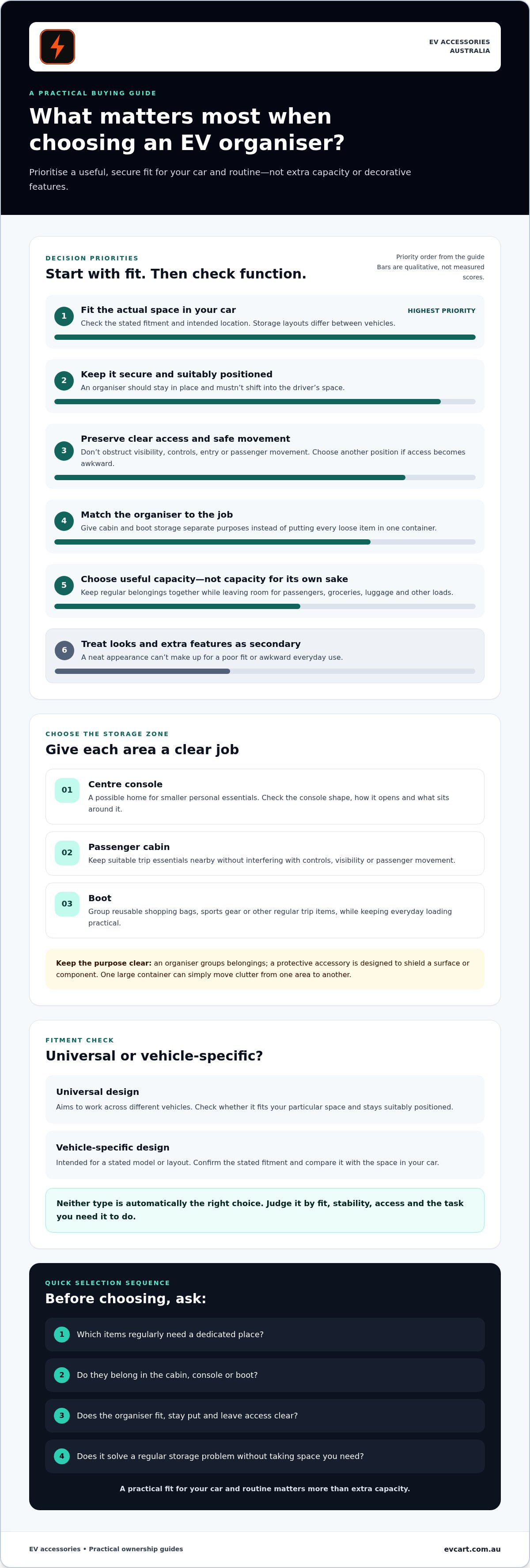
A good setup starts with a real storage problem, not a product feature. Work through the items you carry, where you use them and how your vehicle’s spaces function. Then consider fit and access before deciding whether an organiser earns a place in the car. This helps avoid adding an accessory that creates another obstacle.
Use this sequence to assess an option before you buy:
A four-step organiser selection check
Take a quick inventory of the items that repeatedly create clutter. Note how often you use each one and whether you need it during a drive or only when loading and unloading. This separates everyday essentials from occasional gear, so you can choose storage for a clear purpose rather than unused capacity.
- List recurring items. Include belongings you regularly carry, and mark which need to stay easy to reach.
- Choose a zone. Place drive-time essentials in an appropriate cabin area and items used between trips in the boot, based on your vehicle layout.
- Check the fit. Compare the organiser’s dimensions and intended placement with the available space. For a vehicle-specific option, match the stated fitment to your exact vehicle details.
- Test the routine. After using it, reassess whether items are easy to access and the organiser serves a genuine purpose. Remove or reposition it if it gets in the way.
Place and maintain an organiser without creating new hassles
Position the organiser so it doesn’t obstruct controls, the driver’s sightlines or passenger access. Check how it interacts with nearby seats, lids and other movable parts. If the placement could affect a restraint or safety system, follow the vehicle manual’s guidance and choose a different location if needed. Don’t assume an accessory will hold items safely just because it fits the space.
Stability matters during normal use. Follow vehicle guidance for storing items and keep belongings from shifting into areas where they could interfere with driving or access. Once the organiser is in place, try the actions you perform regularly: reach for an item, open nearby storage, adjust the seat and load the boot as usual. If any action becomes awkward, change the setup.
Keep care straightforward. Remove loose debris and clean the organiser according to its care instructions. Don’t assume a material can be washed or treated in a particular way unless the instructions say so. A quick check during regular tidying can also reveal whether the organiser has moved or become less useful as your routine changes.
Apply the same practical checks when comparing EV accessories. Prioritise fit, stable placement and clear access over decorative features or extra space you won’t use.
Your Next Step: Match EV Accessories to the Way You Use Your Car
An organiser is useful when it solves a problem that comes up regularly. Start with the clutter you notice most, decide where it belongs and choose an option that suits the space and your routine. EV accessories are practical choices, not requirements for every electric car. If your current storage works well, you may not need to add anything.
Build an accessory choice around your routine
Separate a recurring annoyance from a one-off inconvenience. If the same items regularly become hard to find or get in the way, dedicated storage may help. If the issue happened once, changing where you put those items could be enough. A useful accessory should make an everyday task easier, not simply add another item to manage.
Before choosing, consider:
- What needs a place? Focus on belongings you carry often, rather than hypothetical items you might use one day.
- Where do you reach for them? Keep the intended storage zone aligned with when and how you use each item.
- Will it suit your car? Compare the stated dimensions, location and fitment details with your vehicle’s layout.
- Does it improve the routine? Consider whether it leaves access clear and makes the items easier to manage.
Match product information to your exact vehicle rather than relying on a general description. This is especially useful when comparing universal and vehicle-specific designs. The right option is the one that fits its intended space and serves a clear purpose for you.
Use the same approach for other accessory decisions. An item that suits someone else’s driving habits or vehicle may not suit yours. Choose only what addresses a real need, and review your setup if your routine or the items you carry change.
Browse related EV accessory guidance
For broader context, the Australian EV accessories guide can help you think through how different accessories relate to everyday ownership. Keep the decision grounded in your own car and habits: identify the need, compare relevant product information and don’t assume every accessory is useful for every EV.
Once you know what would make your cabin or boot more practical, browse EV accessories and compare the options with your vehicle and routine in mind. Check the product details and choose only what earns its place in your car.
Make Your Next Accessory Choice Count
Your storage needs can change as your driving routine shifts. A setup that works for the daily commute may need adjusting when you regularly carry work gear, sports equipment or shopping. Review the arrangement when your needs change instead of automatically adding more accessories.
Before choosing EV organisers, decide what would make a noticeable difference to everyday use of your car. A clear purpose helps you focus on function and avoid buying something that takes up space without making storage easier.
EV Cart Australia is an online retailer focused on EV accessories, with practical guidance to help owners make informed choices. Use that guidance to consider how an accessory could fit your routine, then review the product information for relevant details.
Explore EV Cart accessories and choose an option that suits your car and the way you use it.
Frequently Asked Questions
Can an EV organiser affect access to airbags or other safety equipment?
Yes, a badly placed organiser could interfere with safety equipment. Check your vehicle manual for airbag locations and keep accessories clear of marked deployment areas, seatbelts and their mechanisms. Don’t attach an organiser to an airbag cover or place it where it could obstruct equipment. If you can’t tell whether a position is safe, choose another spot. Keep the driver’s view and access to controls unobstructed as well.
Will a car organiser move around while I am driving?
It might, depending on its design, placement, contents and how securely it sits. Follow the product’s instructions for positioning or securing it, and don’t assume a close fit will prevent movement. Before setting off, check that it stays in place during normal handling and that stored items don’t spill or shift. If it slides or tips, remove it or change the setup rather than accepting the movement.
Can I move one organiser between different cars?
Sometimes. A flexible organiser may be transferable if it suits the dimensions and shape of both cars, but its fit and stability can differ in each one. Recheck the intended position, access and any attachment method after moving it. For a vehicle-specific design, follow the stated fitment rather than assuming it will suit another model. Don’t leave it in a position that interferes with a seat, door or control.
What should I keep in an EV organiser?
Keep items that belong together and are appropriate for the organiser’s location. For example, a small cabin organiser might hold a pen, parking receipt or spare charging-card holder, while a boot organiser could group a compact car-care kit. Avoid overfilling it or storing anything that could roll, leak or become difficult to retrieve. Keep frequently used items accessible without reaching across the driver’s controls.
How do I clean a car organiser?
Start by removing its contents and checking the care instructions supplied with the organiser. For loose dust or crumbs, use a soft brush or vacuum attachment if the material allows it. Use a damp cloth only if the instructions permit, and avoid strong cleaners unless they’re recommended. Let the organiser dry fully before putting it back, especially if it sits against a vehicle surface or stores fabric items.
Is a boot organiser useful if my EV already has storage compartments?
It can be, if the existing compartments don’t suit the items you carry or are awkward to access during loading. A boot organiser may help group belongings that would otherwise spread across the load area. First try using the built-in spaces for smaller items. Add another storage option only if it solves a regular problem and still leaves room for the luggage or equipment you need to carry.
Can I leave items in a car organiser when the vehicle is parked?
You can leave suitable, low-value items if they’re stored securely, but take valuables and personal documents with you or keep them out of sight. Consider whether an item could be affected by heat, cold or sunlight while the car is parked, and follow any care guidance for the item itself. Don’t leave belongings where they block the windows, controls or access to safety equipment.