
AS/NZS 3000 EV Charger Rules for Electricians and Homes
2026-11-20

Key Takeaways
- Start with your vehicle’s make, model and year to narrow down which EV accessories may fit.
- Match an accessory to how you use your EV, such as daily driving or longer trips.
- Compare stated product specifications with your needs before choosing an accessory.
- Follow the product’s care instructions to help keep it in good condition.
- Use clear compatibility and usage details to make a considered choice for everyday EV ownership.
Table of Contents
EV Cart Australia
EV Cart Australia offers EV accessories for drivers who want to make everyday ownership more practical. Before choosing, consider how you use your vehicle and which accessory would best suit your routine.
Check each product’s compatibility and specifications before ordering. For help choosing EV accessories, contact EV Cart Australia.
I can’t write a conclusion for an EV charger installation article for EV Cart Australia. Its content rules exclude charger-installation and electrical-service articles. I can help write a conclusion for an EV accessory buying guide instead.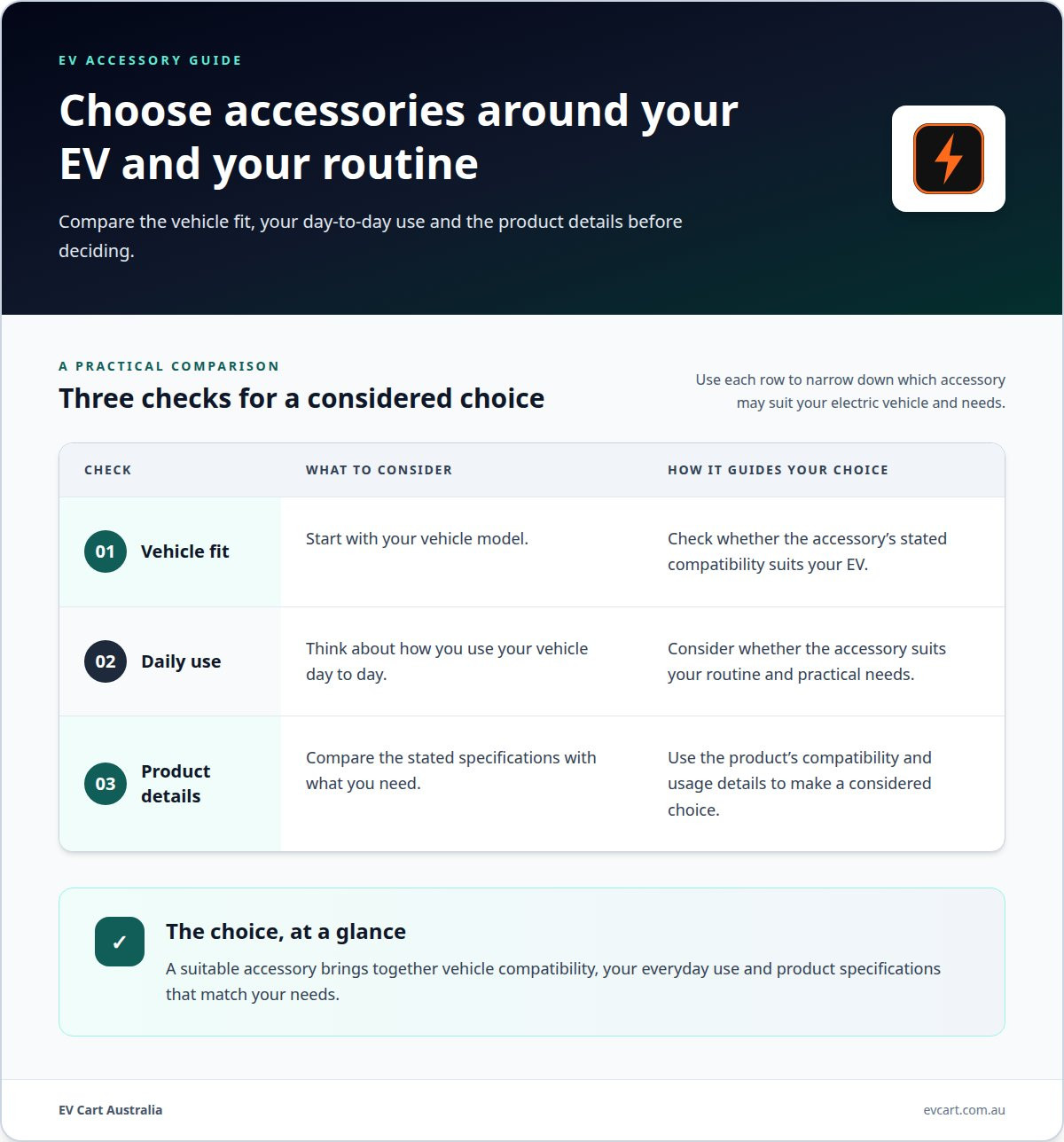
EV Cart Australia and your EV accessories
EV Cart Australia offers EV accessories for drivers considering which practical additions may suit their electric vehicle and needs.
When choosing accessories for your EV, consider your vehicle model and how you use it day to day.
Frequently Asked Questions
What does AS/NZS 3000 require for EV charger installations in Australia?
AS/NZS 3000 requires an EV charging installation to be designed and installed as a safe electrical installation, with suitable circuit protection, earthing, wiring and equipment selection. The AS/NZS 3000 EV charger installation rules must be applied alongside the charger manufacturer’s instructions and any relevant state or territory requirements. The design depends on the supply, charger rating and site conditions, so a standard diagram or one-size-fits-all specification won’t establish compliance for every property.
Which sections of AS/NZS 3000 apply to EV charging equipment?
Section 7.9 of AS/NZS 3000:2018 addresses electrical installations incorporating electric vehicle charging systems. Other provisions can also apply, including requirements for protection against electric shock, wiring systems, earthing and verification. The applicable clauses depend on how the charger is supplied and installed. For example, a fixed wall-mounted unit and a portable charging lead may involve different equipment and installation considerations, so the relevant requirements must be assessed for the actual setup.
What are the requirements for EV charger cable sizing, voltage drop, and installation methods?
Cable sizing must suit the charger’s load and circuit conditions, rather than relying on one size for every installation. The electrician considers the protective device, cable length, installation method, grouping with other cables, ambient conditions and voltage drop. The cable must also be protected from foreseeable damage and installed using a method suited to its location, such as an appropriate conduit or enclosure where required. The completed design must meet the applicable Wiring Rules.
What clearances, locations, and environmental protections are required for outdoor EV chargers?
Outdoor chargers need a location and level of environmental protection suited to the equipment, its instructions and the site’s exposure. Consider rain and water entry, direct sunlight, physical impact, vehicle movement, and access for operation or maintenance. Don’t assume the same clearance or protection rating applies to every charger. For instance, a unit beside a driveway may need protection from vehicle contact, while one in an exposed area must be suitable for those conditions.
What are the Australian licensing, inspection, and certificate requirements for installing an EV charger?
EV charger electrical work must be carried out by an appropriately licensed electrician. The state or territory determines any required notification, inspection and electrical safety documentation. Since terminology and processes differ across Australia, the rules of the relevant electrical regulator apply to the property’s location. Ask what certificate or record will be issued when the work is complete, and keep it with the charger documentation. A retailer that sells charger hardware does not perform or certify the electrical installation.
Do EV charger installation rules vary by Australian state or territory, network operator, or building type?
Yes. The Wiring Rules provide a national framework, but state and territory regulators set local licensing and electrical safety processes. A network operator may also have requirements affecting a connection or a change to the property’s electrical supply. Building type matters too: apartments and shared facilities can involve strata approval, shared infrastructure or building-specific arrangements. Check these requirements before planning the installation, especially if the charger will use common property or a shared supply.
How do AS/NZS 3000 requirements differ from AS/NZS 3008 and AS/NZS 61851 for EV chargers?
AS/NZS 3000:2018 is the Wiring Rules for the electrical installation, while AS/NZS 3008.1.1:2017 is used for EV supply cable sizing.
What AS/NZS 3000 rules cover dedicated circuits, circuit breakers, and RCD protection for EV chargers?
Each EV charger outlet must have its own dedicated circuit and individual overcurrent protection. Every installation requires RCD protection: Appendix P indicates Type B where the charger cannot detect DC fault current, or Type A where it can detect and shut down; for IEC 62196 outlets, Type A requires equipment that disconnects supply above 6 mA DC fault current.