
Choosing single phase or three phase EV charging for your home
2026-11-10

A three-phase charger isn’t automatically the faster choice for your EV. In the single phase vs three phase EV charger comparison, a single-phase home charger can deliver up to 7.4 kW, while a three-phase charger can provide up to 22 kW. Your car’s AC charging capability can limit the actual rate, so the charger and supply don’t tell the whole story.
It’s reasonable to focus on charging speed, but the right option depends on your home’s power supply, your vehicle and how much energy you need to add. This guide explains how single-phase and three-phase power affect home charging, how to identify your supply, and how battery capacity influences charging time. You’ll also see why a larger charger may not make sense if your car can’t use its full output, and how to weigh the options against your usual driving and charging routine.
Key Takeaways
- Compare the charger’s output with your home’s supply and your EV’s AC charging limit; the lowest limit sets the charging rate.
- Learn the signs of single-phase and three-phase power, and why a visual check alone may not give a definite answer.
- See how battery capacity and the amount of charge you need affect the time spent charging.
- Compare typical Level 2 charging speeds to understand when three-phase power could make a practical difference.
- Use your vehicle, home supply and charging routine to decide which setup better suits your needs.
Table of Contents
How does three-phase power affect home EV charging?
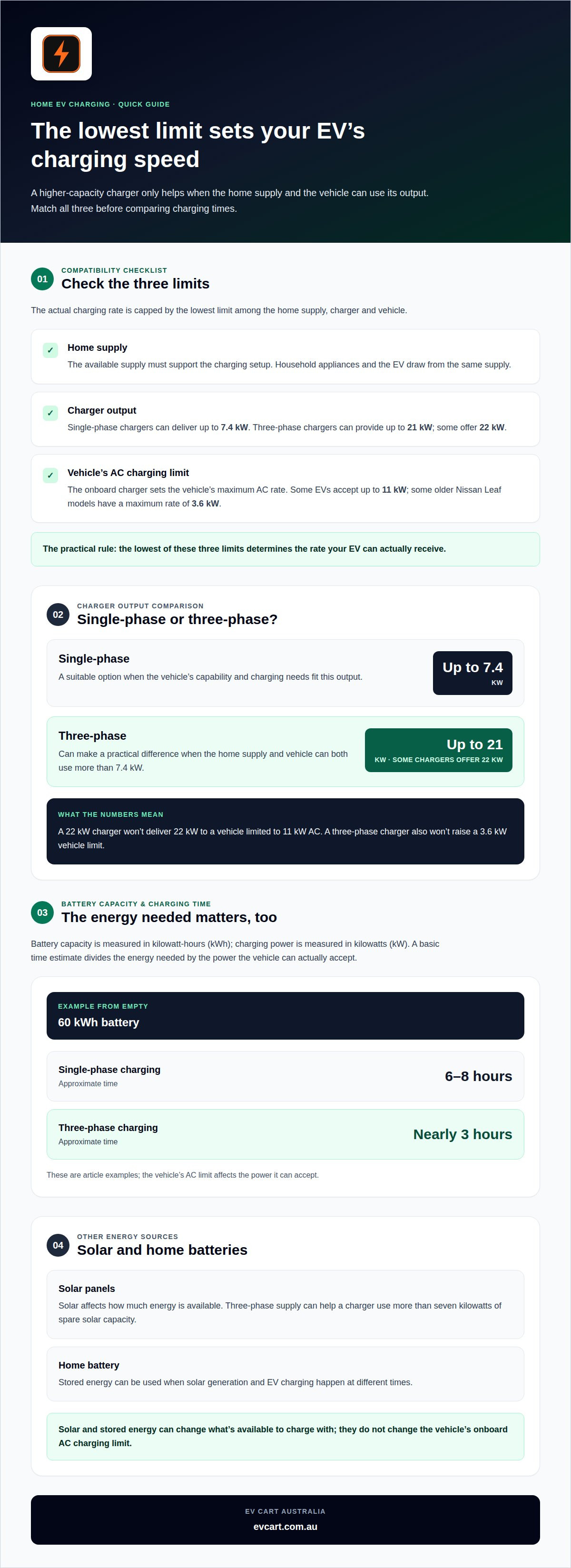
Three-phase power can allow a home EV charger to deliver more AC power, but it does not guarantee faster charging. The vehicle’s onboard charger sets its own limit. The actual rate is capped by the lowest limit among the home supply, the charger and the vehicle.
A dedicated three-phase charger can potentially provide up to 21 kilowatts. Some three-phase chargers offer up to 22 kW, but that figure describes charger capacity, not the rate every EV will accept. A vehicle limited to 11 kW AC charging cannot use the full output of a 22 kW charger. The extra capacity won’t make that car charge faster.
Single-phase charging can deliver up to 7.4 kW. The single-phase vs three-phase EV charger choice depends on whether the vehicle and home supply can use the charger’s output. Three-phase charging is useful when both the charger and vehicle can accept more than 7.4 kW, and the home has suitable supply capacity. The car’s onboard AC charger converts incoming power for its battery, and its limit remains in place even when a higher-capacity charger is connected.
Vehicle limits vary. Some EVs accept up to 11 kW AC, while some older Nissan Leaf models have a maximum charging rate of 3.6 kW. If a vehicle and charger have different phase capabilities, the vehicle charges using one phase. The weakest link limits maximum speed, so check the specific vehicle’s AC charging capability before choosing a charger. This is the key distinction in a single-phase vs three-phase EV charger comparison: higher charger capacity only helps when the vehicle can use it.
Solar panels and home batteries affect how much energy is available, not the vehicle’s onboard AC charging limit. A three-phase connection can help a charger use more than seven kilowatts of spare solar capacity. A home battery can also supply stored energy when solar generation and charging happen at different times.
Use this comparison to distinguish the home supply limit from the vehicle limit:
| Option | Potential charging capacity | Key limit |
|---|---|---|
| Single-phase charger | Up to 7.4 kW | Supply and vehicle capability |
| Three-phase charger | Potentially up to 21 kW; some chargers offer 22 kW | Supply, charger and vehicle capability |
For example, a 22 kW charger connected to an EV limited to 11 kW AC won’t deliver 22 kW to that vehicle. A 3.6 kW onboard limit also remains the ceiling, even with three-phase power. Before a charger is installed, match its phase and output to the vehicle’s AC limit and the home’s supply. Choose three-phase when the vehicle can use its higher output and your charging demand benefits from it; otherwise, single-phase may suit the car’s capability.
How to identify single-phase and three-phase supplies at home
Start with the meter display and switchboard, then check that the supply matches the charger’s phase requirements. In Australia, visual clues can be useful, but they cannot confirm the connection on their own.
Identifying a single-phase supply
A single-phase supply has one active conductor. A meter reading can help indicate whether a connection is single-phase, but it may not be conclusive on its own. These details distinguish it from a three-phase supply, which uses three active conductors.
A single-phase connection has a standard maximum capacity of around 14.5-15 kW. That capacity serves the whole household, not just an EV charger. Household appliances and the vehicle draw from the same supply, so the available capacity for charging depends on other demand at that time.
Identifying a three-phase supply
A three-phase supply has three active conductors. A meter may show 3×220 / 230 V, 380 / 400 V or 380 V; voltage between two active wires should be close to 400 VAC. These readings distinguish three-phase power from a single-phase meter reading of 220 / 230 V.
One switchboard clue is the number of main switches: three can indicate three-phase power, while one can indicate single-phase. Three thick conductors entering the meter box may also suggest three phases, but neither clue is definitive. Don’t rely on the number of switches or conductors alone.
Match the charger to the supply
Use the confirmed supply type to narrow your charger options. A single-phase supply supports single-phase charging, while a three-phase supply can support a compatible three-phase charger. A three-phase charger cannot deliver its full potential on a single-phase supply, and the vehicle’s AC charging capability may limit the rate further.
Compare three details before choosing: the home’s phase, the charger’s phase requirements and the vehicle’s AC charging limit. For example, a three-phase home supply won’t make a vehicle charge on three phases if its onboard charger supports only one. The supply is part of the match, not the only factor determining charging speed.
Knowing whether the supply is single-phase or three-phase helps identify which charging accessories may be compatible. Check the product’s stated phase requirements against the confirmed supply.
For accessory selection, use the meter’s phase and voltage markings as a starting point. The meter-box appearance or switch count alone cannot establish the connection with certainty. Matching the home supply, charger and vehicle helps avoid choosing equipment that cannot deliver its intended charging rate.
Charging time and battery capacity
Battery capacity, measured in kilowatt-hours (kWh), tells you how much energy an EV battery stores. Charging power, measured in kilowatts (kW), tells you how quickly energy can be supplied. To estimate charging time, divide the energy needed by the power the vehicle can actually accept.
A 60 kWh battery takes about 6 to 8 hours to charge from empty using single-phase EV charging. With three-phase charging, the same battery can charge in nearly 3 hours. These examples show why phase can affect charging time, but they don’t mean every vehicle will charge at the charger’s full output.
Start with the energy you need to add, rather than assuming every session begins with an empty battery. For example, a driver topping up after daily driving needs less energy than someone charging a 60 kWh battery from empty. The required energy changes the time, even when the vehicle and charger stay the same.
A standard Australian socket supplying 10 amps at 230 volts can provide 2.3 kilowatts of charging power. Charging a 60-kilowatt-hour battery from empty at about 2.3 kilowatts takes about 30 hours. A lower charging rate means a longer session, even though the battery capacity hasn’t changed.
Use this simple calculation as a planning guide:
- Work out how many kilowatt-hours the vehicle needs to add.
- Use the charging rate the vehicle can accept, not just the charger’s maximum rating.
- Divide the energy needed by that charging rate to estimate the session length.
The vehicle’s onboard charger may accept less power than the home charger can provide. If so, the vehicle’s limit determines the effective rate. The home supply, switchboard capacity and charging equipment also affect the available power. Voltage alone does not tell you how long charging will take: the usable charging rate and energy required matter too.
Cables must also suit the charging setup and carry the intended power. A cable or charger with a lower rating can extend a charging session, even when the battery can take more energy. Match the equipment to the vehicle’s capability and home supply before relying on a quoted charging time.
For everyday planning, estimate the energy your driving uses and the time the vehicle will be connected. If you need to replenish about 10 kilowatt-hours, five hours of charging from a standard socket can replace that amount. The battery doesn’t need to be full for a useful charging session.
Single-phase or three-phase power affects how quickly the battery can receive energy, not its capacity. The same vehicle reaches the same state of charge on either supply. Plan your charging routine around the energy you need to add and the time available, then match the charger to the vehicle and electrical supply.
Level 2 home charging speeds on single-phase and three-phase power
Level 2 charging uses a dedicated home charger, with its charging speed shaped by the supply, charger and vehicle. In the Australian comparison, a single-phase Level 2 charger is listed at 7 kW, while a three-phase Level 2 charger is listed at 11 kW. Those figures help explain the difference, but your vehicle may accept less power.
A single-phase Level 2 charger is estimated to add around 42 km of driving range per hour. A three-phase Level 2 charger can add range faster than a single-phase charger, though the amount depends on the vehicle and charging conditions. These are range estimates, not guaranteed results for every vehicle. Battery efficiency, driving conditions and the vehicle’s charging limit affect how far each hour of charging takes you.
Higher-rated equipment can offer more capacity. A single-phase charger delivering 7.4 kW can add up to 50 km of range per hour, while a 22 kW three-phase home charger can provide about 120 km per hour. These figures describe potential charging rates; the vehicle must also be able to accept that power. A 22 kW unit won’t deliver its full rate to a car with a lower AC charging limit.
The listed Level 2 power ranges are 3.6 kW to 9.6 kW for single-phase chargers, and 3.6 kW to 22 kW for three-phase chargers. These ranges cover different equipment ratings, not a promise that every home or vehicle will reach the top figure. The practical charging speed is limited by the lowest supported rate across the home supply, charger and vehicle.
For many drivers, overnight charging on a single-phase supply can replace more than a typical day’s driving. Three-phase power can be useful if you drive longer distances, share charging between multiple EVs or have a short charging window. A Nissan Leaf with a lower onboard AC limit, for example, will not gain the full benefit of a higher-output charger.
Use the comparison below as a starting point, then match the option to your vehicle’s AC charging capability:
| Home charging option | Listed Level 2 rate | Estimated range added | Useful consideration |
|---|---|---|---|
| Single-phase | 7 kW | About 42 km per hour | May suit overnight charging and typical daily driving |
| Three-phase | 11 kW | About 66 km per hour | Can shorten charging time when the vehicle supports it |
Compare your vehicle’s AC limit, daily driving needs and available charging time. The phase matters most when your vehicle can use the higher charging rate.
What determines whether an EV can charge on three phases?
The vehicle’s onboard AC charger determines whether it can use three-phase power. A three-phase home supply and charger cannot make a vehicle accept phases its onboard system does not support.
Check the vehicle’s AC charging specification, not just its fastest advertised charging figure. With AC charging, power passes through the onboard charger, which converts it for the battery. The vehicle’s maximum AC rate shows how much it can accept. A higher-rated home charger will not raise that limit.
Some EVs accept up to 11 kW AC, while some older Nissan Leaf models have a maximum charging rate of 3.6 kW. Those limits affect the benefit of three-phase equipment. An EV limited to 3.6 kW won’t charge at 11 kW simply because it’s connected to a higher-capacity charger.
Phase compatibility matters as well as the maximum rate. If the vehicle and charger have different phase capabilities, the vehicle charges using the phases its onboard system supports, and the weakest link limits the maximum speed. For example, a three-phase charger may supply a vehicle that can use only one phase.
Before choosing equipment, compare these three specifications:
- The vehicle’s maximum AC charging rate.
- Whether its onboard charger supports single-phase or three-phase charging.
- The phase and maximum output supported by the home charger.
For example, an EV with an 11 kW AC limit won’t use the full 22 kW offered by some three-phase chargers. The charger’s rating describes its available output, not what every connected vehicle will draw. If the vehicle supports only single-phase charging, the extra phases won’t increase its AC rate.
Separate AC charging from connector and cable compatibility. A type 1 charging cable supports single-phase charging only, with a maximum power output of 7.4 kW. That cable limit matters even if other parts of a charging setup could support a higher rate. Check the vehicle’s charging inlet and cable requirements alongside its onboard AC specification.
Use the exact vehicle model and version when checking specifications. An older Nissan Leaf’s 3.6 kW AC limit illustrates why model details matter; a general brand name alone doesn’t establish the charging capability. Compare the vehicle’s AC limit with the charger’s phases and output before deciding whether three-phase charging would make a practical difference.
For other practical EV ownership needs, browse EV accessories and consider which items suit your vehicle.
EV Cart Australia
EV Cart Australia supplies EV accessories for practical day-to-day ownership. After comparing your home supply with your vehicle’s AC charging capability, consider which accessories suit your EV and how you use it. Check the product’s fitment details against your vehicle’s year and variant before ordering, just as charger output needs to suit the car and its electrical supply.
For help choosing EV accessories or checking vehicle fit, contact EV Cart Australia. For decisions about your home’s electrical supply or charger installation, use the electrical and vehicle requirements covered in this guide.
Make your charging choice part of your ownership plan
Treat the single-phase versus three-phase EV charger decision as one part of planning how you use your vehicle. Your priorities may change with your driving routine, household needs or vehicle. Focus on what suits your current setup rather than choosing equipment solely for its highest available rating.
Before making your next EV-related decision, note what you need from your vehicle day to day and which details matter most. This practical approach helps keep choices focused, whether you are considering charging arrangements or accessories that suit your EV.
For help with EV accessories, get in touch with EV Cart Australia. Take the next step with a clear view of what works for your vehicle and your routine.
Frequently Asked Questions
What Is the Difference Between Single-Phase and Three-Phase Charging?
Single-phase charging uses one active phase, while three-phase charging can draw power across three phases when the vehicle supports it. At home, the practical difference is the rate the car can accept, not just the charger’s label. A higher-rated charger will not speed up a vehicle with a lower onboard AC limit. Check the vehicle specification alongside the charger rating before choosing. Your supply type is also relevant when comparing charging equipment, as the vehicle, charger and supply need to work together.
How Does Supply Type Affect Charging?
Supply type affects the AC power available to charging equipment, but it does not determine charging speed on its own. The vehicle’s onboard AC limit also matters, so a three-phase supply will not make a car charge faster than its onboard system allows. When comparing charging options, check the vehicle’s AC specification and your supply details together. This helps you choose equipment that matches your vehicle and charging routine.
How do I tell which supply I have?
Look for phase and voltage markings on the electricity meter, then treat switchboard or meter-box appearance as clues rather than proof. A meter showing 220 / 230 V indicates single phase; markings such as 3×220 / 230 V or 380 / 400 V indicate three phases can be used. Don’t remove covers or handle wiring to investigate. Use the supply details when comparing charging options.
When does three-phase matter?
It depends on your charging demand and whether your vehicle can use three-phase AC power. If you charge overnight and replace a typical day’s driving, the additional charging rate may add little practical value. If you regularly have a short charging window, drive long distances or need to charge multiple EVs, faster charging may matter more. Consider those needs alongside your vehicle’s AC limit and the supply available to you.
What is a single-phase power supply?
A single-phase supply has one active conductor feeding a home’s electrical system. Household appliances and an EV charger draw from that supply, so available capacity is shared. The charger’s output must suit both the home’s electrical capacity and the vehicle’s charging capability. This is why choosing a charger solely by its maximum rating can give an unrealistic impression of everyday charging performance. Check the vehicle’s AC limit and supply details when comparing charging equipment.
When is three-phase actually worth it?
Three-phase may be worth considering if you need to add more driving range in a short charging window, run more than one EV or regularly cover long daily distances. It improves AC charging speed only if the car’s onboard charger supports the higher rate. If the vehicle accepts less power, or overnight charging already suits your routine, extra supply capacity may not change your day-to-day experience. Compare the vehicle’s AC limit with your charging needs before choosing equipment.
Which Solution Do I Need?
Choose the option that fits your vehicle’s AC limit, home supply and charging routine. If your car supports single-phase charging and stays connected overnight, a single-phase setup may meet your needs. If it accepts three-phase power and you often have little time to charge, three-phase may be more useful. Compare the AC specification in the vehicle manual with your supply details before deciding which charging equipment suits your needs.
What is the difference between single-phase and three-phase EV charging?
The difference is how many electrical phases can supply the charger and how much AC power the vehicle can accept through its onboard charging system. Three-phase can support a higher charging rate, but does not guarantee one. A car with a lower onboard limit still charges at that limit, even when connected to equipment with more available capacity. The vehicle, charger and supply must work together, so check all three when comparing charging options.