
Compare EV charger cable protectors by size and price
2026-11-08

The lowest-priced EV charger cable protector isn’t necessarily the best fit. A protector that’s too narrow may not suit the cable, while one that’s too short can leave part of the route exposed. Choose based on the cable’s diameter, the distance to cover and where the protector will sit.
Comparing prices is a sensible starting point, especially when several options look similar. But a cable protector also helps reduce trip hazards and shield a charging cable from passing feet or wheels, so fit and length matter as much as price.
This guide explains how to compare cable diameters, lengths and prices for use around Australian homes and properties. You’ll learn what to measure, how to match a protector to its setting and which practical details to weigh before choosing.
We’ll also consider different routes, from a garage or driveway to a path, and when a surface cover may not be suitable. Use the comparisons and decision guide to find an option that fits both the cable and the space.
Key Takeaways
- Match the protector’s internal channel to the cable’s measured diameter so the cable sits securely without being forced in.
- Estimate the full route before comparing lengths, and consider how joins or gaps could affect coverage.
- Compare prices against usable length and cable capacity, not the headline price alone.
- Choose a protector suited to its setting, and don’t assume every cover is designed for vehicles to drive over.
- For a route across a public footpath, consider local requirements before running a charging cable across it.
Table of Contents
Protecting EV charging cables from trip hazards and damage
An exposed charging cable can catch a pedestrian’s foot or lie beneath a vehicle tyre. A surface protector can create a defined crossing point, but placement and fit still matter.
At Australian homes, keep the cable route on private property where practical. A cover does not give permission to place a cable across a public footpath. Council requirements vary, and a trip or damage incident may lead to complaints or liability concerns.
Alternatives to home cable protectors
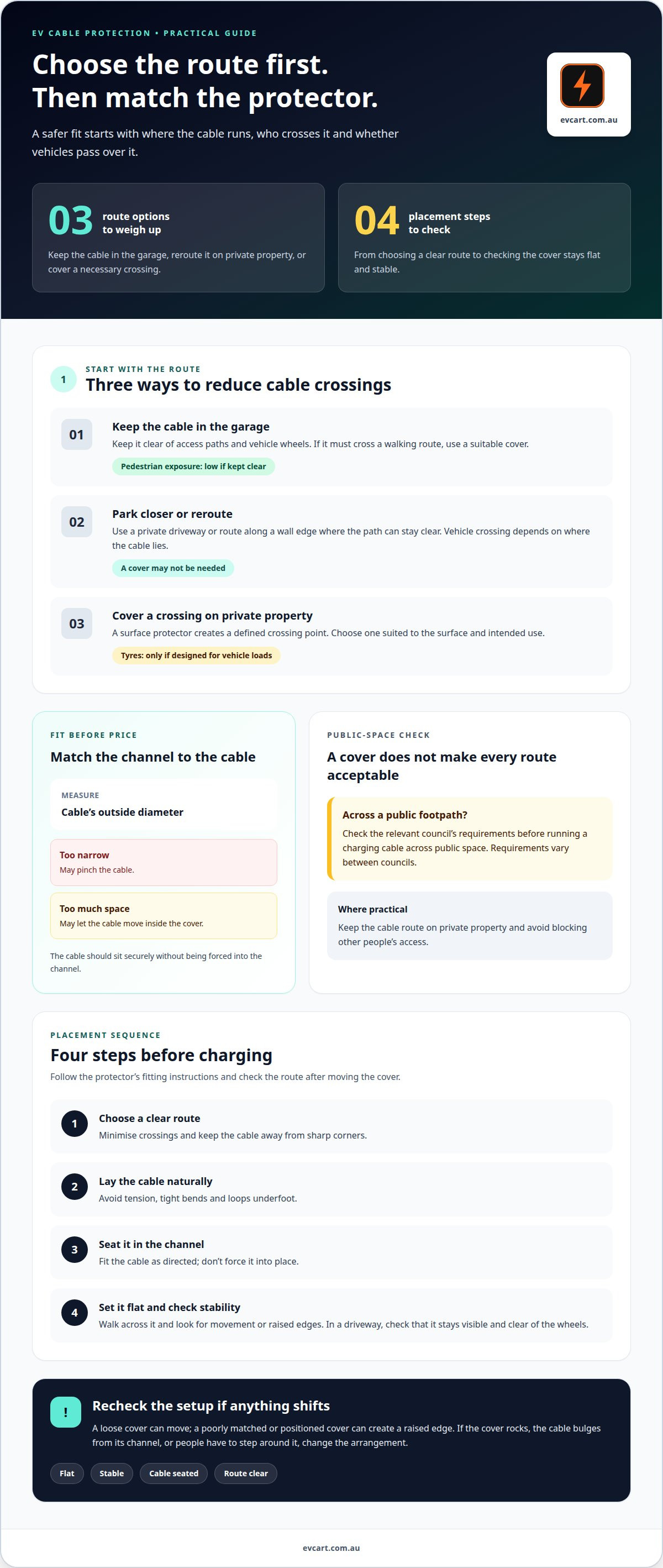
First, consider changing the route rather than covering it. Parking closer to the charging point, keeping the cable inside a garage or routing it along a private driveway can avoid a pedestrian crossing. These options avoid adding a raised cover, but depend on the parking position and available space.
A cable protector can help when the route must cross a walkway on private property. Compare options by considering the route, pedestrian exposure and whether vehicles will pass over the cable.
| Option | Route | Pedestrian exposure | Vehicle crossing |
|---|---|---|---|
| Keep the cable in a garage | Inside the garage | Low if kept clear of access paths | Keep it clear of the vehicle’s path |
| Park closer or reroute | Private driveway or wall edge | Reduced if the path stays clear | Depends on where the cable lies |
| Use a surface protector | Across a private walkway | Creates a defined crossing point | Only suitable if designed for that use |
First choose a route that keeps the cable away from regular foot traffic. Use a cover only where a crossing remains necessary.
Cable damage and added trip hazards
A poorly matched or positioned cover can create a raised edge that people may catch their feet on. A loose cover can shift, while a narrow channel may press against the cable. Inspect the route before charging, and keep the protector flat, stable and clear of sharp bends.
A protector can help separate a cable from foot traffic and incidental contact, but it won’t prevent every kind of damage. A vehicle tyre, pinched cable or sharp edge can still cause harm if the route or cover is unsuitable.
Use this quick check before charging:
- Lay the cable without pulling it tight or folding it sharply.
- Seat it in the protector’s channel, without forcing the fit.
- Position the cover across the crossing, not at an angle.
- Walk the route and look for movement, exposed cable or raised edges.
If the cover rocks, the cable bulges from its channel or pedestrians have to step around it, change the arrangement. Don’t treat a protector as a way to make an unsuitable public-footpath route acceptable. On a home driveway, a clear route and properly seated cable help limit trip exposure and avoidable wear.
Using protectors across pavements, paths, drives and garages
Choose a route based on who uses the surface and what crosses it. A garage doorway, private path and public footpath each call for different decisions.
To position a protector, follow its fitting instructions and lay the cable without twisting it. Seat the cable in the channel, then place the cover flat across the route and check that it stays stable when approached from either side.
On a public pavement, don’t assume a cable cover makes the route acceptable. Check the relevant council’s requirements before running a charging cable across public space. Rules and arrangements vary between councils, so keep the cable on private property when your parking setup allows.
A narrow garden path may be used only by pedestrians, while a driveway crossing may also face vehicle traffic. Match the cover to the surface and intended use. Where possible, keep it clear of door swings, gates and the usual walking line. For example, routing the cable along a fence edge may leave more of the path clear.
Across a private driveway, position the cover where people can see and approach it clearly. Don’t hide it behind a parked car or place it at an awkward angle. If vehicles cross the route, choose a protector designed for that load. A pedestrian cable cover isn’t automatically suitable for tyres.
In a garage, the simplest option may be to keep the cable near the wall and away from vehicle wheels. If it must cross a walking route, use a suitable cover and keep the entrance clear. Don’t trap the cable under a door or between stored items, as pressure can strain its outer sheath.
Use this placement sequence for a surface-mounted protector:
- Choose a route that minimises crossings and keeps the cable away from sharp corners.
- Lay the cable naturally, without tension, loops underfoot or tight bends.
- Fit the cable into the channel as directed by the protector’s instructions.
- Set the cover flat, then walk across it and check for movement or raised edges.
After moving a protector, repeat the walk-over check before charging. In a driveway, also check its position with the vehicle parked and moved to ensure the cover stays visible and clear of the wheels.
On shared paths or apartment driveways, agree on a route that doesn’t block other residents’ access. Keep the cable and cover within the permitted space, and avoid creating a crossing that forces pedestrians onto a driveway or road. If the route would cross a public footpath, follow the relevant council’s guidance.
Cable diameter compatibility
Choose a protector channel that fits the cable’s outside diameter. A channel that’s too narrow can pinch the cable, while too much space can let it move inside the cover. Match the stated size range to the cable itself, not the charger’s amperage or power rating.
Two listed size options illustrate how ranges work: a 12-16 mm channel and a 16-22 mm channel. The first is listed for EV chargers or stations rated at 16A and 3.5KW, 32A and 7KW, or 16A and 22KW. The second is listed for 32A and 22KW. Treat those ratings as compatibility details, not as the cable diameter.
Measure the cable at its widest point, including the outer sheath. Keep it round while measuring, as squeezing it can produce a smaller result than its actual size. Compare the measurement with the protector’s stated channel range before choosing.
A channel’s stated range indicates the cable sizes it can accommodate, but it doesn’t mean every cable in that range will sit equally well. Cable shape, sheath thickness and connector transitions can affect the fit. Check how the cable lies along the covered section, not just near the plug.
The protector also needs a load rating suited to its location. Choose a stated rating appropriate for the heaviest traffic that will cross it. Charger current or kilowatts don’t indicate a protector’s load capacity. A pedestrian-only path and a driveway crossed by vehicles call for different use ratings.
- Measure: Find the cable’s outside diameter without compressing the sheath.
- Match: Compare the measurement with the channel’s stated size range.
- Check: Make sure the cable sits inside the channel without bulging or excessive movement.
- Assess: Match the protector’s stated load rating to the traffic crossing it.
For example, a cable measuring 15 mm falls within a 12-16 mm range. That measurement alone doesn’t establish the protector’s suitability for vehicles; its load rating and intended use matter too.
Don’t force an oversized cable into a narrow channel or pack a loose fit to make it seem secure. Either approach can affect the cable’s position and make the cover harder to seat correctly. If the cable is thicker near a connector, keep that section outside the channel unless the protector’s instructions allow it.
In short, choose by cable diameter first, then check that the protector’s load rating suits the route. These are separate compatibility checks, and both matter.
Cable protector lengths and prices
Measure the section of cable route that needs covering, not the full charging lead. Follow the route from where the cable meets the ground to where it clears foot traffic. Include bends and the width of each crossing. This gives you a practical coverage target before comparing products.
The product’s length describes the cover, not how much cable it protects around corners or gaps. A straight driveway crossing may need less cover than a winding route around a parked vehicle. Mark the intended path with removable tape, then measure it to compare options consistently.
Compare prices in Australian dollars against usable coverage. A lower price may buy less length, while a longer cover may leave surplus material. Divide the listed price by the usable covered length to compare value, then check whether the product suits the route and cable diameter.
| Comparison | What to assess | Why it matters |
|---|---|---|
| Short cover | Length of one crossing | May suit a single, defined walkway |
| Longer cover | Total route and turns | May reduce uncovered sections |
| Multiple covers | Join position and continuity | Gaps or shifting joins can expose cable |
Use the table to shortlist options by route, then compare the Australian-dollar price with the coverage each provides. Don’t assume two covers can be joined neatly: the connection design and surface affect whether they sit securely.
Check the listing for the stated cover length and channel capacity. These are separate specifications: length tells you how much of the route the protector covers, while channel size determines which cable fits. A long protector that can’t accommodate the cable won’t solve the fit problem.
Before ordering, use this practical sequence:
- Measure each straight section and bend along the planned route.
- Add the sections to estimate the total coverage required.
- Compare the stated length, cable channel and intended surface use.
- Compare A$ cost against usable coverage, not length alone.
For example, if the route bends around a garden edge, measure the bend rather than treating it as a straight line. Then check whether one cover or separate sections can follow the route without leaving the cable exposed.
Base the budget comparison on the actual route. A cover with spare length may be useful if the charging position changes, but surplus material shouldn’t create an awkward raised section. Choose a length that covers the crossing cleanly and sits properly on the surface.
The cited average price for slow or fast public EV charging is 55 pence per kWh. Keep that figure separate from a protector’s purchase price: the charging rate is stated per unit of energy, while the cover is assessed by its length, fit and route coverage. Treating them as unlike costs avoids making a low-priced protector seem valuable merely because it is compared with a charging tariff. The figure can provide context when planning the wider cost of using a public charger, but it does not establish the cost of a particular charging session or determine which protector offers better coverage.
Keep your protector choice focused on the route and product specifications. Treat the charging rate as separate budget context.
Which EV cable protector is best for protecting cables from cars driving over them?
Choose a protector that its manufacturer explicitly rates for vehicle traffic. A cover intended only for pedestrians isn’t automatically suitable for a driveway, where a tyre can press directly above the cable. Check the stated load rating and intended use before placing it in a vehicle’s path.
Don’t use charger power ratings as a substitute for a protector’s load rating. The cable’s electrical capacity and the cover’s ability to withstand vehicle loading describe different things. A product listing that names charger ratings, such as 32A and 22KW, doesn’t by itself confirm that vehicles can drive over the cover.
Look for product details that specify vehicle use, supported load and cable channel dimensions. The channel must fit the charging cable without pinching it. The cover must also sit securely on the driveway, without rocking, shifting or leaving a section exposed.
Assess the route before choosing. A car may cross the cable once when entering a garage or repeatedly when reversing and parking. Frequent wheel crossings make the stated traffic rating especially important. Position the crossing so the vehicle approaches it straight, rather than turning across the cover.
Use these checks to compare options:
- Traffic rating: Confirm the manufacturer states that the cover suits vehicle crossings.
- Cable fit: Match the channel to the cable’s outside diameter.
- Route: Measure the crossing and consider how often tyres pass over it.
- Placement: Check that the cover sits flat and doesn’t obstruct walking access.
- Condition: Inspect for movement, cracks or cable exposure before charging.
Don’t treat a protector with no stated vehicle load rating as suitable for a driveway. Choose a model with a stated rating appropriate for the traffic using the driveway. If the product information specifies pedestrian use only, keep it out of the vehicle’s wheel path.
After positioning the cover, walk across it and check the edges. Move the vehicle slowly over the crossing, then inspect the cover and cable for movement or visible damage. Repeat the inspection after changing the parking position or rerouting the lead. A shifted cover can leave the cable exposed again.
Even a vehicle-rated cover needs careful placement. Keep the cable inside its channel, avoid sharp bends at either end and don’t drive over exposed cable. For broader ownership needs, consider EV accessories alongside your charging setup.
EV Cart Australia
EV Cart Australia offers EV accessories for practical electric vehicle ownership. If you’re considering cable protection alongside other charging essentials, explore accessories that suit your vehicle and everyday needs.
Use the comparisons above to narrow down your cable cover options by fit, route and vehicle loading. For other accessories, focus on compatibility with your vehicle and how you plan to use each item.
For help with an EV accessories enquiry, contact EV Cart Australia.
Make your charging setup work for the long term
Think beyond today’s parking position. A new vehicle, a rearranged garage or a changed charging routine can alter where the cable crosses a walking or driving route. Keep your cable measurements and route notes together so you can make future accessory choices using practical details rather than guesswork.
As your setup changes, reassess whether an EV charger cable protector still suits the cable and its position. A cover chosen for one parking arrangement may not suit a new crossing or different vehicle movements. Review the whole route whenever it changes, rather than moving the cover without checking its fit and placement.
For other practical EV accessory needs, EV Cart Australia offers accessories for electric vehicle ownership. Contact EV Cart Australia with your enquiry to find accessories that fit your routine.
Frequently Asked Questions
What is an EV charger cable protector and what types are available in Australia?
An EV charger cable protector is a cover that holds a charging cable in a channel where it crosses a surface. Options include single-channel covers for one cable, wider or multi-channel designs for multiple lines, and modular sections that connect along a route. Compare channel dimensions, cover length and intended traffic. The protector’s shape and stated use matter more than its label.
How much do EV charging cable protectors cost in Australia?
Prices vary according to cover length, cable capacity, construction and stated load rating. Compare the listed price in Australian dollars with the usable coverage, rather than choosing solely by the lowest price. A shorter cover may suit a doorway crossing, while a longer route may need more coverage or connected sections. Check whether the listed price is for one section or a set before comparing options.
Are EV cable protectors suitable for outdoor use and Australian weather?
Some protectors are designed for outdoor use, but suitability depends on the product’s stated materials and environmental limits. Before placing one on an exposed driveway, look for explicit outdoor-use information and consider sun, rain, surface drainage and temperature exposure. A garage cover may not suit an uncovered path. Keep the cable and cover clear of standing water, and inspect them after severe weather or repositioning.
Can an EV charging cable protector be used across a public footpath in Australia?
A protector doesn’t automatically make it acceptable to run a charging cable across a public footpath. Requirements may depend on the local council and the proposed arrangement. Before placing a cable or cover in public space, contact the relevant council about its rules and any approval process. If the route can remain on private property, use that option rather than obstructing the footpath.