
Compare EV charging cable protectors for paths and driveways
2026-10-26

The best EV charging cable protector isn’t simply the widest or heaviest option. For a path or driveway, compare how much ground it covers, how securely it holds the cable, whether pedestrians can cross it comfortably, and how easily it stores away. Match the channel size to your charging cable.
A cover can keep a cable contained across a crossing, but its usefulness depends on fit and handling as well as coverage. It should sit steadily, protect the cable without pinching it, and be easy to put away when charging is finished.
This guide compares protector styles by coverage, pedestrian access, cable attachment, storage and cable fit. You’ll learn what to consider for a path or driveway, how to measure your cable, and how to choose based on your home-charging routine.
Key Takeaways
- Compare how much of the crossing each protector covers and how its shape affects pedestrian access.
- Look for a practical way to attach the protector to the cable, then roll and store them together.
- Measure your charging cable’s diameter and match it to the protector channel to avoid a loose or cramped fit.
- Choose a style based on where it will be used, how often it needs to be moved and the surface it must cover.
- Use the comparison criteria to narrow your options before browsing EV accessories for a suitable match.
Table of Contents
- Cable protection across pavements and paths
- Attaching and rolling up the protector with the charging cable
- Compatibility with EV cable diameters
- What types of EV charging cable protectors are available in Australia?
- Which EV cable protectors suit home driveways, public charging, and commercial sites?
- EV Cart Australia: EV accessories
Cable protection across pavements and paths
A cable crossing a footpath raises two practical concerns: protecting the lead and keeping the walking surface accessible. An EV charging cable protector can cover the section across a path, but the right option depends on the crossing’s width, surface and traffic.
Vehicles should drive over a protector only if it is designed and rated for vehicle traffic. Choose a load rating suitable for the vehicles using the driveway. Don’t assume a pedestrian cable cover can take vehicle weight.
Compare coverage before choosing. A short cover may leave cable exposed at either end, while a longer one can span more of the crossing. Measure the cable route and check whether the cover’s edges sit flat. A driveway crossed by cars needs a different traffic rating from a garden path used only by pedestrians.
| Protector option | Pavement coverage | Pedestrian access | Vehicle use |
|---|---|---|---|
| Low-profile cable cover | Covers a limited crossing | Lower profile can reduce obstruction | Use only if rated for vehicle traffic |
| Modular channel cover | Sections can span a longer route | Check joins and edges for trip points | Rating must suit the vehicles using it |
| Installed pavement gully | Routes the cable through the pavement | Removes a loose cover from the surface | Depends on the installed design |
On a public footpath in Australia, distinguish a removable cover from a permanent pavement alteration. Installing an EV gully involves changing the pavement, and local council permission is required. Council rules may also govern removable covers across public paths, so check the relevant requirements before placing one.
A gully provides a fixed route across pavement but involves pavement work, rather than simply laying down a cover. A removable protector avoids cutting a channel, but sits on the surface and must allow pedestrians to pass. On a private driveway, compare its stated traffic rating with the vehicles that will cross it.
Before choosing, measure the crossing and identify who uses it: pedestrians, vehicles or both. Match the cover’s width and load rating to that use, and check that the cable sits fully inside its channel.
Councils in Suffolk and Kent have banned EV charging cables from being trailed across pavements, so don’t assume a cover is acceptable everywhere. Check the relevant local authority’s rules before using a cable cover across a public path. Requirements depend on the specific location.
Attaching and rolling up the protector with the charging cable
A protector that stays with its charging cable can make setup and pack-away simpler. Check how the two pieces connect: some designs use a clip or strap, while others hold the cable in a channel without fastening it. Consider whether you can wind both pieces together without forcing the cable into tight bends.
Lay the cable straight beside the protector, then place it in the channel. Check that it sits without being pinched or forced around a tight corner. If the design uses a clip, attach it where intended rather than improvising with a tight tie. A secure attachment should keep the protector aligned while allowing the cable to move naturally.
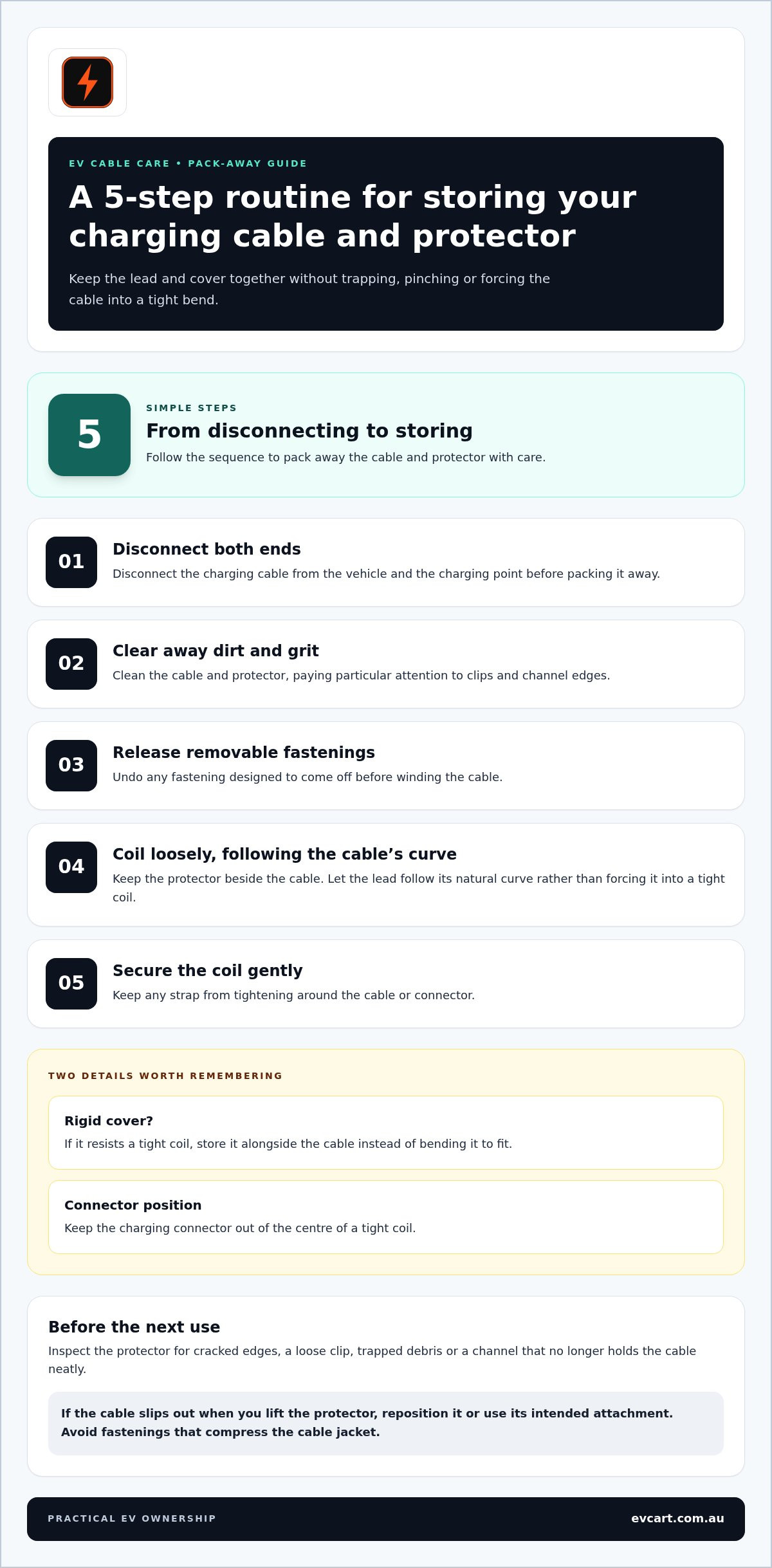
Use this simple check before storing the set:
- Disconnect the charging cable from the vehicle and charging point.
- Remove dirt or grit from the cable and protector, especially around clips and channel edges.
- Release any fastening designed to come off before winding.
- Coil the cable loosely, following its natural curve, and keep the protector beside it.
- Secure the coil without tightening a strap around the cable or connector.
This helps prevent the protector from trapping the lead during storage. If a rigid cover resists a tight coil, store it alongside the cable rather than bending it to fit. A flexible roll may wrap more easily around a cable, but check that it lies flat before use. Keep the charging connector out of the centre of a tight coil.
Attachment details affect daily handling. A fixed clip can keep a cover paired with one cable, while a removable fastener makes separation easier for cleaning or storage. Neither arrangement suits every routine. If you move the cable between a boot and a garage shelf, a quick-release attachment may be more convenient than one that needs repeated threading.
Inspect the protector before each use. Look for cracked edges, a loose clip, trapped debris or a channel that no longer holds the cable neatly. If the cable slips out when you lift the protector, reposition it or use the attachment designed for it. Don’t use a fastening that compresses the cable jacket.
Choose a design that matches how you pack away your lead, not just how it sits across a crossing. If you’re organising other EV essentials alongside your charging setup, browse EV ownership accessories.
Compatibility with EV cable diameters
Match the protector channel to the cable’s outside diameter, not its connector size. The listed options cover cables measuring 12-16 mm and 16-22 mm. A channel that is too narrow can compress the lead, while an oversized channel may let it shift instead of sitting securely.
Measure the cable jacket along a straight section, away from the charging plug and any thicker moulded parts. Use callipers or compare the cable with a ruler and note its outside width. If the cable is oval, measure its widest point. Check the measurement against the protector’s stated diameter range before choosing a size.
| Protector cable range | Listed charging-station ratings | Fit check |
|---|---|---|
| 12-16 mm | 16 A and 3.5 kW; 32 A and 7 kW; or 16 A and 22 kW | Measure the cable jacket and confirm it falls within the range |
| 16-22 mm | 32 A and 22 kW | Check the larger channel against the cable’s outside diameter |
These listings pair cable diameter with charging-station ratings, but the cable’s measured size remains the practical fit check. For example, a cable measuring 15 mm falls within the 12-16 mm range. A cable measuring 18 mm falls within the 16-22 mm range. Don’t select by charging power alone; two leads used with different equipment can have different outside diameters.
Check the protector with the cable seated in its channel. The cable should rest without being forced, crushed or held under tension. Move it gently along the channel to see whether it stays positioned. If it sits high above the channel or slides freely from side to side, the size may not suit its dimensions.
Also inspect the cable near the handle and plug. A protector channel is sized for the cable body, not necessarily the wider connector housing. Position the cover along the section crossing the route, with bulky connectors outside the channel. Don’t force the plug into a space designed for the lead.
Before buying, compare the cable’s measured diameter with the range and listed equipment rating. A 15 mm lead points to the 12-16 mm option; an 18 mm lead points to the 16-22 mm option. This simple measurement gives a more reliable fit decision than guessing from the vehicle model or charging-station power.
What types of EV charging cable protectors are available in Australia?
For an Australian driveway or workplace, compare protectors by how they cover the cable, attach to it and store after use. Four useful design categories are portable surface covers, modular channel covers, flexible roll-up covers and pavement gullies. Each handles a different route or routine, so assess the crossing before choosing a style.
Portable surface covers sit over a cable on the ground. They suit a short, straightforward crossing where the cable needs a defined channel. Check how the cover sits on your surface, such as concrete or pavers, and whether its ends lie flat. Loose edges or awkward joins can affect how people cross it.
Modular channel covers use sections that connect to span a route. They can suit longer crossings or paths that change direction, provided the sections fit together neatly. Count the joins and consider where people will step. For vehicle access, the stated traffic rating must suit the vehicles using it.
Flexible roll-up covers prioritise portability and compact storage. They can be convenient when you remove the cable after each charge, such as in a shared parking area. Check that the material lies flat before use and that the cable sits securely along its length. Position carefully if the edges curl.
Pavement gullies create a fixed cable route through the pavement instead of placing a cover on top. They involve altering the pavement, so local council permission is required before installation. This option suits a planned, permanent route better than a temporary charging setup. Consider the location and how the cable will reach the vehicle.
Cable fit still separates suitable designs from poor matches. Options are listed for cable diameters of 12-16 mm and 16-22 mm. The 12-16 mm option is listed for charging stations rated 16 A and 3.5 kW, 32 A and 7 kW, or 16 A and 22 kW. The 16-22 mm option is listed for stations rated 32 A and 22 kW. Measure the cable jacket before selecting a channel.
- Choose a surface cover for a simple, removable crossing.
- Compare modular sections when the route needs multiple lengths or turns.
- Consider a roll-up design if packing away is part of each charging session.
- Assess a pavement gully only for a fixed route with council permission.
Make the decision in sequence: identify whether the route is temporary or permanent, measure the cable, then compare storage and traffic needs. This narrows down the protector type before you assess individual designs.
For a removable crossing, compare a surface cover for a short, straightforward route with modular channels for longer routes or turns. A roll-up cover suits compact storage between charging sessions. A pavement gully provides a fixed route and requires local council permission.
Which EV cable protectors suit home driveways, public charging, and commercial sites?
Choose a protector for the site’s traffic, cable route and storage routine. A home driveway used by one household differs from a public charging bay or workplace car park. Identify who crosses the cable, whether vehicles pass over it, and whether the equipment stays in place between charging sessions.
Home driveways: A removable cover can suit a cable crossing used during home charging and cleared afterwards. Map the route from the charging point to the parked vehicle, then measure the section across the driveway. If cars drive over it, select a cover with a stated vehicle load rating suitable for those vehicles. For a pedestrian-only crossing, focus on a stable fit and accessible edges.
Public charging: A shared charging area needs a clear route for cable users and passers-by. Position a suitable cover to keep the route orderly without blocking access. If the cable crosses a public footpath, account for council requirements before placing a cover. A pavement gully alters the pavement and requires local council permission.
Commercial sites: A workplace car park may have regular vehicle movements, pedestrians and multiple charging points. Assess each crossing separately rather than assuming one protector suits every bay. A modular cover may suit a longer, defined route, while a removable option may better fit a temporary setup. For a fixed route, consider how the cable reaches each vehicle and whether pavement alteration is involved.
| Setting | Useful comparison | Priority |
|---|---|---|
| Home driveway | Removable cover or fixed route | Vehicle load rating and storage |
| Public charging area | Surface cover or permitted pavement gully | Pedestrian access and council requirements |
| Commercial car park | Modular or removable cover | Traffic pattern and route consistency |
Before selecting a design, walk the route at each site and note where people turn, park or cross. At a home, check that the cover can be cleared after charging. At a workplace, review the route for each bay and consider how staff will reposition or store it. At a public site, keep the walking path in view and account for local council requirements.
Use this decision order: identify the setting, establish pedestrian and vehicle use, then compare cover type, cable fit and storage. For EV accessories that support everyday ownership, browse EV accessories.
An estimated 40% of homes in the UK lack driveway access; the cited public charging option costs 450% more than the cited off-peak home rate, while average UK public slow/fast charging is 55p per kWh.
EV Cart Australia: EV accessories
EV Cart Australia offers EV accessories for practical electric vehicle ownership. Use the comparisons above to narrow your choice, then browse accessories that suit your vehicle and charging routine. Consider how you store your charging lead, where you park and which items help keep your setup organised. Explore the range in the EV Cart online store.
For a cable protector, prioritise the measured cable diameter, route and traffic conditions discussed in this guide. Those details help you assess fit and use before choosing an accessory. Visit evcart.com.au to explore EV accessories.
Choose a setup that works beyond today
A dependable charging setup should still work when your routine changes. A different vehicle, parking position or household access arrangement can alter how you use your lead. Keep flexibility in mind rather than choosing only for the most convenient day.
Before settling on an arrangement, consider how easily you can adjust it without disrupting everyday access. A clear plan helps you respond to changes in where you park or charge. If your setup no longer suits your space, review it and make a considered change.
An EV charging cable protector is one part of a practical ownership setup. Give yourself room to choose an option that fits how you use your vehicle, then explore other ways to support your EV routine. Visit EV Cart Australia to take your next step with confidence.
Frequently Asked Questions
What is an EV charging cable protector and how does it work?
An EV charging cable protector is a cover or channel placed over a charging lead where it crosses a surface. It guides the cable along a defined route and helps shield it from direct contact with feet or wheels. For example, a cover can keep a lead contained across a garage floor. Choose one designed for the surface and traffic at your site.
How much do cable protectors cost in Australia?
Prices vary with a protector’s design, materials, length and intended traffic. A short cover for a simple crossing differs from a modular system or fixed pavement gully. Compare what each option includes, how much route it covers and whether its stated load rating suits your site. This helps you assess value beyond price alone.
How do you choose a cable protector for a Type 2 EV charging cable?
Measure the cable jacket behind the Type 2 connector and match its outside diameter to the protector channel. Don’t measure the connector housing, which is wider than the lead. Check that the cable sits naturally without being compressed. If the lead thickens near its handle, place the cover along a straight section rather than forcing the thicker area into the channel.
How do you position and secure a cable protector?
Lay the disconnected charging lead along the intended route, then seat it in the channel. Place the cover on a clean, level surface and check that it lies flat. Use its intended clips or fasteners, not tight ties that squeeze the cable. Before charging, confirm the lead stays in place and the cover hasn’t shifted into the walking route.
What are the risks of charging cables across walkways, and how can trip hazards be prevented?
A cable across a walkway can catch a foot, mobility aid or trolley, particularly near an entrance or turn. Keep the route short and away from busy walking lines where possible. If a crossing is unavoidable, use a suitable cover and ensure its edges sit flat. Keep the cable clear of doorways and places where people need to turn or pass.
Where can you buy an EV charging cable protector in Australia?
When comparing Australian retailers, look for clear product details, including channel size, intended use and attachment style. Match these to your cable and where you plan to use the cover. EV Cart Australia offers EV accessories for Australian drivers. Browse the EV Cart online store to find accessories suited to your vehicle and routine.