
EV Charger Cable Bag Pricing and Protection for Australian Drivers
2026-11-06

The cheapest-looking option may not be the best fit. An EV charger cable bag’s price depends on its materials, size and features, while colour is a matter of preference. Match the bag to your cable and how you plan to carry or store it.
A cable bag should keep your charging gear together without becoming awkward to handle. This guide explains what affects price and how to compare colour, cable fit, materials, padding, closures and handles. Use these practical checks to choose a bag that suits your setup, rather than paying attention to features you don’t need.
Key Takeaways
- Compare bag options by size, material and practical features, not colour alone.
- Match the bag’s capacity to your charging cable’s length and how you store it.
- Look closely at the zip closure and handle design for easier packing and carrying.
- Consider how fabric and interior padding may help protect your cable from everyday knocks.
Table of Contents
Bag price and colour
Compare the amount shown for each option with the total at checkout. Treat colour as a personal preference, separate from value and suitability.
Bag pricing
Start with the displayed price, then review any other costs shown before purchase. Delivery charges, for example, can change the total you pay, even when two listed prices look similar. Compare the same stage of purchase for each option, rather than setting one displayed price beside another option’s checkout total.
Next, read what the listing says is included. If one option includes an extra item and another does not, their prices may not represent equivalent purchases. Rely on details explicitly stated in each listing. Don’t assume a higher price means better quality or a lower price means fewer useful features.
Check whether the displayed amount is the regular price or a temporary offer, and note any conditions. Review the payment summary before ordering to see the amount being charged. This gives you a clearer basis for comparing options than relying on a headline price alone.
A simple comparison can help: note each option’s displayed price, delivery cost and included items. Compare the resulting totals and decide whether the differences matter to you. Focus on the purchase in front of you, rather than assuming prices from different listings apply to the same item.
Colour options
Choose a colour based on your preference and the options shown for the item. If a listing presents one colour, don’t assume another is available. If it shows several choices, compare the swatches or images and select the one that suits your taste.
Colour can help you recognise your gear when several belongings are stored together. For instance, you might prefer a shade that coordinates with your vehicle’s interior. This is an appearance decision, not a measure of price or performance.
Product images can look different across screens and lighting conditions. Use the written colour description alongside the image when both are provided. If a precise shade matters, base your decision on the product information rather than assuming a screen image reproduces the colour exactly.
Keep colour and cost as separate considerations. First decide which appearance you prefer from the choices shown, then compare the purchase details on their own merits. This helps prevent a colour preference from influencing your assumptions about value.
Compatibility with other charger brands
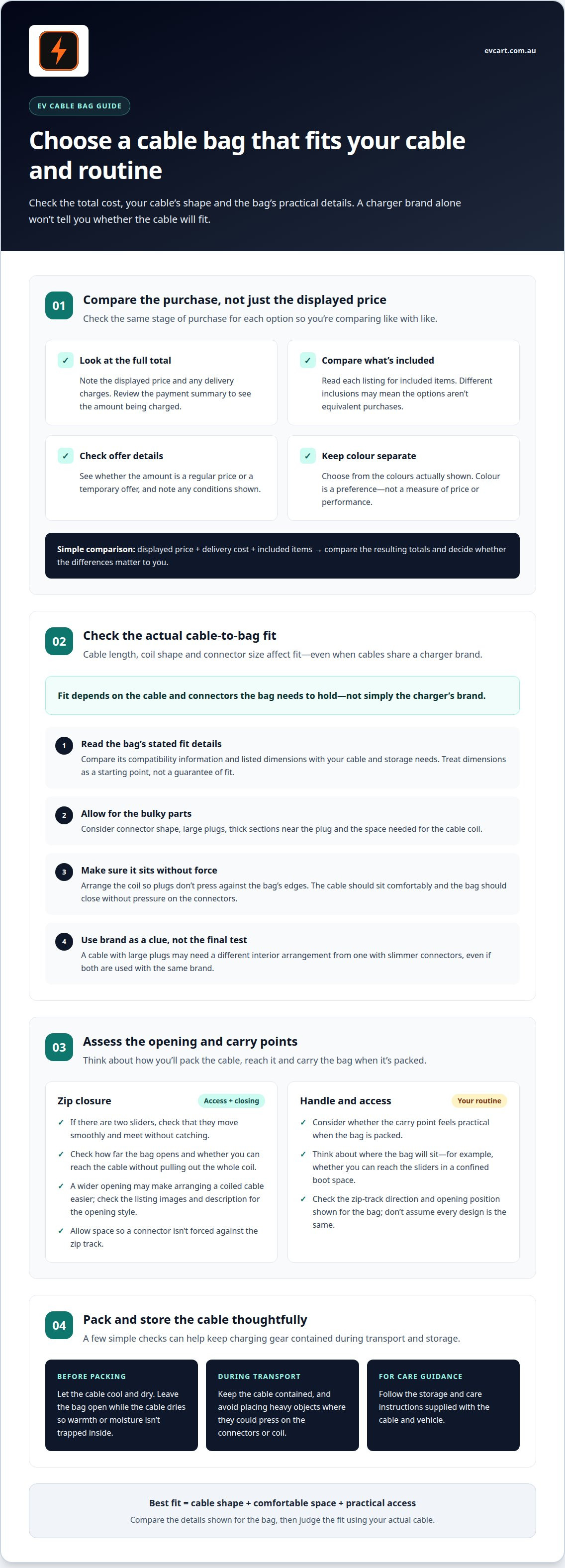
A bag’s compatibility depends on the cable and connectors it needs to hold, not simply the charger’s brand. Cables can differ in length, coil shape and plug size, even when used with the same brand. Compare your actual cable with the bag’s stated fit details.
Start by identifying the cable you’ll store. Check whether it has bulky connector ends, a thick section near the plug or a coil that takes up extra room. These details affect how easily the cable fits and whether the bag can close without pressure. A brand label alone won’t answer those fit questions.
Are there Australian safety rules or recommendations for storing EV charging cables? Follow the care and storage instructions supplied with the cable and vehicle. Keep the cable contained during transport, and avoid placing heavy objects where they could press on its connectors or coil.
Can an EV charging cable be stored while damp or warm? Let it cool and dry before packing it away to avoid trapping warmth or moisture inside the bag. Leave the bag open while the cable dries, then pack it for storage.
For a practical fit check, focus on these points:
- Read the bag’s stated compatibility details and compare them with your cable.
- Consider the connector shape and the space needed for the cable coil.
- Check that the cable sits without force and the bag closes without pressing on plugs.
- Keep the cable’s own care instructions in mind when storing it after use.
For example, a cable with large plugs may need a different interior arrangement from one with slimmer connectors, even if both are used with the same charger brand. Arrange the coil so the plugs don’t press against the bag’s edges. If the cable won’t sit comfortably, choose a bag with a more suitable shape.
Use brand as a starting clue, not the final fit test. The cable’s physical shape and the bag’s stated details are more useful for deciding whether they’ll work together. Compare those features before choosing, and follow the manufacturer’s care advice when storing the cable.
Drivers choosing among EV accessories can use the same practical approach: match the item to the equipment and routine it needs to support. A considered fit helps keep charging gear organised without relying on brand names alone.
Those measurements can help you compare another bag, but they don’t show by themselves whether a particular cable will fit. Allow room for its coil and connector ends, and check the bag’s shape and whether it can close without pressure.
Before choosing a bag from another charger brand, compare its listed dimensions with your cable’s shape and storage needs. If the listing doesn’t explain the interior layout, treat the measurements as a starting point, not a guarantee of fit. The cable should sit securely without its plugs being forced against the sides.
Dual-zipper closure and reinforced handle
Closure and handle design affect how a storage bag works in your routine. Consider how the opening gives you access and whether the carry point feels practical when the bag is packed.
Dual-zipper opening
If a bag has two zip sliders, check that they move smoothly along the track and meet without catching. Their position can affect how far the bag opens, so consider whether you can reach the cable without pulling out the entire coil.
Opening shape matters too. A wider opening may make it easier to arrange a coiled cable, while a narrower one may require more careful packing. Check the product description and images to understand the opening style. Don’t assume every bag has the same closure design.
Consider where you’ll use the bag. If it sits in a confined boot space, an opening that gives access from a convenient side may be useful. Check how the zip track runs and whether you can easily reach the sliders in that position.
When assessing a closure, consider how the cable will sit beneath it. A connector pressing against the zip can make the bag awkward to close. Allow room for the cable and plugs to lie without being forced against the track. The opening should suit the way you pack, not require you to compress the contents.
Reinforced carry handle
If a bag has a reinforced handle, inspect how it attaches to the body. Look for secure stitching or extra material at the joins, where lifting puts stress on the fabric. The handle should be positioned so you can grip it without the packed bag twisting uncomfortably.
Think about the route between your vehicle and the place you charge. An easy-to-grip handle can make a packed bag more manageable to carry. Consider its width, position and clearance from the closure, particularly if you’ll often lift the bag from a low boot.
A sturdy-looking handle doesn’t make a bag suitable for every load. Pack the cable evenly, then lift gently and notice whether the handle or seams pull. Avoid overfilling the bag or carrying it by the zip, as either can strain parts not intended for lifting.
Assess the closure and handle together. A useful opening should let you pack and retrieve the cable without catching it, while a practical handle should make the closed bag easier to move. Compare these details with your usual storage spot and carrying routine, then choose a design that feels straightforward to use.
Oxford cloth construction
Material labels help you compare cable bags, but they don’t describe every construction detail. One listed portable bag uses 600 Denier polyester fabric; another is described as 600D Oxford cloth and measures 32 × 32 × 10 cm. Read each description carefully, as those details belong to different bag listings.
“600D” and “600 Denier” are fabric descriptors, not complete measures of a bag’s suitability. The label alone doesn’t tell you the bag’s internal dimensions, seam finish or padding. For example, the 600D Oxford cloth listing gives its external dimensions, while the separate polyester listing identifies its fabric. Compare the full description rather than treating the terms as interchangeable product specifications.
Oxford cloth identifies a fabric construction, while polyester identifies a fibre type. Product descriptions may use one term, the other, or both. A 600D Oxford cloth bag and a 600 Denier polyester bag therefore shouldn’t be assumed to share identical construction. Look for the exact wording and any other details given for the particular bag.
Use a practical inspection sequence when assessing fabric construction. First, review the material description. Next, check whether the stated dimensions suit your cable. Then examine product images for visible seams, edges and stress points. These checks help you assess the available information without assuming a fabric label guarantees a particular level of protection.
For a 32 × 32 × 10 cm option, the depth may matter as much as its width and length. A cable that coils broadly may need more room across the bag, while bulky connectors can use up internal space. Dimensions are a guide to the bag’s overall size, not proof that every cable will fit neatly inside.
Choose a material that suits how you store the bag. One kept in the boot may be handled differently from one you carry in and out regularly. Consider the fabric description alongside the closure, handle and interior design. Each feature affects a different part of use, so don’t rely on “Oxford cloth” alone to judge the whole bag.
Keep the fabric in good condition with simple care. Remove loose dirt with a soft, dry cloth, then let the bag air before storing it. Avoid scrubbing or applying cleaners unless the care instructions allow them. If something spills, clean it promptly and follow the product’s care guidance.
For a sound comparison, record the exact fabric wording and dimensions from each listing. For example, note “600D Oxford cloth” beside “32 × 32 × 10 cm”, then compare those details with other stated materials and sizes. This keeps the decision grounded in the product description, not assumptions about what a fabric label means.
Padded interior and protection from knocks
A padded lining can buffer a coiled cable from nearby items. Before choosing a bag, look at the lining, seams and available space.
Padded inner lining
Check the lining across the base, sides and lid, rather than judging the padding from one visible panel. A padded base, for example, may cushion contact with the boot floor, while an unlined side leaves the cable closer to surrounding objects.
Also consider how the lining sits around the connectors. A plug resting against a hard edge may still take knocks, even inside a padded bag. Look for padding over the areas likely to make contact, and don’t assume a soft interior prevents every kind of damage.
Safe cable storage and transport
Store the cable in a stable position, with its coil contained and connectors kept away from sharp or heavy items. Secure the bag during transport so it cannot slide around the boot when the vehicle moves.
For example, place the bag beside other soft luggage rather than beneath a heavy toolbox. Keep the cable in its natural coil shape, and avoid tight bends or forceful packing that could strain the cable or connectors.
Padding is a buffer, not a substitute for careful handling. A bag can reduce direct contact with loose items, but a dropped connector or a heavy object pressing down may still cause damage. Check the cable and plug before use if the bag has been crushed or struck.
Use this packing sequence each time:
- Coil the cable without pulling it tight or twisting the connectors.
- Place the coil flat, with plugs positioned away from the zip and bag edges.
- Close the bag without forcing the closure over a protruding connector.
- Set the packed bag in a stable spot, clear of heavy or sharp gear.
For example, a connector wedged between the cable coil and the bag wall can come under pressure when other luggage shifts. Reposition it before closing the bag. If the cable doesn’t sit comfortably, choose a roomier design rather than compressing the coil.
Inspect the lining after regular use. Look for torn fabric, flattened padding or exposed seams, especially around the base and corners. These areas meet the boot floor and nearby objects during loading. A quick visual check can help you spot wear before your next trip.
For an organised setup, pair suitable cable storage with other EV accessories. Choose a bag that contains the coil without pressure, then secure it in the vehicle before travelling.
The bag is designed to fasten inside an electric vehicle’s boot, keeping cables in place during transit and preserving boot space.
EV Cart Australia
EV Cart Australia offers EV accessories to support practical ownership, including products for organising charging gear during storage and transport. Use the points in this guide to narrow your choice: match the bag’s capacity to your cable, then consider its material, lining, closure and handle.
If you’re choosing accessories to organise your EV setup, focus on features that suit your vehicle and routine. Contact EV Cart Australia to discuss your EV accessory needs.
Make cable storage part of your EV routine
Choose an EV charger cable bag that fits the way you use your vehicle, not just how it looks on a shelf. A practical storage choice can help keep charging equipment together and ready for your next trip. Consider where the bag will stay between charges and how you’ll access it when plans change.
Use your usual routine as the final test. If you often move the cable between home, work and the car, easy handling matters. If it stays in the boot, consider how it sits alongside your regular gear. The right choice suits your setup without adding unnecessary fuss.
Ready to take the next step? Contact EV Cart Australia about cable bags and find a practical way to organise your charging gear. A considered choice can make everyday EV ownership simpler.
Frequently Asked Questions
How much do EV charger cable bags cost in Australia?
Prices vary between listings, so compare materials, dimensions and included features rather than judging by price alone. Compare bags designed for similar cable lengths and storage needs, and check whether the listing clearly describes the fabric, closure and carrying design. These details help you understand the differences without assuming a higher price means a better fit.
Which brands and retailers sell EV charger cable bags in Australia?
Australian EV accessory retailers sell cable storage options, but listings may describe fit by cable length rather than charger brand. For example, product descriptions in the market include bags for cables up to 7 metres, 7.5 m and 10 m. Treat these as separate capacity claims, not evidence of a specific brand match. Compare the actual cable and bag details before choosing.
What features should you compare when choosing an EV charger cable bag?
Start with the cable and how you’ll use the bag. Decide whether it will stay in the boot or travel between locations, then prioritise features that support that routine. Check how the bag closes when packed, whether its handle is comfortable to grip and whether the interior accommodates connector ends without forcing them against the sides.
What types of EV charger cable bags are available in Australia?
Listed options include a 600 Denier polyester bag, a 600D Oxford cloth bag, and a 1680D nylon bag, in different shapes and sizes. One option is a black circular case with a clam shell zip opening.
What size bag fits a portable EV charging cable and accessories?
Match the bag to the cable’s length, connector size and coil. The Portable EV Cable Bag is listed for cables up to 7 metres, while another portable bag is described as suitable for a 10 m cable; a 40 × 13 cm bag is listed for cables and accessories.
Are EV charger cable bags compatible with Type 2 and Type 1 charging cables?
Compatibility depends on the cable’s length, connector shape and coil size, not just its type or brand. Compare your cable with the bag’s stated fit details, and check that it sits comfortably and the bag closes without pressing on the connectors.