
EV charger options for solar owners: compare costs and charging
2026-11-16

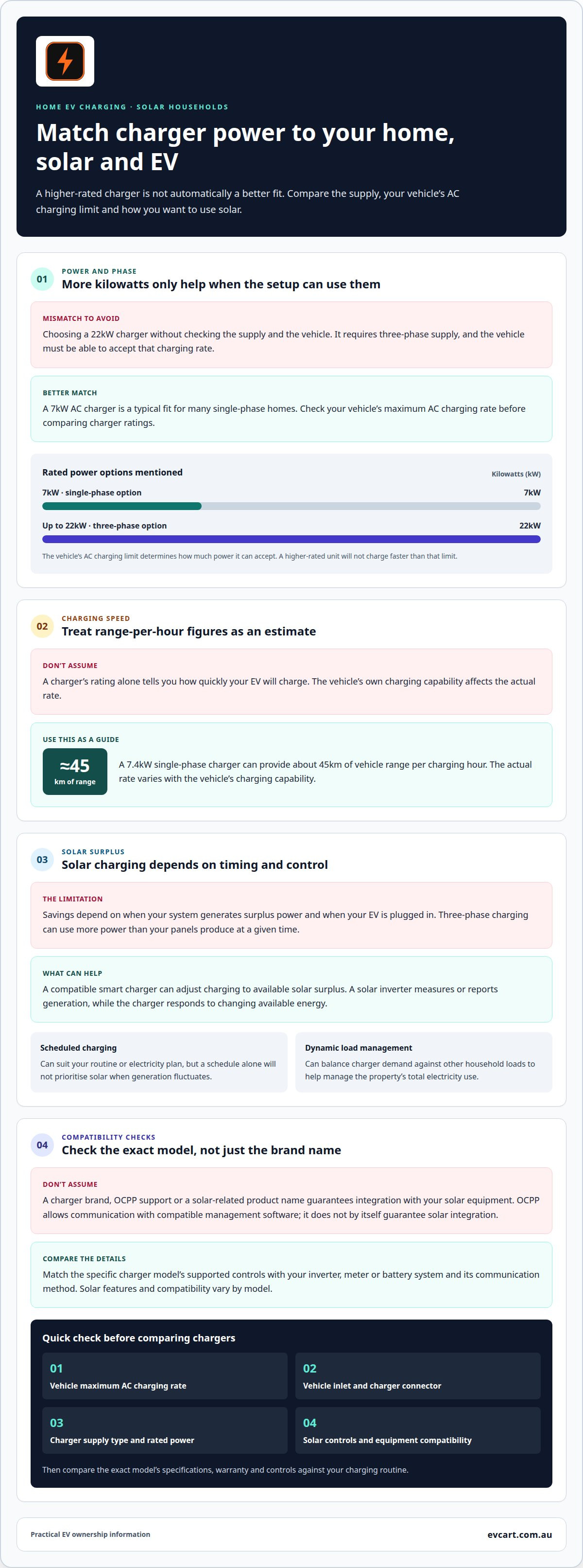
A faster EV charger isn’t automatically the best match for a solar home. For many households, the best EV charger for solar owners in Australia is a 7kW AC charger, a typical fit for most single-phase homes. A 22kW three-phase charger requires three-phase supply, and the vehicle must be able to accept that charging rate.
Solar owners want to make practical use of rooftop generation, but a charger’s rated output is only one part of the decision. Charging phases, solar surplus and vehicle compatibility all affect which option suits your home and driving routine.
This guide compares home charging options and explains how solar charging works alongside grid power. Learn what to weigh when comparing charger features, compatibility and charging speed, so you can narrow down an option that suits your needs.
Key Takeaways
- Choose a charger to suit your solar generation and charging routine. Smart charging features can help use surplus solar when it’s available.
- Check that the charger is compatible with your EV and suits your charging needs before choosing the hardware.
- A 7kW single-phase charger suits many homes, while a 22kW charger needs three-phase supply and a vehicle that can accept that rate.
- Solar charging savings depend on when your system generates surplus power and when your EV is plugged in.
- Check your EV’s charging capability and the charger’s supply type when comparing home charger options.
Table of Contents
Is solar EV charging cheaper than petrol?
Often, yes, when your EV charges using surplus solar energy. Actual savings depend on your electricity tariff, solar generation and driving habits.
Smart charging can direct surplus generation into your car instead of exporting it. A solar inverter measures or reports generation, while a compatible smart charger adjusts charging as available energy changes. Dynamic load management can also balance charger demand against other household loads, helping manage the property’s total electricity use.
OCPP, or Open Charge Point Protocol, allows communication between a charger and compatible management software. It doesn’t by itself guarantee solar integration. Check the exact charger model’s supported controls and whether it works with your solar inverter, meter or battery system. Scheduled charging can suit your routine or electricity plan, but a schedule alone won’t prioritise solar when generation fluctuates.
How do Zappi, Fronius Wattpilot, Tesla Wall Connector, Ocular and Wallbox compare for solar charging? Compare each model’s solar-surplus controls, inverter or meter compatibility, OCPP support and load management. These features vary by model, so a brand name alone doesn’t show which charger will integrate best.
| Option | Solar control | Integration to compare | Useful consideration |
|---|---|---|---|
| Zappi | Check the exact model’s solar modes | Inverter, meter and battery compatibility | How it responds to changing surplus |
| Fronius Wattpilot | Check available solar-priority settings | Compatibility with your solar equipment | Whether scheduled charging suits your routine |
| Tesla Wall Connector | Check solar-control options for the model | Meter or inverter integration | Load management requirements |
| Ocular | Check the model’s solar features | OCPP and system compatibility | Charging control options |
| Wallbox | Check solar-surplus functionality | Inverter, meter and battery integration | Dynamic load management support |
Which EV chargers work with Australian solar inverters, smart meters and batteries? Compatibility depends on the charger model and the equipment’s communication method. Before choosing, match the specific inverter, meter or battery with the charger’s supported integration.
In South Australia, consider Smarter Homes requirements separately from the charger’s solar-control features.
Prioritise surplus-solar controls and equipment compatibility, then compare scheduling and load-management features against your charging routine.
EV charger product comparison
Compare home EV charger products by their names and listed specifications. EV Cart’s listed chargers are hardware products, so check the product details to see which options suit your needs.
| Charger | Charger rating | Comparison point |
|---|---|---|
| FoxESS A-Series 7kW EV Charger | 7kW option | |
| MyEnergi Glo 7kW EV Charger | 7kW option | |
| FoxESS A-Series 22kW EV Charger | 22kW option | |
| FoxESS A-Series 22kW Solar EV Charger | 22kW solar-labelled option |
Check each charger’s specifications against your vehicle’s AC charging capability and the features you want. A higher-rated model isn’t automatically a better fit if your vehicle can’t use its full output.
Focus your comparison on details that affect daily use: the charger’s rated power, any solar features stated in its specifications, and whether its controls suit your routine. A product name may indicate the broad type of unit, but it doesn’t replace checking the full specifications.
For a straightforward comparison, shortlist chargers that match your vehicle and preferences. Then compare their listed specifications side by side, including any features that matter for your routine.
Accessories are a separate part of EV ownership. Explore EV accessories for your vehicle alongside your charger research, and use the charger specifications to guide your comparison.
Single-phase and three-phase charging
For home EV charging, match the charger’s phase and power to your vehicle’s charging limits, connector and daily routine.
Before choosing, check your vehicle’s maximum AC charging rate and connector, and compare these with the charger’s specifications. A higher-rated unit won’t charge faster than your vehicle can accept, and available solar surplus depends on panel generation.
Single-phase and three-phase speeds
A 7kW single-phase charger is a typical option for Australian EV owners. A 7.4kW single-phase charger can provide about 45km of vehicle range per charging hour, while the actual rate varies with the vehicle’s charging capability.
A 22kW three-phase charger can charge at up to 22kW if the vehicle accepts that rate. That higher output can shorten charging time, but it may be an expensive choice if the car accepts less or the household doesn’t need rapid home charging.
Three-phase charging can use more power than your panels produce at a given time. A compatible smart charger can adjust charging to available surplus, with the benefit depending on its solar controls and your home’s generation.
Charging power and phase options
Phase describes the charger’s power configuration; kilowatts describe its rated power. Single-phase chargers are commonly rated at 7.4kW, while three-phase chargers can be rated up to 22kW. The vehicle’s AC charging limit determines how much power it can accept.
Compare the charger rating with the car’s onboard AC charger instead of choosing a premium unit by headline power alone. Check the connector against the vehicle’s inlet, then compare the exact model’s warranty and solar controls.
For a household with a vehicle that accepts single-phase charging, a 7kW charger may provide ample overnight charging.
Check the charger’s specifications against your vehicle’s AC charging limit and connector. The selected charging power should suit your vehicle’s capabilities and charging routine.
Use this comparison to narrow your options: choose single-phase if its charging rate suits your vehicle and routine; consider three-phase if your vehicle can use the higher rate. Solar owners should also consider whether the charger can use available surplus, not just its maximum power.
Can I save on EV Charging Costs with solar?
Yes, charging from rooftop solar can reduce the energy cost of driving, especially when your EV charges during surplus generation. Savings depend on how much solar power your household can use directly instead of exporting.
Solar self-consumption savings
Self-consumption means using solar electricity at home rather than sending it to the grid. The comparison changes if your car charges after sunset, when solar output has fallen and the home draws power from the grid.
A solar-aware home EV charger can direct surplus energy to the vehicle when it’s plugged in. Charging during midday generation can raise self-consumption, while a home battery can store some solar power for later. A 10-13kWh battery is one example of storage for evening EV charging, although actual suitability depends on household use.
Potential savings and payback
For 15,000km of annual driving, estimates put solar owners’ potential savings at A$600 to A$900 yearly when surplus exports are diverted into an EV.
A separate estimate suggests a smart charger with a modest solar or battery top-up may pay back within two to four years through fuel savings alone. Treat this as an estimate, not a guaranteed return: annual kilometres, charging times, petrol use and the share of solar energy used all affect the result.
Solar system size and surplus power
What solar system size and surplus power are needed to charge an EV at home? An 8-10kW solar system is recommended for many Australian EV owners, but there’s no single surplus level that suits every home. EV energy use is roughly 14-18kWh per 100km, depending on the vehicle, driving style and climate.
Driving 15,000km annually uses about 2,100-2,700kWh of EV electricity. A 6.6kW system may produce closer to 5-5.5kW on a hot summer afternoon, so its available output can vary with conditions and household demand. A 7kW charger may draw more power than the solar system’s surplus at that time.
Match charging to your solar system’s actual output. Solar integration lets a compatible charger adjust to available surplus, while grid power can supplement charging when the sun isn’t providing enough. If you mostly charge in the evening, a battery or scheduled grid charging changes the cost comparison. What matters is how much of your EV’s energy can come from solar during your normal routine, not just the panels’ rated capacity.
Charger features and vehicle compatibility
Vehicle compatibility matters when choosing a home charger. A charger’s specifications describe its features and potential charging power, while your car’s charging capability affects what it can use. Keep the comparison focused on your vehicle, the charger’s features and your charging routine.
A charger’s rated output describes its potential charging power, not what every vehicle will use. The vehicle’s charging capability also affects the rate. A higher-rated model may offer little advantage if your car can’t accept that power or your usual routine doesn’t need it.
Solar owners have another consideration: household electricity is used for more than EV charging. Depending on its features and settings, a charger may draw from solar generation, grid electricity or both. Compare the charger’s solar controls with how your household uses and generates electricity, rather than treating them as a measure of vehicle compatibility.
Use these distinctions to keep the comparison focused:
- Vehicle: compare charger output with the car’s AC charging capability.
- Charger features: compare the controls and charging options offered by each model.
- Daily routine: assess whether your normal charging window suits the rate you’re considering.
- Solar use: compare the charger’s solar controls with how your household uses and generates electricity.
- Product details: check charger specifications against your vehicle and intended use.
Dynamic load management can adjust charging in response to household demand. It helps coordinate charging with other electrical use, but doesn’t change the vehicle’s charging limit or create more solar generation. Its value depends on whether the feature suits the equipment and charging routine you plan to use.
For a practical decision, shortlist chargers by vehicle compatibility, preferred charging controls and intended routine. Treat the maximum rating as one specification to compare, not the sole reason to choose a model. This keeps the comparison focused on what your vehicle can use and how you plan to charge.
EV Cart Australia
EV Cart Australia makes everyday EV ownership more practical with vehicle-specific accessories. After comparing charging speed, solar use and switchboard capacity, consider which accessories suit your vehicle and routine. Check compatibility details before choosing, especially when your model or connector type affects fit.
Charger selection and electrical installation are separate decisions. Use this guide to narrow your home-charging requirements, then consider EV accessories for the practical details of owning and using your vehicle.
For help with EV accessories, contact EV Cart Australia.
Make your next EV decision with confidence
Choosing the best EV charger for solar owners in Australia is one part of planning a practical EV setup. Your needs may change as your driving routine or vehicle changes, so keep a simple record of your vehicle model, charging connector and accessories. This makes future compatibility decisions easier and helps you focus on products that suit your car and daily use.
EV Cart Australia offers EV accessories for Australian EV owners. Consider accessories in light of your vehicle’s requirements, rather than choosing by appearance or broad category alone. Check product details against your model and intended use before deciding.
For assistance with EV accessories, contact EV Cart Australia. Take the next step at your own pace, with your vehicle details and priorities in hand.
Frequently Asked Questions
What is the best 7kW EV charger?
The best option depends on your vehicle and preferred charging features. EV Cart lists the FoxESS A-Series 7kW EV Charger and MyEnergi Glo 7kW EV Charger. Compare their product specifications with your car’s AC charging capability and connector. Check the model details before choosing, especially if you want particular solar controls. A charger’s 7kW rating alone doesn’t determine whether it’s the right match for your vehicle.
Can I charge my EV directly from solar panels?
Solar panels can supply electricity for EV charging through your home’s energy system, but you don’t connect the car directly to the panels. The charger manages the power delivered to the vehicle. Depending on its features and settings, charging may use solar generation, grid electricity or both. Available solar energy changes with generation and household use, so charging results can vary throughout the day.
What is the best home EV charger in Australia in 2026?
There’s no single model that suits every vehicle and household. EV Cart lists FoxESS A-Series chargers at 7kW and 22kW, a FoxESS A-Series 22kW Solar EV Charger, and the MyEnergi Glo 7kW EV Charger. Use the vehicle’s AC charging limit and your preferred charging features to narrow the options. Compare the full product specifications, rather than choosing solely by the charger’s rated power.
Do I need a home battery to charge my EV with solar?
No, a home battery isn’t required. An EV can use solar electricity while the panels are generating, depending on the charger’s features and available output. A battery stores electricity for later use, which may suit households whose vehicle is usually at home after solar generation falls. Consider your parking and charging routine alongside other household energy use before deciding whether storage would be useful.
Is a home EV charger suitable if I already have solar?
A dedicated home charger may suit you if it works with your vehicle and makes charging more convenient. Solar can contribute when the car is at home during generation, while charging at other times may draw from the grid. Consider when your vehicle is parked, which charging controls matter to you and how your household uses solar. These practical details help determine whether a dedicated charger fits your routine.
What are the best EV chargers for solar owners in Australia in 2026?
EV Cart lists the FoxESS A-Series 22kW Solar EV Charger as a solar-labelled option, alongside other FoxESS and MyEnergi home charger models. Compare each model’s specifications with your vehicle and solar equipment. Look for product details that match the solar controls you want, and don’t assume that a model’s name alone describes every supported feature. Vehicle compatibility and charging needs should guide the final comparison.
Which Australian EV chargers offer solar surplus charging and dynamic load management?
Those functions depend on the individual charger model and its documented features. EV Cart lists the FoxESS A-Series 22kW Solar EV Charger, but the product name alone doesn’t establish whether it offers every solar-surplus or load-management function. Compare the specifications for the exact model you’re considering. Also consider whether its controls suit your solar equipment and household charging pattern, rather than relying on a general brand-level assumption.
What does a solar-compatible home EV charger cost in Australia?
That listed amount is for charger hardware, not a complete home charging setup. Product specifications can help you compare this option with other listed models, including the 7kW chargers. Match the charger’s rated power and features to your vehicle and intended use before deciding which hardware best suits your needs.