
EV Charger Wall Brackets and Mounts for Australian Homes
2026-11-03

A wall bracket is the practical choice when there’s a suitable wall near your home charging spot; a pedestal can work where there isn’t. Choose an EV charger wall bracket to suit the charger or cable it will hold and the available mounting surface. Type 2 AC and CCS2 DC charging standards are widely adopted in Australia, but the mount itself doesn’t determine whether a charger suits your vehicle.
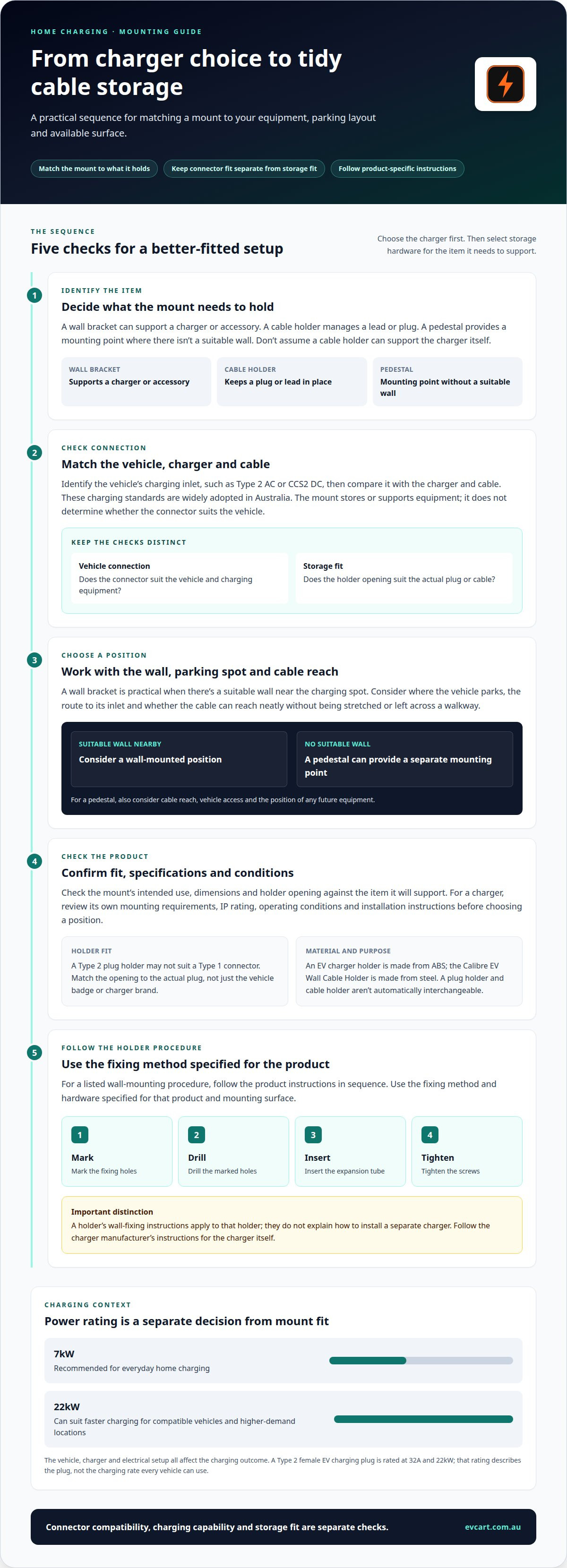
Choose the charger first, then select a mount that keeps its cable tidy and easy to reach. The right setup depends on what you need to store, where you park and how the charging area is arranged.
This guide explains how to compare wall brackets, cable holders and pedestals, what to consider for different home layouts, and how Australian charging requirements relate to your choice. You’ll also learn which product specifications to check so you can choose accessories that suit your charging equipment and routine.
Key Takeaways
- Match the mount to what it needs to hold, the available surface and your parking layout.
- Type 2 AC and CCS2 DC are widely adopted in Australia; check that the cable and charging equipment suit your vehicle.
- Choose between a wall mount and a pedestal based on where you can position the charger and manage the cable.
- Check the charger or accessory’s specifications, including its installation requirements and operating conditions, before mounting it.
- Explore EV Cart Australia’s EV accessories when you’re choosing practical additions for your home charging setup.
Table of Contents
- Compatibility with Australian EV charging standards
- EV charger stands, pedestals and mounting solutions
- Wall-mounted versus freestanding charger installations
- Which wall brackets are compatible with popular EV chargers in Australia?
- What are the risks of using an incompatible or poorly installed EV charger bracket?
- EV Cart Australia: EV accessories
Compatibility with Australian EV charging standards
Type 2 AC and CCS2 DC charging standards are widely adopted for electric vehicles in Australia. A mount stores or supports charging equipment, but doesn’t determine whether its connector suits your vehicle.
Separate the vehicle connection from the storage hardware. Type 2 and CCS2 describe charging connector standards, while a bracket or holder supports a charger, cable or plug. A Type 2 female EV charging plug is rated at 32A and 22kW. That rating describes the plug, not the charging rate every vehicle can use.
Power also affects the equipment choice. A 7kW charger is recommended for everyday home charging, while a 22kW charger can suit faster charging for compatible vehicles and higher-demand locations. The vehicle, charger and electrical setup all affect the charging outcome. Choose a cable with specifications suited to both the vehicle and charging equipment, then select a holder that fits its connector and cable.
Vehicle compatibility
Start with the charging inlet on your vehicle and identify its connector standard, such as Type 2 AC or CCS2 DC. Then compare it with the charger and cable you plan to use. For example, a Type 2 holder won’t store a differently shaped connector securely just because both accessories are used for EV charging. Keep connector fit and charging capability as separate checks.
Wall chargers and portable chargers also differ in how their equipment is stored. A wall-mounted charger stays at the charging point, while a portable charger can be packed away or carried between locations. Match the holder to the item it supports: a plug cradle holds a connector, while a cable holder manages coiled cable. Neither changes a charger’s connector standard or power rating.
Bracket fit for popular chargers
There isn’t one universal bracket fit for every charger sold in Australia. Check the specific charger or accessory’s mounting requirements, dimensions and intended use before choosing a wall mount. A holder designed for a Type 2 plug, for example, may not suit a Type 1 connector. Match the holder opening to the actual plug, not simply the vehicle badge or charger brand.
Use this sequence: identify the vehicle connector, confirm that the cable and charger match it, then check whether the mount suits the item it will hold. Review the charger’s installation requirements and operating conditions too. This keeps connector compatibility, charging performance and storage fit as distinct considerations.
EV charger stands, pedestals and mounting solutions
A wall bracket, cable holder and pedestal have different functions. A bracket can support a charger or accessory on a suitable wall, while a cable holder keeps a plug or lead in place. A pedestal provides a mounting point where there’s no suitable wall. Choose according to what needs support and where the vehicle parks.
Start with the mounting surface and the charger’s instructions. A wall installation needs a position that suits the unit, cable route and vehicle inlet. A pedestal can provide a separate mounting point in an open parking area, but its position must still suit the cable’s reach and keep access clear. Don’t assume a cable holder can support the charger itself.
Material and purpose matter. An EV charger holder is made from ABS, while the Calibre EV Wall Cable Holder is made from steel. These examples show why the product description matters: a plug holder and a cable holder aren’t automatically interchangeable. Compare the intended use and connector shape with the item you need to store.
Wall-mounted charger features vary by model. Check the specific unit’s dimensions, IP rating, operating conditions and installation requirements before choosing its position or mount. The cable outlet and vehicle inlet also affect whether the lead can reach neatly without being stretched or left across a walkway. Follow the manufacturer’s instructions for the charger itself.
DC fast-charging equipment requires more site planning than a simple cable holder. When planning a multi-charger location, consider charger placement, available electrical capacity, load management and possible future expansion. Commercial and permanently connected charging equipment should be installed and commissioned by appropriately qualified and licensed professionals, in line with applicable requirements and manufacturer instructions. A pedestal provides a mounting point, but doesn’t replace these requirements.
For a listed wall-mounting procedure, follow the steps carefully: mark the fixing holes, drill them, insert the expansion tube, then tighten the screws. Use the fixing method and hardware specified for the product and mounting surface. A holder’s wall-fixing instructions don’t explain how to install a separate charger.
Before choosing, separate the decisions:
- Identify whether the mount supports the charger, cable or plug.
- Compare the holder opening with the connector it needs to hold.
- Check the charger’s own mounting and operating instructions.
- Plan pedestal position around cable reach, vehicle access and future equipment.
This approach keeps accessory selection separate from charger installation. It also helps prevent choosing a plug cradle, cable holder or pedestal for a job it wasn’t designed to do.
Wall-mounted versus freestanding charger installations
A wall bracket supports a charger or accessory, a cable holster stores a plug or lead, and a pedestal provides a separate mounting point. Choose between wall-mounted and freestanding positions by considering the parking layout, cable reach and charger installation requirements.
Outdoor conditions and product ratings
For an outdoor position, check the specific charger’s IP rating, operating conditions and installation requirements before deciding where to place it. These details apply to the charger or accessory itself, not automatically to a separate bracket or holster. Match each item’s specifications to its location and follow the manufacturer’s instructions for the equipment being mounted.
A covered carport and an exposed driveway have different conditions. Review the product information for the intended location, then plan a cable route that reaches the vehicle without crossing a regular access path. Don’t assume a bracket’s material or appearance means it’s suitable for outdoor use.
Installation location and support
Start with the vehicle’s usual parking position. A wall-mounted charger needs a suitable wall within practical cable reach, while a freestanding unit can suit a parking space without a nearby wall. Before choosing a support, check the proposed position against the charger’s mounting instructions and operating conditions.
Installation requirements depend on the equipment and project. In Australia, commercial and permanently connected EV charging equipment should be installed and commissioned by appropriately qualified and licensed professionals, in line with applicable requirements and manufacturer instructions. A mount or pedestal provides physical support; it doesn’t replace professional installation or commissioning.
Bracket, holster and pedestal differences
Choose a wall bracket when an item needs wall support, and a cable holster when the main task is storing a plug or lead. A pedestal provides an independent mounting point where there’s no suitable wall. These accessories serve different purposes, so match the product’s stated use to the item you plan to hold.
For example, a holster can keep a charging plug off the ground, while a pedestal can position a charger beside a parking bay. Neither automatically manages the cable. Consider where the cable will rest between charging sessions and whether the setup keeps the connector accessible without obstructing movement.
Risks of incompatible or poor installation
A poorly matched holder may not secure the connector it’s meant to store. If the opening doesn’t match the plug, the cable may sit awkwardly or be harder to handle. A mount installed against its instructions may not support the intended item as designed. Check compatibility and fixing requirements before installation.
Position matters too. A cable routed across a walkway can obstruct access, while a poorly placed pedestal can interfere with parking. For permanently connected equipment, follow the manufacturer’s installation requirements and use appropriately qualified and licensed professionals for installation and commissioning.
Before choosing a position, compare the charger’s specifications, the mounting surface and the vehicle’s parking spot. Then select a bracket, holster or pedestal for its stated purpose. This keeps the accessory decision separate from the charger’s installation requirements.
Which wall brackets are compatible with popular EV chargers in Australia?
No single EV charger wall bracket fits every charger or connector. Compatibility depends on what the mount supports, the connector shape, the charger’s mounting points and the installation instructions for that model. Start with the charger’s make and model, then decide whether you need to mount the unit or store its cable and plug.
Keep charger support separate from cable storage. Some charging units have their own mounting arrangement, while a cable holder or plug holster stores accessories beside the charging point. A holder’s connector opening doesn’t mean it can support a charger’s weight. Match the mount’s intended use to the item it will carry.
Connector type gives you a practical starting point. EV charger holders are offered in American Standard (Type 1) and European standard (Type 2) options. Match the holder to the physical plug rather than relying only on the vehicle name. For example, choose a Type 2 holder for a Type 2 plug, then check that the holder’s shape and dimensions suit the connector.
Use this comparison before selecting a mount:
- Charger model: Find its mounting instructions and fixing points.
- Item being stored: Separate a charger housing from a charging plug or cable.
- Connector: Match the opening to Type 1 or Type 2 as applicable.
- Mounting surface: Check the fixing method against the intended wall or support.
- Use and position: Plan cable access without placing strain on the plug.
Material can help identify a product’s intended role, but it doesn’t prove universal fit. An EV charger holder made from ABS and the Calibre EV Wall Cable Holder made from steel illustrate different holder designs. Compare each product’s stated use and dimensions with the accessory you want to store. Don’t infer charger compatibility from material alone.
Check the specific charger or accessory’s installation requirements and operating conditions before fitting a mount. For an outdoor location, review its IP rating and the manufacturer’s instructions. These details apply to the named product, not automatically to a separate bracket. A charger mounting plate and a cable holster are different components, even when installed beside each other.
For a clean match, identify the connector, confirm whether the mount holds the charger or an accessory, and compare the product’s dimensions and fixing instructions. That process narrows the choice without assuming a bracket suits every popular charger. A Type 2 plug holder, for instance, is a storage accessory, not a universal charger mounting plate.
What are the risks of using an incompatible or poorly installed EV charger bracket?
A mismatched bracket can leave a plug loose, a cable unsupported or a charger poorly secured. The risks depend on the item, its instructions and the mounting surface. Treat a charging unit, plug holder and cable holster as separate products with separate purposes.
Start by identifying what the bracket must hold. A Type 2 plug holder, for example, is designed for storing a matching plug, not automatically supporting a charger housing. If the connector doesn’t sit correctly, it may be awkward to remove or return. A cable that hangs from the wrong point can also pull against its plug or rest across a walkway.
Fixing errors can cause different problems. Misaligned holes may prevent a holder from sitting flush, while unsuitable fixings may not secure it to the surface. Follow the product’s specified mounting method and hardware. For a listed wall mount, mark and drill the fixing holes, insert the expansion tube, then tighten the screws.
Before mounting, use this check sequence:
- Identify whether the product supports a charger, cable or plug.
- Compare the holder opening with the actual connector shape.
- Read the product’s fixing instructions and check the mounting surface.
- Position the cable so it reaches the vehicle without crossing accessways.
- Review the charger’s own installation requirements separately.
Position matters in a garage or driveway. A cable crossing the path from a door to the car can create a trip hazard. A holster placed out of easy reach can make it harder to store the plug neatly. Mark the proposed position, then consider the parked vehicle, cable route and access to the charging inlet before drilling.
Outdoor placement adds another compatibility check. Review the specific charger or accessory’s IP rating, operating conditions and installation requirements. Don’t assume a bracket shares the charger’s rating, even when they’re installed beside each other. A holder’s material or shape alone doesn’t establish its suitability for a particular location.
Permanently connected charging equipment should be installed and commissioned by appropriately qualified and licensed professionals, in line with applicable requirements and manufacturer instructions. Correctly fitting an accessory doesn’t confirm that the charger itself is installed correctly. Keep these decisions separate.
If a bracket shifts, sits unevenly or doesn’t hold its intended item, stop using that setup and reassess the product match and fixings. Don’t force a plug into a holder or stretch a cable to reach. Recheck the instructions, mounting surface and cable route before using the setup again.
EV Cart Australia: EV accessories
EV Cart Australia offers EV accessories to help organise and equip your charging setup. Explore its range when you’ve identified what you need to store or manage, such as a charging cable or plug. Match each accessory to your connector and intended use before choosing.
For a home setup, use the checks in this guide to distinguish a charger mount from a cable holder or plug holster. Then browse EV Cart Australia’s EV accessories for options that suit your needs. Accessories support your charging routine, but don’t replace charger installation or electrical work.
Visit evcart.com.au to explore EV accessories for your setup.
Make your charging space work for you
Before settling on a mount, picture your full charging routine, from parking the car to putting the cable away. That everyday movement can show whether the chosen position is practical or whether the EV charger wall bracket would work better elsewhere. A small adjustment can make the charging area easier to use without changing the charger.
Consider how the space might be used over time. A second vehicle, a different parking position or a new cable can change what works for your setup. Choose accessories for their specific purpose, and keep the charging space clear and easy to use.
For a next step focused on EV accessories, contact EV Cart Australia. Bring your setup requirements into the decision and choose your next accessory with confidence.
Frequently Asked Questions
What is an EV charger wall bracket and what does it support?
An EV charger wall bracket is a mounting accessory for charging equipment or related hardware. Before buying, read the product description to see whether it supports a charger unit, a plug or a cable. Check whether the required fixing hardware is included and whether the bracket is designed for your equipment. A bracket doesn’t change the charger’s connector or charging capability.
Can an EV charger be installed on a brick, concrete, or timber wall?
Yes, different surfaces can be suitable when the mounting method and fixings match the wall’s construction and condition. Solid brick and timber stud walls need different fixing approaches. Plasterboard alone may not provide adequate support for a charger unit. If the wall is cracked, loose or hollow, have its suitability assessed before mounting heavy equipment.
Does a licensed electrician need to install a wall bracket for an EV charger in Australia?
A bracket used only to store a cable or plug doesn’t make an electrical connection. Permanently connected charging equipment is different: in Australia, it should be installed and commissioned by appropriately qualified and licensed professionals, in line with applicable requirements and the manufacturer’s instructions. Keep accessory mounting separate from charger wiring. If the bracket is part of the charger’s mounting system, follow the charger’s installation requirements.
How do you choose the right height and location for a wall bracket?
Place the bracket where you can reach its controls and return the cable without twisting or dragging it. Check the charger’s cable outlet direction and the vehicle’s inlet position, then consider door swings, storage access and the space around the parking area. A quick layout test with the vehicle parked can reveal awkward reaches or blocked access before you secure the bracket.
How do you install an EV charger wall bracket safely?
Use the bracket manufacturer’s instructions and fixings specified for your wall type. Before drilling, identify concealed services and choose a location clear of wiring or plumbing. Keep the charger isolated from electrical work, and don’t alter its casing or mounting system to make a bracket fit. Permanently connected equipment should be installed and commissioned by appropriately qualified and licensed professionals.
Are outdoor-rated wall brackets available in Australia?
Outdoor-rated mounting products are available in Australia. Choose one whose stated use suits the exposure at your property, such as a sheltered carport or an uncovered driveway. Sun, rain and dust exposure can differ by location. A bracket’s rating applies to that product, so don’t assume it provides the same protection as the charger mounted nearby.
Where can you buy EV charger wall brackets in Australia?
Browse EV Cart Australia’s online store for EV accessories, then compare each listing’s intended use and fitment details with the hardware you need to mount or store. Read the product information before choosing, especially if your setup uses a particular plug shape or charger model. For product questions, contact EV Cart Australia through its website before ordering.