
EV Charger Weather Covers for Home Units Outdoors
2026-11-12

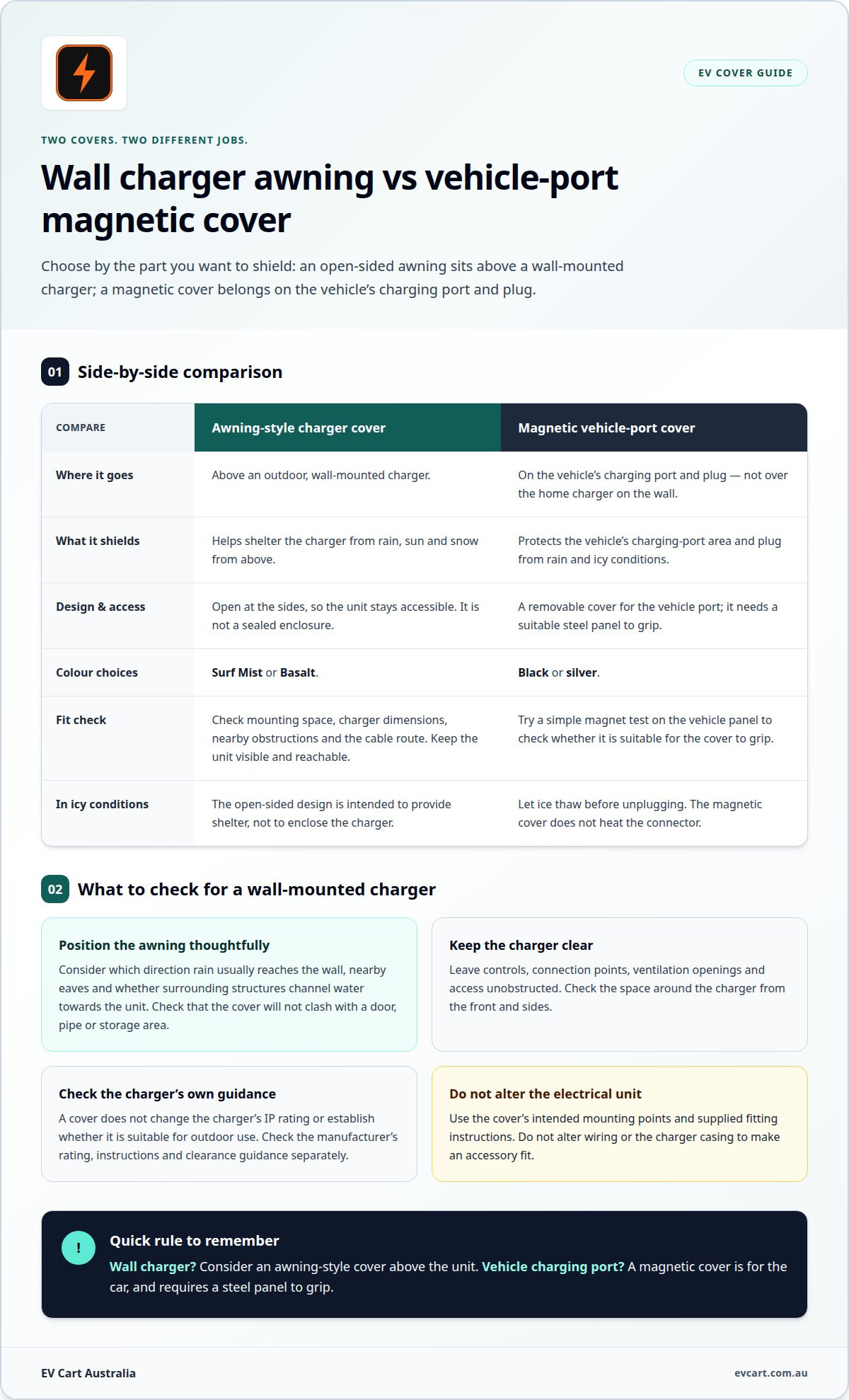
A small roof can be more practical than a sealed box for an outdoor home charger. An awning-style EV charger weather cover is open at the sides, helping shield the unit from rain, sun and snow while keeping it accessible. It isn’t fully enclosed, so its design and placement matter.
It’s easy to assume every magnetic cover is made for a wall-mounted charger. In fact, magnetic covers protect a vehicle’s charging port and plug, not the home charger itself. That distinction matters when choosing protection from rain or icy conditions.
This guide explains how awning-style covers and magnetic vehicle-port covers differ, what each can protect, and why ice calls for care. You’ll also learn about colour choices and practical fitting and removal, so you can work out which type suits your setup. We’ll focus on everyday-use details, including the limits of an open-sided cover and why a magnetic cover belongs on the car, not the wall.
Key Takeaways
- An awning-style cover shields an outdoor charger from rain and sun but leaves the sides open, so it isn’t a sealed enclosure.
- Separate covers suit different jobs: awning-style designs cover wall-mounted chargers, while magnetic covers protect a vehicle’s charging port and plug.
- Match the colour to your setup: awning-style options include Surf Mist and Basalt, while magnetic covers are available in black or silver.
- Magnetic covers need a steel panel to grip. A simple magnet test can help determine whether the vehicle’s panel is suitable.
- For icy conditions, let ice thaw before unplugging; the magnetic cover doesn’t heat the connector.
Table of Contents
Awning-style cover design
Awning-style covers and enclosed housings are two broad ways to protect an outdoor wall charger. The key design question is how the cover shelters the unit while preserving access.
Outdoor weather protection ratings
An awning-style cover sits above the charger, with open sides. Its position determines how much direct exposure it blocks. Consider the direction rain usually reaches the wall, nearby eaves, and whether surrounding structures channel water towards the unit.
A cover doesn’t change the charger’s IP rating or establish its suitability for outdoor use. Check the charger’s rating and outdoor-use instructions separately. A cover can’t make a charger suitable for conditions its manufacturer excludes.
Before choosing a design, compare the available mounting space with the charger’s dimensions and cable route. A projection that clashes with a nearby door, pipe or storage area may obstruct access. Position the cover so the unit stays visible and reachable without forcing the cable into a sharp bend.
An EV charger weather cover is a separate accessory, not an electrical enclosure or compliance certificate. Whether a setup meets applicable Australian requirements depends on the charger and its installation, not the cover’s appearance. Don’t alter wiring or the charger casing to make an accessory fit.
Charging with the cover in place
A cover above a charger shouldn’t interfere with the manufacturer’s instructions for use. Keep controls, connection points and ventilation openings unobstructed. With an open-sided design, check the space around the unit from the front and sides, not just from directly below.
Cooling and warranty terms depend on the charger. Avoid adding a wrap, box or other layer around the unit, as it may block openings or change how heat escapes. Follow the charger maker’s guidance on clearances and outdoor operation.
Before charging, make a simple visual check: confirm the cover is secure, the unit remains accessible, and the cable reaches the vehicle without rubbing against an edge. If the cover shifts, presses on the charger or blocks a vent, stop using that arrangement until it’s corrected.
In practice, an awning-style EV charger weather cover should shelter the unit from above without forming a barrier around it. Assess the wall, likely rain direction, cable path and access together. These details help determine whether the design suits the location, while the charger’s own specifications remain the guide to outdoor operation.
These covers have an open-sided awning design, rather than a fully enclosed housing, and are intended to shield the charger from rain, snow and sun exposure. Their stated purpose is shelter from these weather conditions, while the open form keeps the unit accessible.
Colour options
Choose a cover colour by considering the surface it will sit beside. For a wall-mounted unit, compare it with the wall, charger casing and nearby fittings. For a vehicle-port accessory, consider the paintwork and trim around the charging flap. This helps you judge whether the cover will blend in or stand out.
Check colours in daylight, not just under garage lighting. A finish can look different beside a pale rendered wall than beside dark brick or a shaded carport. If the cover will be outdoors, look at the area at different times of day, as changing light can alter the contrast with nearby surfaces.
Think about the overall look of the charging area. A close colour match can make an accessory less prominent, while a contrasting finish can make it easier to spot. Neither choice changes the cover’s purpose or suitability. Treat appearance as a preference, after confirming the cover type and fit.
Surface marks may be more visible against some colours than others. Consider the surroundings: a dusty driveway, leafy garden or frequently handled charging area can affect how noticeable dirt is. Follow the care instructions for the specific item rather than choosing a cleaning method based only on colour.
Use this quick comparison before deciding:
- For a wall unit: compare the cover with the wall, charger casing and nearby fixtures.
- For a vehicle accessory: compare it with the paint and trim around the charge-port flap.
- For a visible contrast: decide whether you want the cover to blend in or stand apart.
- For regular care: consider whether surface marks will be noticeable in your setting.
For example, a cover beside a light-coloured garage wall may blend in better in a similar tone. Against dark brick, a contrasting colour may be easier to see. On a vehicle, compare the accessory with both the body paint and the darker trim around the charge-port area.
Choose a colour only after confirming that the item is intended for the part of the setup you want to protect. A visual match doesn’t establish fitment, material or weather performance. Use the product details to assess those factors, then select a finish that suits your home or vehicle.
For practical additions beyond appearance, browse EV accessories for electric vehicle owners and choose options that suit your vehicle and routine.
Fitting and removing covers
Fitting depends on whether the cover is fixed above a charger or used around a vehicle’s charging port. Identify the cover type first, then follow its product instructions without altering the charger or vehicle.
Fitting the cover
For a fixed cover, follow the supplied fitting instructions and use the intended mounting points. Check its position against the charger, wall and cable route before securing it. Keep the charger’s controls and access points clear. If the instructions call for work beyond fitting the accessory, don’t improvise around the electrical unit.
For a removable vehicle-port cover, follow the product’s placement directions. Make sure the port area is clean and dry if the instructions require it. Align the cover as directed, and avoid forcing it against the charge-port flap or cable. Fitment depends on the vehicle and panel the cover is designed for.
Removing the cover
Remove a temporary cover according to its instructions, keeping the cable and connector supported. Don’t pull on the charging lead to free the cover. If the cover or connection is iced, allow the ice to thaw before unplugging; the cover doesn’t heat the connector.
Removing a fixed cover may involve its mounting hardware. Follow the product directions and avoid disturbing charger wiring or the unit’s casing. If removal requires electrical work, stop rather than trying to disconnect or reposition the charger yourself.
Keep the two processes separate. A wall-mounted cover stays in place as an accessory, while a vehicle-port cover is handled around charging sessions. Don’t, for example, apply instructions for a removable magnetic cover to a fixed wall accessory. Their attachment methods and surfaces differ.
Use this sequence to keep the task controlled:
- Identify the cover. Confirm whether it fits above a wall unit or around a vehicle port.
- Read the instructions. Use the directions supplied for that specific accessory.
- Clear the working area. Keep the cable, controls and charge-port flap unobstructed.
- Fit or remove gently. Don’t force the cover or pull on the charging lead.
- Stop if the task reaches wiring. Accessory fitting shouldn’t involve modifying electrical connections.
After fitting, check that the cover sits as directed and doesn’t interfere with normal access. After removing a temporary cover, store it as its care instructions specify. Check for visible damage before using it again, especially if it has been caught, bent or exposed to debris.
For a Tesla charge port, distinguish the single CCS dust cap from the silicone double cap before closing the door. The single CCS dust cap allows the charge-port door to close, but the silicone double cap must be removed first. Check the door after fitting a removable cover rather than assuming both cap designs sit the same way.
Allow for the stated handling times when planning the task. The product states that installation and removal each take under 10 seconds, while the page estimates that a cover can be installed in about 10-15 minutes. These are different stated timings, so follow the instructions for the particular cover and confirm that it is seated as directed before ending the check.
Magnetic cover for rain and ice
A magnetic cover shields a vehicle’s charging handle and inlet while charging outdoors. It’s intended to keep rain, sleet and road spray off the connection, not to protect a wall-mounted home charger. Its usefulness depends on suitable vehicle-panel material and correct placement around the port.
The cover is made from waterproof PVC, with welded seams and a UV-resistant coating. Dual embedded magnetic strips along its edges hold it against a steel panel. It won’t grip aluminium or composite panels, so the material beside the charging port matters more than the vehicle’s badge.
Before relying on the magnetic attachment, test the panel with a fridge magnet. A firm hold indicates the cover should stay in place; a weak or absent grip means the panel isn’t suitable. Position the cover around the charging connection, with the cable and handle seated as intended.
The cover is described as providing 360° weatherproof protection against rain, dust, insects and UV exposure. That description applies to the covered charging-port area. It doesn’t mean the cover makes the vehicle or charger floodproof, nor does it promise protection during every storm condition.
Can a weather cover protect an EV charger from flooding or severe storms? No. A magnetic cover shields a vehicle’s charging port from rain, sleet and road spray, not flooding or severe storms. It isn’t a substitute for suitable charger placement or the charger’s own outdoor protection.
Cold weather calls for a separate precaution. The cover is described as flexible and resistant to cracking in cold conditions, but it doesn’t heat the connector. Fit it when the connector is dry, and thaw any ice before unplugging. Pulling against an iced connection can make removal difficult.
Use this sequence during wet or icy charging:
- Start with a dry connector. Fit the cover only when the connection is dry.
- Seat it around the port. Align the magnetic edges with the steel panel.
- Remove ice before unplugging. Let ice thaw first, because the cover provides no heat.
- Keep expectations specific. Treat it as a shield for the vehicle connection, not flood protection.
For BYD vehicles from 2023 onward, the cover is described as compatible with the Seal, Shark 6, Atto 3, Dolphin, Sealion 6 and Sealion 7. Match the model before choosing it. Compatibility with a listed BYD vehicle doesn’t mean the cover fits every vehicle or charging-port design.
These distinctions matter in Australian conditions: match the cover to the port, panel and charging method. A magnetic cover can help keep everyday spray away from a compatible connection, but a vehicle-port accessory won’t protect against flooding or severe storms.
Can an EV charger be safely covered while charging?
A magnetic vehicle-port cover is designed to keep rain, sleet and road spray off the connection while the car charges outdoors. An awning-style cover sits above a wall-mounted charger and remains open at the sides. The two designs protect different equipment, so don’t use one as a substitute for the other.
For a home unit, the awning’s open-sided shape matters. It shields the charger from rain, snow and sun exposure, but doesn’t enclose it. The cover itself doesn’t establish whether a particular charger is suitable for outdoor use. That depends on the charger’s own design and instructions.
Keep the unit accessible. A Tesla Wall Connector or Zappi Charger still needs its controls and connector available during charging. Position the awning so it doesn’t press against the unit or obstruct the cable path. Avoid adding a separate wrap or enclosure around the charger, which would change the setup beyond the awning’s open design.
A magnetic cover serves a different purpose. It fits over the vehicle’s charging port and plug while charging outdoors, using embedded magnetic strips to attach to a steel panel. It won’t hold on aluminium or composite panels. A fridge magnet can help you check whether the panel beside the port is steel.
Separate the charging steps from the cover’s limits:
- Identify the equipment. Use an awning above a wall-mounted charger, not a magnetic port cover.
- Keep access clear. Leave the Tesla or Zappi controls, connector and cable unobstructed.
- Check the vehicle panel. A magnetic cover needs steel to grip, rather than aluminium or composite.
- Fit the magnetic cover dry. Its instructions call for a dry connector before fitting.
Cold conditions call for care at the vehicle connection. The magnetic cover is described as flexible in cold weather, but it doesn’t heat the connector. If ice forms, thaw it before unplugging. Don’t assume the cover removes ice or warms the plug.
Nor should a cover be treated as flood protection or a shield against every severe storm. The magnetic cover is intended to protect the port from rain, dust, insects and UV exposure. Its described 360° weather protection applies to that covered area, not to a flooded charger or vehicle.
For a practical setup, match the cover to the equipment, keep the charger accessible, and follow the charger’s own outdoor-use instructions. Explore EV charging accessories to find options for protecting your vehicle’s charging connection.
EV Cart Australia
EV Cart Australia supplies vehicle-specific accessories for Australian EV owners. Its range includes home charging hardware and accessories for vehicle care. If you’re choosing an accessory for a vehicle’s charging connection, first confirm that it is designed for your model and the panel around the port.
Use these distinctions to narrow your choice. An awning-style cover protects a wall-mounted charger, while a magnetic cover protects a compatible vehicle port. Matching the accessory to its purpose and your vehicle helps prevent choosing a cover for the wrong part of your charging setup.
Browse EV Cart Australia’s accessories to find an option for your EV.
Choose a cover that suits your charging routine
Before choosing, consider how your outdoor charging setup works day to day. Note where the vehicle parks, how the cable reaches it, and how exposed the charging area is to local weather. These practical details help you focus on an accessory that suits your needs, rather than choosing on appearance alone.
An EV charger weather cover is one part of managing an outdoor charging setup. Keep the charger and vehicle instructions central to your decision, and treat a cover as an accessory, not a replacement for the equipment’s own weather protection or guidance. If you’re weighing up EV accessories for your setup, EV Cart Australia can help you take the next step.
Browse EV Cart Australia’s accessories to explore options for your setup. A clear choice starts with the equipment you have and the way you use it.
Frequently Asked Questions
Do EV chargers need a weather cover in Australia?
Not every outdoor charger needs an additional cover. Start with the charger’s outdoor suitability and manufacturer instructions. A cover adds a physical shield but doesn’t replace them. For an exposed wall unit, consider how rain and direct sun reach it. If the charger is under an existing roof, assess whether that shelter suits the location while keeping the unit accessible.
How do I choose a weather cover for an EV charger exposed to rain, sun, dust or salt air?
Choose based on the equipment you want to protect and its exposure. For a wall charger, consider how the cover sits above the unit and whether it leaves controls and cable access clear. In coastal conditions, pay attention to the cover material and care instructions. To protect a vehicle connection from dust or road spray, choose a vehicle-port accessory designed for the specific panel and charging connection.
How do you install and maintain an EV charger weather cover?
Follow the instructions supplied for the specific cover, and don’t modify the charger to make it fit. After fitting, check that the charger remains accessible and the cable moves freely. Inspect the cover for movement, damage or accumulated debris after strong weather and during routine outdoor equipment checks. Clean it according to the product’s care guidance, and address any change in fit before relying on it again.
How much do EV charger weather covers cost in Australia?