
EV charging adapters in Australia: plug and cable compatibility
2026-10-30

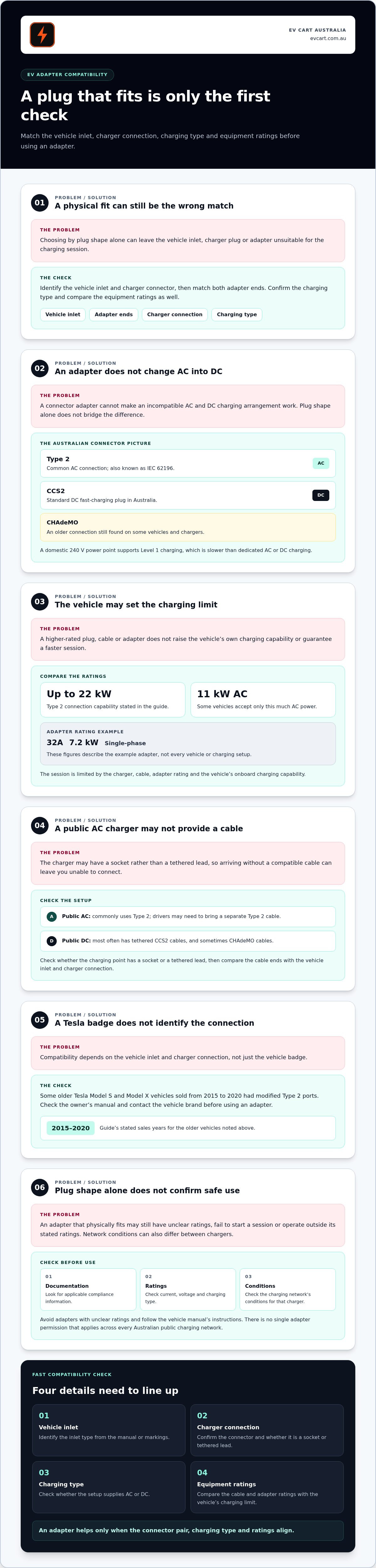
A plug that fits isn't enough: an EV charging adapter in Australia must match the vehicle inlet and the charger connection, and it can't turn AC charging into DC charging. A standard Australian power point supplies 240 V for Level 1 charging, while public AC chargers commonly use Type 2 plugs and DC fast chargers use CCS2. The vehicle’s own charging limits also affect the result.
It’s easy to confuse an adapter with a charging cable, or assume one connector works with every charging type. The right match depends on the plug ends and whether the charger supplies AC or DC power.
This guide explains how adapters, plugs and cables fit together, where Type 1 and Type 2 connections differ, and what to expect from a domestic power point compared with AC and DC charging. You’ll also learn why connector compatibility alone doesn’t determine charging speed, so you can understand what suits your EV and charging situation.
Key Takeaways
- Match an adapter to both the vehicle inlet and charger plug. An adapter connects compatible plugs; it doesn’t convert AC charging to DC or increase the vehicle’s charging limit.
- Type 2, also known as IEC 62196, is common at public AC chargers. Many drivers need to bring a separate Type 2 cable.
- A domestic 240 V power point supports Level 1 charging, which is slower than dedicated AC or DC charging.
- CCS2 is the standard DC fast-charging plug in Australia, while CHAdeMO is an older connection still found on some vehicles and chargers.
- For Tesla charging, focus on the vehicle’s inlet, the charger type and the cable or adapter connection rather than the vehicle badge alone.
Table of Contents
EV charging plug adapters
An EV adapter connects compatible plug types, but it can’t make every vehicle and charger combination suitable. Match the connectors, charging type and equipment ratings before use.
Australian EV plug types
Australia uses Type 2 connections for AC charging and CCS2 for DC fast charging. CHAdeMO remains on some older EVs, while Type 1 appears on some vehicles.
Type 2 is also known as IEC 62196 and can provide up to 22 kW. Some vehicles accept only 11 kW AC, so a higher-rated plug does not raise the car’s limit. Public AC chargers commonly use Type 2, while public DC chargers most often have tethered CCS2 cables and sometimes CHAdeMO cables.
A Type 2-to-Type 1 adapter can connect a Type 2 charging lead to a compatible Type 1 vehicle inlet. For example, a 32A Type 2-to-Type 1 adapter is rated for 32A, 7.2 kW and single-phase operation. Those ratings describe the adapter, not every vehicle or charging setup.
Choosing compatible charging adapters
Choose an adapter by matching the charger’s connector to the vehicle’s inlet, then compare the adapter’s ratings with both. This helps you avoid buying a connector that fits physically but isn’t suitable for the charging session.
For a home or public AC charger, identify whether the vehicle inlet is Type 1 or Type 2. Then match the cable or adapter ends, and ensure the vehicle supports the supplied AC power. A three-phase Type 2 cable can also be used with single-phase power.
Tesla compatibility depends on the vehicle’s inlet and the charger connection, not just the badge. Some older Tesla Model S and Model X vehicles sold from 2015 to 2020 had modified Type 2 ports. Check the owner’s manual and contact the vehicle brand before using an adapter.
Adapter rules and charging networks
A plug’s shape doesn’t prove that an adapter meets Australian safety requirements. Check its documentation for applicable compliance information and ratings, including current, voltage and charging type.
Australian public charging networks don’t have one universal adapter permission that applies at every charger. The network’s conditions and the charger’s connector determine whether an adapter can be used. Public DC chargers commonly have tethered CCS2 cables, so the vehicle inlet must match that connection or have a suitable adapter.
Third-party or incompatible adapters can create a poor connection, fail to start a session or operate outside their stated ratings. A connector mismatch can also prevent the vehicle from communicating correctly with charging equipment. Avoid adapters with unclear ratings and follow the vehicle manual’s instructions.
Adapter effects on charging
An adapter connects compatible plugs; it doesn’t convert AC power into DC or change the vehicle’s charging standard. AC and DC charging use different vehicle and charger arrangements, so a plug shape alone can’t bridge that difference.
An adapter also doesn’t increase charging speed. The session remains limited by the charger, cable, adapter rating and vehicle’s onboard charging capability. For example, a Type 2 connection may support up to 22 kW, but a vehicle limited to 11 kW AC won’t take the full amount.
Before using an adapter, confirm the connector pair and charging type, then compare the ratings. An adapter only helps when those details align; it can’t make an incompatible DC connection work for AC charging, or the reverse.
Finding plug and cable information
Start with the vehicle manual and the markings on its inlet and charging lead. Matching those details helps distinguish a compatible Type 2 AC cable from a connector that only looks similar.
Identifying Type 2 AC connectors
Type 2, also called IEC 62196, is an AC connector used by EVs and charging equipment. Its name or diagram in the vehicle manual helps identify the inlet before choosing a cable. Each connector type needs a matching vehicle inlet or an adapter for an effective connection, according to the California Air Resources Board.
Check both ends of the charging setup. The vehicle-side plug must match the car’s inlet, and the supply-side plug must suit the charging point. Don’t rely on a photograph alone: compare the connector label with the vehicle manual, especially for an older vehicle or a modified inlet.
Understanding Type 2 AC cables
A Type 2 AC cable has a connector at each end, linking a compatible vehicle inlet and charging point. Most public AC chargers in Australia use Type 2, and drivers need to bring their own cable. This matters when planning a public charging stop: the charger may provide the socket, not the cable.
Three-phase Type 2 cables can also work with single-phase power. A cable rated for three-phase use therefore offers flexibility across compatible charging locations, but it doesn’t make a single-phase supply deliver three-phase power.
Use this short check when reading a vehicle manual or cable label:
- Identify the vehicle inlet as Type 1 or Type 2.
- Confirm the charging point’s connector and whether it supplies a socket or tethered lead.
- Compare the cable ends with both connections before plugging in.
These steps separate the connector match from the cable’s electrical capability. A Type 2 plug can provide up to 22 kW, but some EVs accept only 11 kW AC. The car’s limit still matters, even when the cable and charging point support more.
Cable length affects where you can position a vehicle beside a charger. A Type 2 cable of at least 5 metres is recommended for flexibility at different Australian locations. Consider the distance between the charging point and inlet, then allow enough reach without pulling the cable tight.
For example, an older Tesla Model S or Model X sold from 2015 to 2020 may have a modified Type 2 charging port. Use its manual to identify the connection rather than assuming every Type 2 cable fits identically.
Once you’ve identified the inlet, cable ends and reach required, use those details to compare connector-compatible charging gear for your setup.
Portable Level 1 charging from a domestic power point
Australia’s Level 1 charging uses a standard 240 V power point and a specialised portable charging cable. It offers a practical option where a dedicated AC charger isn’t being used, but its output is lower than Level 2 AC charging.
Level 1, also called Mode 2, connects through an existing single-phase power point rated at 10-15 Amp. The portable EV charging equipment manages the connection between the outlet and vehicle. The wall socket supplies electricity; it isn’t itself an EV charger or a plug adapter.
A standard power point supplies a maximum of 2.4 kW for Level 1 charging. The actual charging rate depends on the equipment and the vehicle’s acceptance. For example, a standard portable electric vehicle charger uses a 10 Amp plug and delivers 2 kW, with a 5-metre cable.
For a typical EV, Level 1 charging adds about 10-12 km of driving range per hour. The broader estimate for Level 1 / Mode 2 is 10-20 km per hour, depending on the vehicle and charging setup. A full charge can take up to 24 hours, so this method suits overnight charging or topping up when time allows.
Australia has three main charging levels: Level 1 AC, Level 2 AC and Level 3 DC. Level 1 uses a domestic power point. Level 2 supplies dedicated AC charging, while Level 3 supplies DC power through a fast charger. The charging level describes the supply arrangement, not simply the plug’s appearance.
Level 2 AC chargers typically provide 7-22 kW. A single-phase 7 kW charger can add about 35-40 km of range per hour, depending on the EV. Three-phase Level 2 chargers, up to 22 kW, can add about 50-130 km per hour. The vehicle’s onboard charger can limit the rate, even when the charging equipment supports more.
Level 3 DC charging works differently from charging through a household socket. Australian Level 3 chargers can add about 150-300 km of range per hour, depending on the vehicle and charger. That figure illustrates the difference between charging levels, not a speed that a domestic power point can achieve.
- Use the vehicle manual to identify its charging inlet and permitted charging method.
- Match the portable charger’s plug to the power point and its vehicle connector to the EV.
- Compare the charger’s output with the vehicle’s charging capability before estimating charging time.
When shopping for an ev charging adapter australia drivers trust, remember that Level 1 AC EV charging provides charging capability of about 1.4 to 2.8 kW, reflecting variation across equipment and installations. The page estimates that charging a first-generation Tesla Model Y from empty takes about 8 hours. It also estimates that a BYD Atto 3 can gain 58 km of range per hour of charging. These figures are estimates, and actual results depend on the vehicle and charging setup.
Which EV charging adapters are compatible with electric cars sold in Australia?
Compatibility depends on the vehicle inlet, charger connector and charging type. For Australian EVs, identify those details before choosing an adapter. A connector that fits physically isn’t enough to establish compatibility.
For AC charging, compare the vehicle inlet with the charging lead’s vehicle-side plug. Type 2 is common at public AC charging points, while some vehicles use Type 1. A Type 2-to-Type 1 adapter can bridge those connector types when the vehicle and charging equipment support that arrangement.
Use the adapter’s ratings as another part of the compatibility check. Its current, voltage, phase and power ratings describe its operating limits. They don’t override the vehicle’s charging capability or the charger’s output. A higher-rated adapter can’t make a car accept power beyond its onboard charging limit.
DC fast charging needs a separate compatibility check. CCS2 is the standard DC fast-charging plug in Australia. CHAdeMO is an older DC connector, and few new EV models use it. Public DC chargers most often provide tethered CCS2 cables, with some also offering CHAdeMO.
An older EV with a CCS1 inlet may be able to use an adapter at a CCS2 charging point. That possibility doesn’t mean every CCS1 vehicle, adapter and charger combination works together. DC charging relies on the vehicle and charger supporting the same charging connection and communication.
Use this compatibility sequence for a specific EV:
- Find the vehicle inlet type and charging instructions in the owner’s manual.
- Identify whether the intended charger supplies AC or DC power.
- Match the adapter’s vehicle-side and charger-side connectors to those connections.
- Compare the adapter’s ratings with the vehicle and charging equipment.
Keep AC and DC connectors distinct in this check. A Type 2-to-Type 1 adapter addresses an AC plug mismatch; it doesn’t replace a CCS2 or CHAdeMO DC connection. An adapter also doesn’t convert one charging method into another.
For example, a driver with a Type 1 vehicle inlet and access to Type 2 AC equipment needs to assess an AC adapter. A driver with a CCS2 inlet using a public DC charger must match that DC connection instead. The same adapter won’t necessarily suit both situations.
The vehicle model and inlet details matter more than the badge alone. Tesla vehicles, for example, can have different connector arrangements across models and production years. Use the manual’s connector information to identify the right charging connection before selecting an adapter.
Can Tesla owners use home and public adaptors in Australia?
Yes, but compatibility depends on the Tesla’s charging inlet, the charger connection and the charging type. The Tesla badge alone doesn’t identify which adapter suits a particular vehicle or charging session.
Start with the owner’s manual and the inlet fitted to the car. Some older Tesla Model S and Model X vehicles sold from 2015 to 2020 had a modified Type 2 charging port. That makes the vehicle’s own connector information more useful than assumptions based on another Tesla model or year.
At home, distinguish the power source from the vehicle connection. A domestic power point uses a portable charging unit, while a dedicated AC charger supplies power through its charging lead or socket. Check the plug entering the supply, the connector meeting the Tesla and whether the equipment is designed for that charging setup.
A Tesla owner using public AC charging should check whether the charge point has a Type 2 socket or a tethered cable. Australian public AC chargers commonly use Type 2, and drivers may need to bring a separate cable. The vehicle inlet, cable ends and any adapter must form a compatible connection.
Public DC charging needs a different check. CCS2 is the standard DC fast-charging plug in Australia, and public DC chargers most often have tethered CCS2 cables. Some also provide CHAdeMO. An AC adapter won’t convert a Tesla’s charging setup to DC, so match the vehicle inlet and charger type before relying on an adapter.
Use this compatibility check at each home or public charging location:
- Identify the Tesla model’s charging inlet using its manual or connector information.
- Decide whether the charger supplies AC or DC power.
- Check whether the charger has a socket or a tethered cable.
- Match both adapter ends to the vehicle and charger, then compare equipment ratings.
For example, a Type 2 AC connection and a CCS2 DC connection serve different charging arrangements. An adapter designed for one connection doesn’t automatically suit the other. The vehicle’s charging capability also affects the rate, even when the charger or adapter has a higher rating.
Keep the vehicle manual’s instructions in view when choosing a Tesla charging connection. If you’re comparing equipment for an EV setup, browse EV charging accessories by connector type and intended use.
EV Cart Australia: EV accessories
EV Cart Australia offers EV accessories for Australian drivers. Explore its range for accessories that support everyday EV ownership or complement your charging setup. Use the vehicle manual to identify your connector type and charging needs, then compare those details with the relevant product information before choosing.
Clear compatibility details help narrow your options without confusing a cable, adapter and charger. Keep your vehicle model and inlet information handy as you browse. Visit evcart.com.au to explore EV accessories.
Make your next charging choice with confidence
Your charging setup may change as your routine, vehicle or access to charging changes. Keep your vehicle’s connector details and charging instructions easy to find. They’ll give you a practical reference when choosing accessories, rather than leaving you to rely on memory or appearance alone.
Before choosing an EV charging adapter in Australia, consider where you expect to use it and which vehicle it must connect to. Clear notes about your setup help you focus on suitable accessories and avoid choosing by plug shape alone.
EV Cart Australia offers EV accessories for Australian EV owners. Explore the range or get in touch to discuss your accessories enquiry. Contact EV Cart Australia for help, and take your next step with a clearer view of your charging setup.
Frequently Asked Questions
What are the differences between Type 2, CCS2, CHAdeMO and Type 1 charging connectors in Australia?
Type 2 and Type 1 are AC connector types, while CCS2 and CHAdeMO are used for DC fast charging. Type 2 is common at Australian public AC chargers, and CCS2 is the standard DC fast-charging connector. CHAdeMO is an older DC type found on some vehicles and charging points. Check your vehicle’s inlet and manual: a connector’s name identifies its type, not whether every charger or adapter will suit your car.
Where can I buy EV charging adapters in Australia, and which brands are reputable?
Buy through an Australian EV accessories retailer, and judge an adapter by its documented compatibility, ratings and instructions, not its brand name alone. EV Cart Australia offers EV accessories through its online store. Before choosing any adapter, compare its connector ends with your vehicle inlet and charging equipment, and review its stated electrical ratings. Keep the vehicle manual’s guidance in view so the product choice matches your particular charging setup.
Are EV charging adapters legal and safety-certified for use in Australia?
A plug’s shape alone doesn’t show that an adapter meets Australian safety requirements. Check its documentation for applicable compliance information and ratings, including current, voltage and charging type.