
EV Charging Cable Reel for Tidy Home Charging
2026-11-04

A tidy home charging setup starts with a reel suited to your cable, connector and available space. An EV charging cable reel keeps a lead organised between charges, while an auto-rewind design gathers it away when you’re finished. Match the reel’s capacity to the cable you need to store, and consider where it will sit.
Loose cable takes up room in a garage and can be awkward to handle around the car. Choosing storage isn’t just about the rewind mechanism: cable length, compatibility, protection and product dimensions all affect how well it fits your charging routine.
This guide explains what to look for in auto-rewind storage, how to assess cable capacity and compatibility, and which protection and size details matter before you choose. Use these practical checks to decide whether a reel suits your home setup in Australia, rather than relying on a one-size-fits-all recommendation.
Key Takeaways
- Choose an auto-rewind design that suits how and where you store your charging lead.
- Match the reel’s capacity to your cable length so it can be gathered and stored neatly.
- Consider how the storage setup can help keep the cable organised and reduce unnecessary wear.
- Check compatibility with your charging cable’s mode and electrical rating before choosing a reel.
- Use the product’s material, weight and dimensions to assess whether it will suit your available space.
Table of Contents
Auto-rewind EV charging cable storage
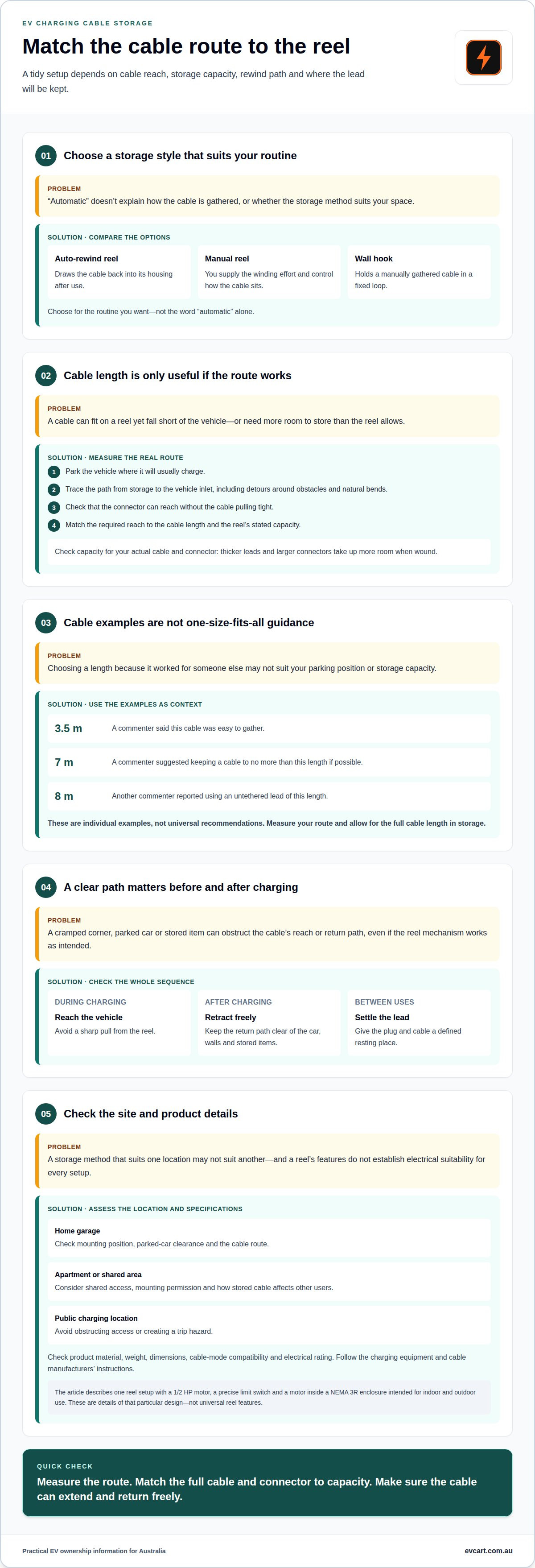
Retractable reels rewind the lead for storage, while wall hooks hold a manually gathered cable in a fixed loop. Manual reels also require you to wind the cable yourself, giving you direct control over how it sits.
In Australia, separate cable-storage convenience from electrical suitability. Follow the charging equipment and cable manufacturers’ instructions, and don’t assume a reel’s enclosure or rewind mechanism makes it suitable for every charging setup.
A reel can suit a home garage when its mounting position, cable reach and storage path fit the space. Apartments and public charging locations require closer attention to shared access, mounting permission and how the stored lead affects other users.
Auto-rewind storage works by drawing a cable back into a housing after use. In a described reel setup, a 1/2 HP motor operates a precise limit switch. That switch controls the stopping point, helping the cable return to its intended position rather than continuing to wind.
That mechanism differs from a passive hook. A hook holds a manually gathered cable in place, while an auto-rewind reel manages the return movement. A manual reel also gathers the lead, but the user supplies the winding effort. Choose based on the routine you want, not the word “automatic” alone.
Consider the full sequence before choosing:
- During charging: The cable must reach the vehicle without pulling sharply from the reel.
- After charging: The lead needs a clear path back into storage.
- Between uses: The plug and cable should have a defined resting place.
For example, a garage setup may place the reel beside the parking space, with the cable extending towards the vehicle. A cramped corner can make a retracting cable awkward, even when the mechanism works as intended. Check that the cable moves freely and its connector won’t strike a wall or vehicle as it rewinds.
Some setups include a docking station and cable carrier. In the arrangement described, a hook-and-loop fastener attaches the carrier to boot carpet while driving. This is a way to store a cable in a vehicle, not a substitute for a fixed home reel.
The described reel’s motor sits inside a NEMA 3R enclosure, and that setup is intended for indoor and outdoor use. Treat this as a specification of that particular design, not a universal feature of every reel. Match the enclosure information to the place where the product will be used.
In a garage, plan around parked-car clearance and the cable’s route. In an apartment, shared walls and common areas can limit where storage is practical. At a public charging location, a reel must not obstruct access or create a trip hazard. These site conditions determine whether retractable storage is suitable.
Before settling on a design, trace the cable’s path from storage to the vehicle and back. A reel works well when its rewind action, mounting position and intended environment suit that route. If there’s no fixed mounting point or clear return path, a simple hook or manual storage method may fit better.
Cable length capacity
Choose reel capacity based on the cable’s full length, not just the distance between the charger and car. Account for bends, the position of the inlet and enough slack to connect without pulling the lead tight. A reel that holds the cable but leaves too little reach won’t suit your parking arrangement.
Measure the charging route with the vehicle parked in its usual position. Follow the path from the storage point to the vehicle inlet, including any detour around a wall or parked car. Consider whether the same lead must reach another parking position. These steps reveal the useful cable length your setup needs.
Reported cable lengths show why one size won’t suit every home. A commenter suggested keeping a cable to no more than 7 metres if possible. Another reported using an 8-metre untethered lead. A separate commenter said a 3.5-metre cable was easy to gather. These are examples, not universal recommendations.
Capacity depends on more than the length printed on a cable. A thicker lead or larger connector takes up more room when wound. Check that the reel’s stated capacity accounts for your actual cable and connector, rather than an assumed thin cable or one without connectors. Read how the product defines its capacity before matching it to your lead.
Use this practical sequence to make a suitable match:
- Park the vehicle where it will usually charge.
- Trace the cable path from storage to the vehicle inlet.
- Include the route around obstacles and the cable’s natural bends.
- Compare the required reach with the cable length and reel capacity.
- Allow the connector to reach without hanging under tension.
For example, a 3.5-metre cable may be easy to gather, but its reach may not suit a charger positioned farther from the inlet. A 7-metre lead may cover a longer route, while an 8-metre lead needs storage capacity for its full length. Measure the real path instead of choosing by length alone.
Auto-rewind storage also needs a clear return path. The cable must retract without catching on the car, a wall or stored items. A longer cable may need more room on the reel and along its route. Check both the extended and stored positions before deciding.
For a cable carried between locations, consider the longest route it must cover. A lead that reaches one bay may not reach another. At home, base your choice on regular parking positions, not an occasional workaround. Matching route, reach and storage capacity helps prevent excess cable trailing across the charging area.
Cable protection and organisation
Use storage to keep the cable orderly, protected from avoidable contact and easy to retrieve. Your storage routine should also account for whether the lead is charging, stored indoors or exposed outdoors.
Winding the cable during charging
Don’t leave an EV charging cable wound on a reel while charging unless its manufacturer expressly permits it. A tightly coiled lead can retain heat, so fully unwind it before charging as a cautious storage practice. Check the cable and reel instructions together, not just the reel’s rewind function.
Keep the cable route clear while charging. Avoid tight bends, trapped sections and contact with vehicle wheels or doors. After charging, let the cable cool as needed, then gather it without forcing the connector into the reel housing.
Overheating, damage and water exposure
Heat, abrasion and water exposure can each affect cable condition. Before use, inspect the lead, plug and reel for cuts, crushed sections, damaged insulation or signs of overheating. For outdoor storage, choose equipment intended for that location and position connectors as their instructions require.
A water hose reel isn’t automatically suitable for EV cable storage. Fully unwind a hose reel before storing an EV cable on it, and don’t charge with the cable wound on it. Reel materials, electrical ratings and intended use matter more than appearance.
Organisation starts with a clear storage point. A wall-mounted Type 2 plug holder was advertised for storing two to three Type 2 plugs and cables. That capacity suits a defined plug-storage need, but doesn’t establish that the holder can carry every cable or connector arrangement.
For a reel with adjustable saddle clamps, align the cable carefully. The clamps are designed to guide the cable and reduce wear. Don’t squeeze the lead or create a sharp turn at the clamp. A smooth route helps prevent repeated rubbing at the same point.
Follow the product’s instructions for mounting and care. Choose a position that supports the reel, keeps the cable path clear and avoids sharp edges. Use the specified fixings and mounting method. Don’t improvise a support or alter an electrical component.
Make inspection part of the storage routine:
- Look over the cable and connector before charging.
- Check the reel path for dirt, snags or visible damage.
- Keep the plug off the floor and away from standing water.
- After use, wind the lead without twisting or forcing it.
- Stop using damaged equipment until it has been assessed appropriately.
For outdoor use, protect connections from direct exposure as the equipment instructions specify. A reel’s weather-resistant housing doesn’t mean every cable, plug or connection has the same protection. Make sure the whole setup suits its location, and address wear before it worsens.
Compatible charging cable mode and rating
Check the charging cable, charger and storage reel as separate components. Their roles differ: the cable carries charging current, while a storage reel holds and organises it. Compatibility means the cable’s connectors and physical dimensions suit the reel, and the charging equipment is used as its manufacturer directs.
Start with the cable label and product instructions. Note its charging mode, connector type and electrical rating. Compare these details with the reel’s stated intended use and capacity. A holder designed for a particular plug shape may not suit another connector, even if both cables are for electric vehicles.
A charging setup described as operating at 32 amps and 240 volts needs equipment intended for that application. Those figures describe the charging equipment, not a universal rating for storage reels. Don’t assume a reel can carry current simply because its cable fits the housing or winding guides.
That distinction matters with ordinary extension reels. A commenter questioned the safety of an extension reel marketed for a continuous 16-amp load lasting several hours. Treat this as a warning against assuming general-purpose reels suit EV charging. Use the cable and charging equipment according to their instructions, and don’t charge through a storage reel unless its manufacturer expressly allows that use.
Check these compatibility points before choosing:
- Connector: Confirm the plug fits its holder without force.
- Cable type: Match the reel’s design to the cable you own.
- Electrical rating: Keep charging current and voltage distinct from storage capacity.
- Use instructions: Follow the cable and charger manufacturers’ directions.
An untethered charging setup, for example, uses a separate cable to connect the vehicle to charging equipment. Its plug ends need accessible storage, and the cable must fit the reel’s winding path. A tethered setup has a cable attached to the charging unit, so storage needs depend on the unit’s arrangement and instructions.
Charging mode affects which cable suits the equipment. Don’t choose by plug appearance alone. Match the mode and connector details specified for the vehicle and charging unit, then check whether the storage accessory accommodates that cable. A reel can organise a compatible lead, but it can’t make mismatched charging equipment compatible.
Keep the charging connection outside the reel unless the product instructions specifically say otherwise. A lead that physically fits a reel may still be unsuitable for charging while wound. Keep storage separate from electrical operation, especially when a cable’s current rating or intended use differs from the reel’s purpose.
Before use, compare the cable markings with the charger’s instructions. Confirm the connector seats correctly, the cable routes without strain, and the reel is used only for its stated purpose. For a 32-amp, 240-volt setup, that careful match matters more than a reel’s appearance or rewind feature.
Product material, weight and dimensions
Compare a reel’s listed construction, weight and measurements with its intended position. These details affect mounting, clearance and everyday handling.
Product material
Read the product description for the reel’s stated material and finish. Material alone doesn’t establish suitability for every location. Compare the stated use with your planned position, such as a sheltered garage wall or an exposed area, and follow the product’s care instructions.
Inspect the housing, cable guides and mounting points separately. For example, a metal housing and plastic guide have different roles, so assess each against the product description. Don’t assume a material is weatherproof, corrosion-resistant or suitable outdoors unless the product information says so.
Product weight
Use the listed product weight to plan handling and mounting. A wall-mounted reel places its weight on its support, while a portable unit needs to be manageable when lifting and storing it. Consider the cable’s weight too, as the installed or carried setup weighs more than the empty reel.
Before mounting, identify the surface and the product’s stated fixing method. A reel mounted on a garage wall, for example, needs support suited to its weight and mounting points. Follow the supplied instructions rather than choosing fixings by appearance. Don’t alter the housing or mounting arrangement to make it fit.
Product dimensions
Compare the listed height, width and depth with the available space. Measure the intended position, allowing for the housing, cable outlet and connector movement. A reel that fits between shelves when empty may still conflict with nearby items as its cable extends or retracts.
Check the full operating space, not just the reel’s body dimensions. Mark the reel’s outline on a garage wall, for example, then trace the cable route towards the parked vehicle. Make sure doors, shelves and the vehicle won’t block access. Keep the plug’s resting position accessible without forcing a bend.
Use this simple comparison before choosing:
- Match the stated material and intended use to the storage location.
- Account for the reel and cable weight at the mounting or carrying point.
- Compare product measurements with the space and cable movement path.
- Keep access to the plug and controls clear.
For a tidy charging area, dimensions and mounting position need to work together. A compact housing won’t solve a blocked cable route, and a suitable material won’t compensate for poor clearance. Review product details alongside your actual space, then browse EV accessories to explore practical additions for EV ownership.
EV Cart Australia
EV Cart Australia offers EV accessories for practical electric vehicle ownership. Explore its range to complement your charging setup with useful accessories, or organise the equipment you carry and use day to day.
Your choice of cable storage still depends on the lead, charging routine and available space. Use this guide to assess what suits your setup, then explore EV accessories that support your needs without assuming every accessory serves the same purpose.
For help with EV accessories, contact EV Cart Australia.
Make your charging space work better
Choose storage around how you actually use your vehicle. A well-planned EV charging cable reel should make charging easier to manage, not add an obstacle to your garage or parking area. Before deciding, picture where the cable will sit after use and how you’ll access it next time.
Next, decide which accessory would make the clearest difference to your setup. EV Cart Australia offers EV accessories for practical electric vehicle ownership. Focus on the need you want to solve, then use the product details to guide your decision.
Contact EV Cart Australia about cable reels to discuss your accessory needs. A more organised charging space starts with a considered choice.
Frequently Asked Questions
Are EV charging cable reels compatible with Mode 2 and Mode 3 chargers?
Compatibility depends on the reel’s design and the cable, not just the charging mode. A Mode 2 lead with an in-cable control unit may need extra space, while a Mode 3 cable may have different connector dimensions. Check whether the reel accommodates the complete lead and control unit. Treat storage separately from charging, and follow the cable and reel manufacturers’ instructions.
What cable lengths, connector types and current ratings do EV cable reels support?
Reel capacity varies by product. Supported cable length, connector shape and cable thickness depend on the design. Check the specifications against your complete cable, including both plug ends and any in-cable control unit. Current rating describes electrical use, not storage capacity. Don’t assume a reel can carry charging current just because the cable fits physically.
Which Australian retailers sell EV charging cable reels, and what are their warranties?
EV Cart Australia offers EV accessories. Product details and warranty terms are specific to each item, so don’t assume one warranty applies across different cable-storage products. Before choosing, read the product’s stated coverage, exclusions and claim process, and keep your purchase documentation. Warranty coverage doesn’t replace using a reel according to its intended purpose and instructions.
How much do EV charging cable reels cost in Australia?
What Australian electrical standards and safety rules apply to EV charging cable reels?
Follow the charging equipment and cable manufacturers’ instructions, and assess electrical suitability rather than assuming a reel is suitable because of its enclosure or rewind mechanism. Fully unwind the cable before charging unless its manufacturer permits otherwise, and inspect the cable, plug and reel for damage before use.