
EV charging extension cables in Australia: safety and prices
2026-11-01

A standard household extension lead is generally not advisable for EV charging. Long or thin leads can cause electrical loss and may overheat if left coiled. An EV charging extension cable in Australia must suit the charger and connection, and should be fully uncoiled during use.
It’s understandable to look for a simple way to reach a car parked beyond the charging cable. But cable choice is only part of the decision: the plug and socket condition also matter when charging draws power for hours.
This guide explains when an extension may be suitable, what affects the cost of EV charging cables, and what to check on plugs, sockets and cables. You’ll also learn how to reduce avoidable risks and choose accessories that match your charging setup.
Key Takeaways
- A standard household extension lead is generally not advisable for EV charging. If an extension is needed, the article explains the safer approach and why cable size and length matter.
- Compare EV charging cable costs by type and intended use, rather than assuming every cable serves the same purpose.
- Inspect plugs, sockets and cables for damage before charging. A worn or damaged connection can affect safe operation.
- Keep extension leads fully uncoiled during charging, and avoid double adaptors and power boards.
- Understand the difference between safety guidance and a legal ruling, then choose EV accessories suited to your charging setup.
Table of Contents
Can I use an extension cord with my EV charging cable?
A standard household extension lead is generally not advisable for EV charging. Long or thin leads can cause electrical loss, and a coiled lead may overheat during a long charging session.
Using extension cords for EV charging
Check the portable charger’s instructions before considering an extension. A product listing may state that its cable isn’t suitable for use as an extension lead, and using an unsuitable lead can affect efficiency and safety.
If the outlet is too far away, a practical alternative is an outdoor socket installed within reach by an electrician. An extension may be an option for EV charging, but use only equipment appropriate for the charger and outlet.
Continuous loads and cord heating
EV charging can draw power continuously for four, six or eight hours. A general-purpose outlet may supply 80% of its rated capacity for several hours straight, so a lead used for a short appliance may face a different demand.
Long or thin cords increase electrical loss, while a coiled lead can trap heat. Stop charging if the plug, socket or cable becomes unusually hot, and don’t keep using a connection that shows damage.
Cable size, length and coiling
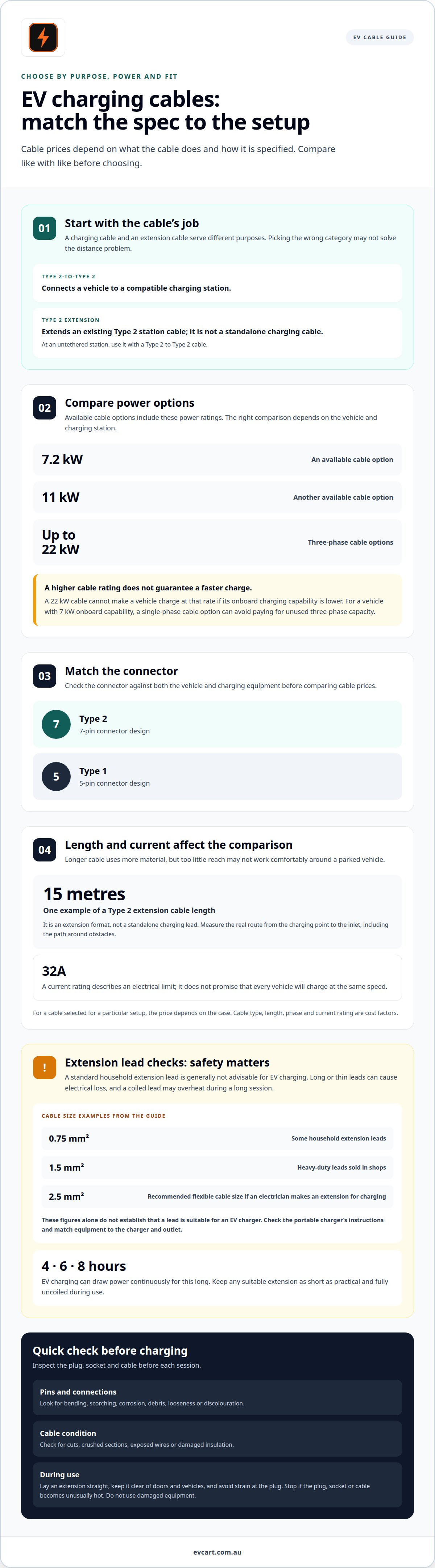
Household extension leads can use cable as small as 0.75 mm², while heavy-duty leads sold in shops may use 1.5 mm² cable. Those figures alone don’t establish suitability for an EV charger. If an electrician makes an extension for charging, the recommended flexible cable size is 2.5 mm².
Keep any extension as short as practical and fully uncoiled during use. Before charging, lay the cable out straight, check that it isn’t crushed beneath a door or vehicle, and keep the plug connection free from strain.
Safety and Australian charging guidance
There isn’t one blanket allowance that applies to every Australian EV manufacturer. Follow the instructions for your specific portable charger and vehicle, and don’t assume an extension is permitted just because the plugs fit.
For a distant outlet, first consider having an electrician install a closer outdoor socket. If using a suitable extension, match its power rating to the charger, keep it short and uncoiled, and avoid double adaptors or power boards.
Inspect the plug, socket and cable before each charging session. Don’t use equipment with cracks, loose connections, discolouration or damaged insulation. Switch off the wall outlet before unplugging a plug-in charger.
EV charging cable prices
EV charging cable prices depend on the cable’s purpose and electrical specifications. A Type 2-to-Type 2 charging cable connects a vehicle to a compatible charging station. A Type 2 extension cable extends an existing station cable, so it serves a different role. Compare like with like before judging whether one option costs more.
Start with the connection type. Type 2-to-Type 2 cables are used between compatible charging equipment and vehicles. An extension cable is designed to extend an existing Type 2 charging station, not to work as a standalone charging cable. At an untethered station, the extension must be used with a Type 2-to-Type 2 cable. Buying the wrong category can leave you with equipment that doesn’t solve the distance problem.
Power rating and phase also shape the comparison. Available cable options include 7.2 kW and 11 kW, as well as three-phase models rated up to 22 kW. A 22 kW cable won’t make a vehicle charge at that rate if its onboard charging capability is lower. For an EV with 7 kW onboard charging capability, a single-phase cable option can avoid paying for unused three-phase capacity.
- Check connector type: match the cable ends to the vehicle and charging equipment.
- Compare power and phase: consider the vehicle’s onboard charging capability and the station.
- Measure the route: choose a practical cable length without buying excess reach.
- Confirm its role: distinguish a charging cable from an extension cable.
Length is another cost factor. A longer cable uses more material, but the shortest option may not reach comfortably around a parked vehicle. Measure the real route from the charging point to the inlet, including the path around obstacles. A 15-metre Type 2 extension cable is one example of an extension format, not a standalone charging lead.
For a cable selected for a particular setup, the price depends on the case and is given after a quote request; cost factors include cable type, length, phase and current rating. Compare specifications alongside the amount, rather than choosing on price alone. Current ratings such as 32A describe an electrical limit, not a promise that every vehicle will charge at the same speed.
Check compatibility before purchase. Type 2 connectors have a 7-pin design, while Type 1 connectors have a 5-pin design. Match the connector to the vehicle and charger, then confirm whether you need a complete cable or an extension. Explore EV charging accessories as you compare suitable cable types and charging needs.
Plug and socket condition
Sound plugs and sockets matter during EV charging because the connection carries power for hours. Before each session, inspect the vehicle charging plug, any extension socket and the wall GPO. Look for cracks, looseness, discolouration, damaged insulation or signs of heat. Don’t charge with damaged equipment.
Check the wall outlet as well as the charger end. A plug should sit securely in the GPO, not wobble or partly fall out. A loose connection can heat during use. If the plug or socket feels unusually hot, stop charging and switch off the wall outlet before unplugging.
Use this quick check before connecting the charger:
- Inspect the pins: check for bending, scorching, corrosion or debris.
- Examine the cable: look for cuts, crushed sections, exposed wires or damaged insulation.
- Check the socket: confirm the outlet face is intact and the plug seats firmly.
- Watch for changes: stop if a connection heats, smells unusual or changes colour.
Australian household wiring behind a general-purpose outlet normally uses 2.5 mm² cable back to the switchboard. That wiring doesn’t make every plug, socket or extension suitable for prolonged EV charging. The outlet’s condition and the charger’s power rating still matter.
Don’t treat a heavy cable as proof of a safe plug connection. A 4 mm² cable can be difficult, if not impossible, to fit properly into plug ends. Poor fit can leave the connection unreliable. Cable size must work with the plug and socket design, not just appear substantial.
For regular charging from a household outlet, a new, good-quality GPO is recommended. A worn outlet may have a loose grip or visible damage that a new plug won’t fix. Keep the plug and socket dry, unobstructed and free from strain while charging.
Inspect EV charging cables regularly, including both connector ends. Check for cracked housings, loose parts, flattened sections or heat marks. If you find damage, don’t patch the cable with tape or continue charging. Set it aside until it can be replaced or assessed appropriately.
Before unplugging a portable charger, switch off the wall outlet. Then remove the plug without pulling on the cable. This simple sequence reduces strain on the plug, socket and cable during repeated charging sessions.
The author reports replacing plugs, extension sockets and GPO wall plates after 5 years of charging a car with a standard EVSE.
Risks of melted plugs, damaged sockets and fire
A melted plug can signal overheating at the connection, not just cosmetic damage. EV charging draws power for an extended period. A loose plug, damaged socket or unsuitable adaptor can create a weak point that heats under load. Stop charging if you notice melting, scorching, a burning smell or unusual warmth.
Heat can damage the plug body and socket face, then worsen the connection. Melted plastic, brown marks or deformation are clear warning signs. Don’t reconnect the charger to the affected outlet, even if it still powers another appliance. Continued use can aggravate the damage and increase the risk of electrical failure.
Check the entire connection path, from the wall GPO to the vehicle. Look for damage at each plug, socket and cable joint. Pay particular attention to add-on connections, as each extra connection is another point that can become loose or damaged.
- Scorching or discolouration: stop charging and leave the affected equipment disconnected.
- Melted plastic: don’t reuse the plug, socket or adaptor.
- Crackling or a burning smell: stop the session and switch off the wall outlet if safe.
- A loose plug fit: don’t hold it in place or wedge anything around it.
Avoid double adaptors and power boards for EV charging. They add connection points and may be unsuitable for the sustained demand of charging. Don’t combine adaptors to reach a distant vehicle. Use the charging equipment as intended, with connections that fit securely.
Heat can build without an obvious failure at first. Check the plug and socket during use, without touching exposed or damaged parts. If the connection becomes hot, stop charging. Switch off the wall outlet before unplugging a plug-in charger, and don’t pull the cable to remove the plug.
Fire-risk figures can be misleading without knowing the setup and condition of each connection. A single estimate can’t make a damaged plug safe. Treat visible heat damage as a reason to stop, not as a problem to monitor through another charging session.
After a fault, keep the affected equipment out of use. Don’t tape a melted plug, reshape bent pins or continue using a marked GPO. Replace damaged charging cables or adaptors, and have a damaged wall socket assessed before using it again. Check the replacement connection before the next session.
Are EV charging extension cables legal in Australia?
There isn’t a reliable yes-or-no answer based only on an extension cable’s plug or label. In Australia, distinguish whether the equipment is suitable for EV charging from whether the specific charger’s instructions permit its use. A plug that fits a household GPO establishes neither point.
Start with the portable charger’s manual and product label. Follow directions about extension leads, maximum load, connection type and approved use. If the instructions say the charger isn’t suitable for an extension lead, don’t add one. A generic heavy-duty label doesn’t override the instructions for your specific charger.
Think of the decision in two parts. First, confirm the charger manufacturer’s stated use. Then assess whether the proposed equipment and connections suit the charging load. A lead intended for ordinary household appliances isn’t automatically suitable for hours of EV charging. Its rating, condition, length and construction all matter.
For example, a 15-amp extension socket is described as an option for EV charging, but that alone doesn’t make every 15-amp setup appropriate. The charger, outlet and cable must work together. An electrician-made extension for EV charging should use the recommended flexible cable size of 2.5 mm², rather than relying on a general-purpose lead.
Manufacturer guidance varies by portable charger and vehicle. Don’t assume every Australian EV brand gives the same direction. Check the instructions for your exact equipment, including any restrictions on extension leads. If those instructions prohibit an extension, use another charging arrangement.
- Read the charger manual: follow the stated use and extension-cord directions.
- Match the equipment: compare cable and socket ratings with the charger requirements.
- Inspect the setup: don’t use damaged, loose or heat-marked connections.
- Consider another route: a closer outdoor socket can avoid a temporary lead across the driveway.
Legal compliance and safe operation are related, but they aren’t interchangeable. A setup that appears to work may still conflict with the charger’s instructions or use unsuitable equipment. A cable being for sale doesn’t prove it suits your specific EV charging arrangement.
Keep the decision specific to your equipment. Note the charger model, read its instructions, and identify the cable and socket ratings before connecting anything. If you can’t establish that the arrangement matches the stated use, don’t charge through it. Choose a setup that follows the manufacturer’s directions and avoids improvised connections.
EV Cart Australia: EV accessories
EV Cart Australia offers EV accessories for practical electric vehicle ownership. Browse its range when comparing charging-related accessories or choosing what to carry for your setup. Before selecting any cable or connector, match its type and rating to your vehicle and charging equipment, then follow the charger manufacturer’s instructions.
Use this guide to distinguish a charging cable from an extension cable and assess whether an accessory suits your intended connection. Product details can help you compare options with your vehicle’s requirements. If you’re weighing up which EV accessories suit your needs, visit evcart.com.au.
Make your next charging decision with confidence
Use your vehicle and charger instructions as the starting point for any change to your setup. If you’re considering an EV charging extension cable in Australia, confirm compatibility and intended use before choosing an accessory. Decisions based on your actual equipment are more useful than relying on a cable’s appearance or a general product description.
EV Cart Australia offers accessories for practical electric vehicle ownership. Browse the range with your vehicle and charging requirements in mind, and compare relevant product details before choosing.
Explore EV accessories at EV Cart Australia and take the next step towards a setup that suits your needs.
Frequently Asked Questions
What are the safety considerations when using EV charger cables and adaptors?
Match every cable and adaptor to the charger’s stated power rating and intended use. Adding an adaptor changes the connection path, so check that each component is suitable as part of the full setup, not just on its own. Keep the vehicle inlet and cable connectors free from dirt and damage. If a charger displays a fault or the connection behaves unusually, stop the session and follow the manufacturer’s instructions.
What cable rating and current capacity are needed for EV charging in Australia?
Choose a cable rating that suits the charger, vehicle and charging station. Some Type 2-to-Type 2 cables are rated at 32A and up to 22 kW, while cable options also include 7.2 kW and 11 kW. Those ratings describe cable capacity, not the charge rate every vehicle can use. Check the vehicle’s onboard charging capability and the charger’s output before selecting a cable.
What are the safety risks of using an extension cable to charge an EV?
An unsuitable extension can add electrical loss and another connection point that may heat or fail during charging. Risk depends on the cable’s rating, condition, length and use. A lead left coiled, for example, can retain heat. Don’t use a double adaptor or power board, and stop charging if you notice heat damage, a burning smell or unusual warmth.
Can I use a standard household extension cord with an EV charger in Australia?
A standard household extension cord generally isn’t advisable for EV charging. Household leads can use cable as small as 0.75 mm², while heavy-duty leads may use 1.5 mm² cable. Those sizes alone don’t prove suitability for a portable EV charger. Read the charger’s instructions and use only equipment whose rating and intended use match that charger. If the manual rules out extension leads, don’t use one.
How much do EV charging extension cables cost in Australia?
There isn’t one price for every EV charging extension cable in Australia. Cost depends on the cable’s length, connector type, current rating and whether it’s an extension or a complete charging cable. Compare these specifications before comparing prices. A higher power rating may not suit your vehicle better if the vehicle or charging equipment can’t use that capacity.
Where can I buy an EV charging extension cable in Australia?
EV Cart Australia sells EV accessories through its online store. Browse the range and compare product information with your vehicle and charging equipment before choosing. For an extension cable, distinguish it from a standalone Type 2 charging cable: the extension is intended to extend existing compatible charging equipment. Check connector type, rating and intended use, and follow your charger manufacturer’s instructions.
Which EV charging extension cables are suitable for Australian Type 2 plugs?
A Type 2 extension cable is designed to extend an existing Type 2 charging station, not to work as a standalone charging cable. At an untethered station, use it with a Type 2-to-Type 2 cable, and check that the connectors and power rating suit your setup.