
EV Console Tray: How to Choose the Right Fit for Your Car
2026-10-12

Could an extra storage layer make your centre console harder to use? An EV console tray can separate small essentials from the larger storage area, but the wrong shape or layout may get in the way of items you reach for every day. The best fit is the one that suits your vehicle and routine, not simply the one with the most compartments.
Check compatibility before comparing finishes or features. Console shapes and layouts vary, and a tray that doesn’t sit properly may limit access to the space below or crowd nearby controls. This guide explains how to assess fit, storage layout, access and care details so you can compare options against your cabin and daily needs.
Start by matching a tray to your vehicle, then consider which items need a dedicated place and whether the design makes everyday storage more practical. You’ll also learn what to look for in product information and how to avoid relying on appearance alone.
Key Takeaways
- Identify your vehicle and centre-console layout before comparing an EV console tray.
- Check the exact model, year and version named in the product listing.
- Compare tray layouts by how they affect access to stored items and the space beneath.
- Shortlist options based on what you carry and how you use your cabin each day.
- Base your choice on clear product details and your actual console, not appearance alone.
Table of Contents
What an EV console tray can add to your cabin
A console tray is an accessory that organises space around a vehicle’s centre console, often by creating a separate place for smaller belongings. It can help keep loose items from collecting in a larger compartment, but its usefulness depends on the vehicle’s layout and the tray’s design. No single shape suits every cabin.
The centre console sits between the front seats, but its storage and access points vary from car to car. Some consoles have a deep compartment; others include dividers, sliding covers or nearby controls that affect how an added tray can sit and be used. A general overview of electric car interiors offers broader context, but your own vehicle’s layout is what matters when choosing an accessory.
Where a console tray sits and what it is designed to do
A tray may divide part of the centre-console storage area, giving smaller belongings a dedicated place above or alongside the space below. Depending on the vehicle and tray, it might help separate items such as a parking ticket, earbuds or a charging cable from larger belongings stored in the console.
That extra layer can also change how easily you reach the original compartment. Check whether the tray leaves the lid, controls and lower storage area usable. To judge day-to-day convenience, compare the product information with the specific console layout rather than relying on appearance alone.
Which everyday storage problem are you trying to solve?
Start with what you actually keep close by. Think about the small items you carry regularly and whether you want to separate them, stop them mixing with larger belongings or simply leave the console as it is. Consider when you need to reach those items, and keep belongings secure and out of the way while travelling.
Keep quick-access storage distinct from storage for less-used or bulkier belongings. A console tray is for organising the centre-console area, not for sorting everything carried in the cabin or boot. If your main concern is luggage or larger items, the EV organisers guide covers the broader storage question.
Prioritise a clear, usable cabin over adding compartments for their own sake. If a tray crowds controls, blocks storage you use or creates a place for items you don’t need close at hand, it may not solve the problem. First identify what needs a place, then decide whether the tray’s layout supports that use without making the console awkward.
Check your EV's centre-console layout before comparing trays
Start with the vehicle, not the accessory photo. A tray can look close to the console in your car and still differ in shape, depth or position. Before comparing options, identify your vehicle, inspect the console and check the product information that applies to it.
- Identify the vehicle. Record its make, model, year and relevant version.
- Inspect the console. Note its outline, existing compartments and nearby access points.
- Compare product details. Look for fitment information that matches the vehicle details you recorded.
Record the vehicle details that matter
Write down the full vehicle description before browsing. If a listing names a specific model, year range or version, compare it with your own details rather than relying on the model name alone. Model generations and variants can have different cabin layouts, even when they share a similar name or exterior shape.
This is a useful first check, but it is not proof of compatibility by itself. Compare your notes with the product information and make sure any stated fitment applies to your vehicle. A familiar badge or a photo that looks close isn’t a substitute for relevant details.
Compare the tray with the console's shape and access points
Look at the console in your own car. Note the available space, existing dividers and how the lid or cover moves. Check where controls, ports and storage openings sit in relation to the area a tray would occupy. These details help you judge whether an added layer could make routine access awkward.
Then assess the product information. Images can help you understand a tray’s general shape, but treat them as a fit guide only when they clearly show the relevant vehicle and version. Dimensions are useful when supplied, provided they describe the correct tray and can be compared with the space in your cabin. A similar-looking console alone does not establish a match.
- Does the listing identify your exact model and version?
- Are the images or dimensions clearly tied to that fitment?
- Could the tray obstruct a control, port, lid or compartment you use?
- Would the remaining space still suit the items you carry?
Base your comparison on details that apply to your vehicle, not assumptions drawn from another market or a similar-looking cabin. As you compare EV accessories, browse EV Cart Australia’s accessory range with your vehicle details in mind.
Compare EV console tray designs by fit, access and daily use
Once you’ve recorded your vehicle details and inspected the console, compare options against the way you use that space. Judge an EV console tray by its stated fit, usable layout, access and care information, not just its appearance. A feature only helps if it is clearly described and suits your routine.
Use this table to assess the information available for each option. If a detail is missing or unclear, treat it as unknown rather than assuming a particular feature.
| What to compare | What to look for | Why it matters day to day |
|---|---|---|
| Fit information | Vehicle model and version, plus any stated fitment details | Helps you judge whether the design relates to your actual console, rather than a similar-looking one. |
| Usable layout | Compartments or layout shown in images or described in the listing | Lets you consider whether the spaces suit the small belongings you want to organise. |
| Access | How the pictured or described design relates to the console’s existing storage and controls | Helps you assess whether you can still reach the areas and controls you use. |
| Care details | Cleaning guidance and material details, if provided | Gives you a basis for maintaining the accessory. Don’t assume a material or care method that the listing doesn’t state. |
Assess how the design uses available console space
Compare the product images with the arrangement you observed in your car. Look at where the tray sits and how its visible layout might separate the items you carry, such as keys or a small notepad. Don’t infer compartment numbers, capacity or dimensions from a photo. Use those details only when the product information states them and clearly ties them to the relevant version.
A more divided layout may suit someone who wants distinct places for different small items. A simpler design may make more sense if you prefer one open area. Neither approach is automatically better. The useful question is whether the layout matches your belongings and leaves the console practical to use.
Balance easy access with a tidy cabin
Consider what you reach for regularly and whether the tray’s position could affect access to controls, ports, a lid or storage below. Listing images can help you compare the described arrangement, but they can’t guarantee how an accessory will sit in your car. Rely on product information for claims about fit, stability or other features.
Materials, measurements and included features should come from the product listing, not assumptions based on appearance. A console cover and a tray also serve different purposes: one covers an area, while the other is intended to organise space. For a broader look at those options, the console tray and cover guide sets them in context. Compare the stated details, then choose the design that fits your cabin and routine.
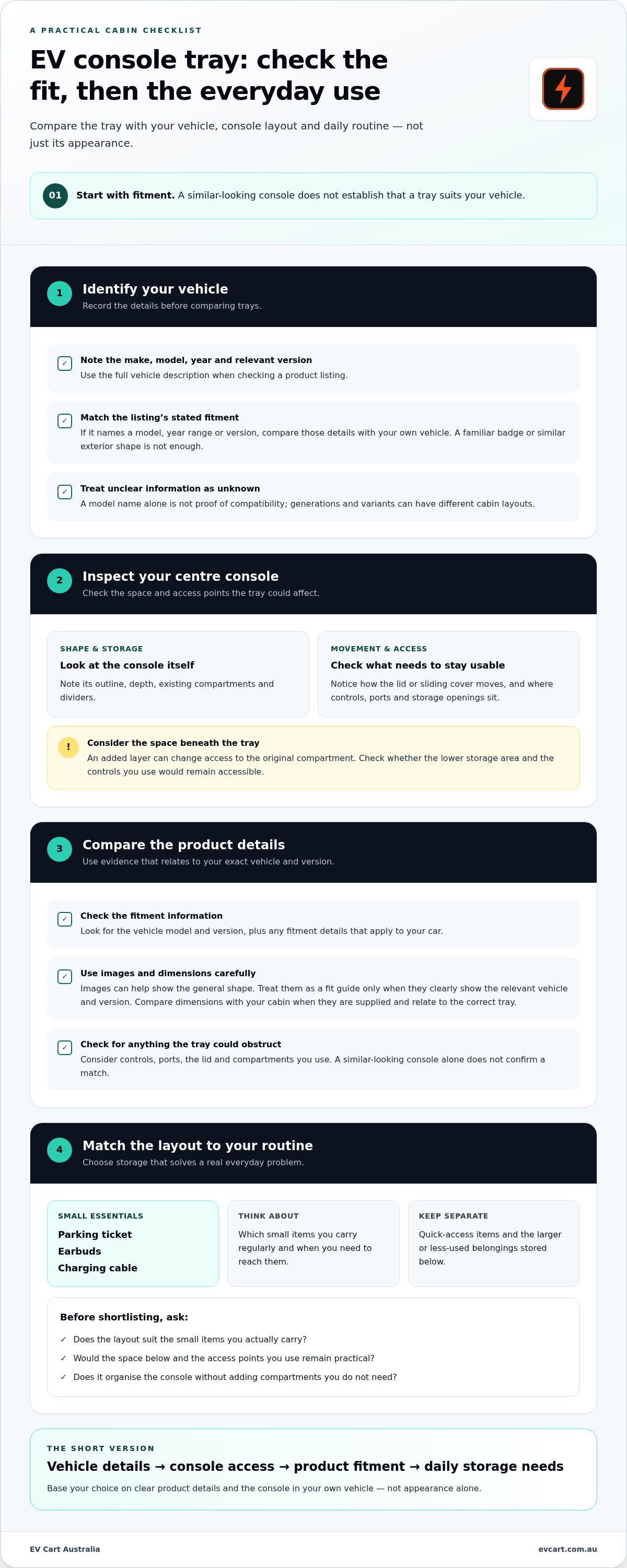
Use this checklist to shortlist an EV console tray
A useful shortlist starts with facts about your car and your routine, not with the tray that looks most appealing. Keep your vehicle details and notes about your console nearby as you compare. That makes it easier to separate options with relevant fit information from those that only appear similar.
Build a shortlist around your vehicle and routine
Begin with your vehicle’s make, model, year and version, then decide which belongings you want to organise. Use the fitment details in each listing to narrow the options. For those that remain, compare the stated layout with your console and consider whether it could affect access to controls, ports, the console lid or storage beneath it.
- Vehicle details: Does the listing specify the make, model, year or version that matches your car?
- Fitment: Does the stated compatibility apply to your exact vehicle details, rather than a similar model?
- Console layout: Do the product details correspond to the shape and existing compartments in your cabin?
- Access: Could the tray interfere with controls, ports, a lid or another storage area you use?
- Intended use: Does the described layout suit the small belongings you want to keep organised?
- Product information: Are materials, measurements, features and care instructions clearly stated in the current listing?
Review listing details before making a decision
Compare the listing with your actual cabin, not just with a product photo. Images may show the tray’s general appearance, but they don’t establish fitment unless the pictured vehicle and applicable details are clear. Use measurements only when they’re provided and relevant to the listed version. Don’t infer material, compartments or included features from colour, shape or styling.
Keep your shortlist grounded in verifiable information. Consider warranty, delivery and availability details only when they’re stated on the current website. If fitment details are unclear, incomplete or conflict with your vehicle information, set that option aside rather than guessing. A close visual match isn’t a substitute for clear compatibility details.
Shortlist by vehicle, stated fit details and daily-use priorities. Then compare the remaining options against how your console is arranged and what you actually need to store. This gives you a practical basis for choosing without assuming one design will suit every cabin.
Once you’ve narrowed your criteria, explore EV accessories with your vehicle details and routine in mind.
Choose an EV console tray that makes sense for your cabin
A considered choice follows a clear order: start with your vehicle details, check the stated fit, assess access, then decide whether the storage layout suits your everyday needs. This keeps the decision grounded in your actual cabin instead of a product photo or a broad compatibility claim.
Give fitment more weight than appearance. If the listing’s vehicle details don’t match yours, or the information is unclear, don’t treat a similar-looking console as proof. Set that option aside until the product information gives you a sound basis for comparison. A tray that looks tidy but affects access to controls or storage may not suit your priorities.
Match the final choice to your priorities
Think about what matters most in your routine. If quick access is your priority, compare how the described design relates to the controls, ports and storage you use. If you want to separate small belongings, focus on the layout and features specifically stated in the listing. A simple arrangement may suit one driver, while another may prefer more defined storage.
Keep the order of checks consistent. Confirm the vehicle and version first, then assess fitment details, access and intended use. Give stated compatibility more weight than colour, styling or resemblance to another vehicle. Choose only features supported by the product information, and don’t assume an image reveals the tray’s dimensions, material or included parts.
Take the next step with clear product information
Before deciding, compare the listing with the centre-console layout in your car. Check that any stated measurements, material details and care instructions apply to the item and vehicle version you’re considering. If the details don’t resolve a question about fit or access, pause rather than filling the gap with an assumption.
If you’re planning beyond console storage, the Australian EV accessories buyer’s guide can help you consider how different accessories relate to your vehicle and routines. Tie each choice to a practical need rather than adding accessories without a clear purpose.
The right EV console tray is the one whose stated fit and design make sense for your cabin and the items you want to organise. Ready to compare accessories? Explore EV Cart accessories and use the product information to guide your shortlist.
Make your next cabin upgrade a considered one
Treat your console as part of the cabin you use every day, not a space that needs filling simply because an accessory is available. A practical upgrade should support the way you use the car while keeping the interior comfortable and straightforward to navigate.
Before choosing an EV console tray, consider whether the items you want to organise are genuinely better kept there. Your storage needs may change with your routine, so leave room to reassess rather than choosing extra features for their own sake. A considered decision can help keep future accessory choices focused too.
Use that same approach as you explore other additions for your vehicle. Compare what each accessory is intended to do with the way you drive and use your cabin. Explore EV Cart accessories and choose an option when it fits your needs.
Frequently Asked Questions
What is an EV console tray used for?
An EV console tray gives small cabin items a dedicated place within the centre-console area. It may suit belongings you’d otherwise have to sort through in a deeper compartment, such as a parking ticket or earbuds. It isn’t a substitute for a door-pocket or boot organiser, so consider whether those items are easier to manage there. Keep anything you need secure and unobtrusive while travelling.
Will an EV console tray fit every electric car?
No. Console shapes, depths, lids and internal dividers vary between vehicles, so an accessory designed for one cabin may not suit another. Even cars from the same maker can differ by model year or trim. Treat compatibility information as specific to the vehicle versions named in the current listing. If yours falls outside that description, don’t assume a close visual match will fit.
Can a console tray block access to controls or ports?
Yes, depending on the tray’s shape and position. Consider whether it could cover a port, press against a control or prevent a console lid from opening fully. A cable connected to a port may also need room to bend without being pinched. If normal access becomes awkward, that design may not suit your cabin, even if it offers useful storage.
How do I check whether a console tray suits my vehicle?
Use your vehicle details, then compare them with the listing’s stated fitment. Check the named year or version, not just the badge. Look for measurements or images that clearly apply to that fitment, and compare them with your cabin. If the EV console tray listing is vague or inconsistent, pause rather than treating a resemblance as confirmation.
Can I move a console tray between different vehicles?
Only if the tray is specified for both vehicles and suits each console layout. Similar dimensions alone may not account for differences in shape, lid clearance or access points. If you share a tray between cars, reassess its position and whether controls, ports and storage remain usable each time. Don’t assume a tray that suits one vehicle will sit or function as intended in another.
How should I clean an EV console tray?
Follow the cleaning directions supplied with the tray, since care can depend on its material. Don’t assume a household cleaner or abrasive cloth is suitable, as it could mark the surface. Keep liquids away from vehicle controls and ports while cleaning nearby, and make sure the area is dry before returning belongings. Check your vehicle’s interior-care guidance as well.
What should I compare when choosing a console tray?
Compare stated vehicle fitment first, then review the layout, clearance, material and care instructions. Consider what you carry: a single open space may suit some belongings, while separate sections can help keep items apart. Check whether the tray affects access to a lid, port or control. Set aside features that aren’t clearly described in the product information.