
EV key fob cover prices, colours and materials
2026-10-21

Fit an EV key fob cover by matching it to your key’s shape, placing the fob inside, aligning the buttons and openings, then closing the cover as designed. Don’t force a tight or misaligned fit, as it can make the buttons harder to use.
A cover should protect your key without getting in the way of everyday use. The right choice depends on the exact fob shape, so compare your key with the product images before choosing.
This guide explains how to fit a cover and assess its compatibility, colour, material and finish. It also explains how to compare Australian prices so you can choose an option that suits your key and preferences.
Key Takeaways
- Match the cover to your exact fob shape and button layout before buying; keys can differ between models and variants.
- Install the case gently, aligning its openings with the buttons so the key remains easy to use.
- Compare colour, material and finish against how you use and carry your key, not appearance alone.
- Compare prices by cover type and construction, and check what each option includes before choosing.
- Use product images to compare the pictured key with yours, especially when choosing a model-specific cover.
Table of Contents
Model-specific fit and compatibility
A key case must match the fob’s outline, button positions and openings. Similar badges don’t mean two keys share the same shape. The MG4 and MGS5 EV fobs differ, so an MG4-shaped case may not fit an MGS5 EV key. Compare the actual key with the product images before choosing.
For MG owners, fitment depends on the key itself, not only the vehicle badge. A cover listing for MG S5 and QS keys refers to those shapes; it doesn’t establish a fit for every MG model. MG4, MGS5 EV and MG ZS EV owners should compare their fob against the pictured reference rather than assume one MG case suits all three.
Use this check before ordering:
- Identify your vehicle model and the key you carry for it.
- Compare the fob’s outline, button count and button arrangement with the product images.
- Check the key’s width and shape, including any raised edges or attached blade.
- Look for openings that line up with each button and the key’s other usable features.
Button layout matters as much as the outer shape. A case may look close in size but place a cut-out over the wrong button. For a BYD key, compare the button arrangement in the cover images with your own fob. A mismatch can make a button difficult to press or leave it covered.
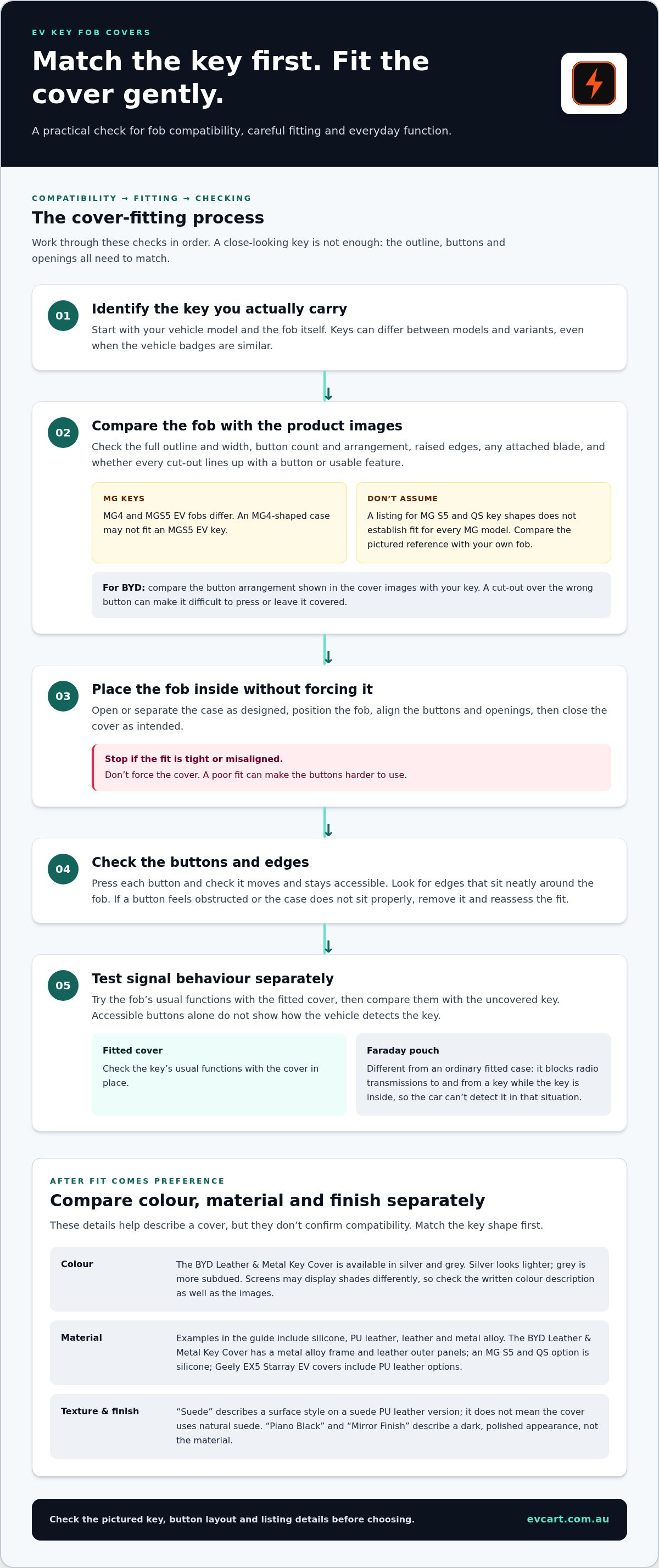
Once the shapes match, fit the case without force. Open or separate it as designed, place the fob inside, and align the buttons and openings. Close the cover, then press each button to check that it moves and remains accessible. If the edges don’t sit neatly or a button feels obstructed, remove the cover and reassess the fit.
Signal compatibility
Check signal behaviour separately from physical fit. A fitted case may leave the buttons accessible, but that alone doesn’t show how the vehicle detects the key. Test the fob’s usual functions with the cover fitted, then compare its operation with the uncovered key.
A Faraday pouch is different from a fitted case. It blocks radio transmissions to and from a key while the key is inside, so the car can’t detect it in that situation. An MGS5 EV owner described that effect with a pouch. Don’t treat a signal-blocking pouch as an ordinary protective cover, or assume a cover blocks signals.
Colour options
Colour affects how a key looks with your other keys, bag or car interior. For example, the BYD Leather & Metal Key Cover is available in silver and grey. Compare those finishes with the items you carry daily instead of choosing by product name alone.
Silver gives the cover a lighter appearance, while grey offers a more subdued look. These are visual differences, not indicators of fit or function. A silver cover still needs to match the BYD fob’s shape and button layout, and a grey one won’t make an incompatible case fit.
Use a simple comparison before deciding:
- Hold your key beside a silver or grey item you already own to compare the overall look.
- Consider the colour of your car’s interior, such as dark trim or lighter upholstery.
- Think about the other keys and attachments on your keyring, then choose a colour that sits comfortably with them.
- Look at the product images and description together, separating colour from material and finish.
Product images can help you assess the shade, but screens may display colours differently. Check the written colour description too. If the listing says silver and grey, treat those as the available choices for that cover rather than assuming it comes in another shade.
Colour names can appear alongside finish descriptions. “Piano Black” and “Mirror Finish”, for example, describe a dark appearance and a polished look. Read both terms carefully: colour identifies the visual tone, while finish describes the surface appearance. This helps you compare products without mistaking a glossy effect for a different material.
Check compatibility first. Once you’ve matched the case to your fob, compare the listed colours and consider which suits your daily use. A shade that complements your car may be harder to spot among other items in a crowded bag, so weigh appearance against how you store and find your keys.
For the BYD Leather & Metal Key Cover, compare silver and grey against your own key and the accessories you carry. Use the product description to confirm the colour name, then choose the option that best suits your preference. You can also browse EV Cart Australia’s website as you compare accessory options.
Cover materials and finishes
Compare the material and surface finish separately. A cover can combine different materials, as the BYD Leather & Metal Key Cover does. It has a metal alloy frame and leather outer panels. This construction differs from a silicone case or PU leather cover, even if the products have similar colours.
Silicone is a flexible material used for key covers, including an MG S5 and QS silicone option. Check how the case is formed around the buttons and edges. A soft, flexible shell feels different in the hand from a structured metal-and-leather design. The material name alone doesn’t establish the exact fit or level of protection.
PU leather appears in Geely EX5 Starray EV covers, including a suede PU leather version. The term describes the listed material, while “suede” identifies its surface style. Compare the product images and description to distinguish a smooth-looking panel from a suede-style texture. Don’t assume the texture means the cover uses natural suede.
The BYD Leather & Metal Key Cover combines two materials in one item. Its alloy frame contrasts visually and to the touch with its leather panels. Consider how the sections meet, how the key sits within the frame, and whether the cover’s shape suits your everyday use. A mixed-material design may look more structured than a single-material silicone shell.
Finish describes the surface appearance, not the material itself. For example, “Piano Black” and “Mirror Finish” identify a dark, polished look in a BYD protective cover listing. Neither phrase names the material. Read the construction details separately so you don’t mistake a glossy finish for metal or leather.
Use these checks to compare a listing:
- Identify each material named, such as silicone, PU leather, leather or metal alloy.
- Separate texture and finish terms, such as suede, Piano Black or Mirror Finish.
- Look at how different materials meet around the key’s edges and button openings.
- Consider what you prefer to hold and carry, then compare that preference with the listed construction.
For everyday use, think about where you keep your key. A silicone case is flexible, while a metal alloy frame with leather panels has a more structured build. These descriptions help you compare feel and appearance, but they don’t establish how a cover will perform after a drop or prolonged wear.
Choose a material after checking the product’s construction and finish details. For instance, compare a suede PU option with a silicone case by texture, structure and presentation. Then make sure the design suits your key and the style you want to carry.
Key fob cover prices
Compare prices only after identifying the exact cover you need. A model-specific case, different construction or included attachment can affect the price. Start by checking fit, then compare the materials and components included in each listing.
Compare like with like. A Geely EX5 Starray EV PU leather cover and its suede PU leather counterpart are separate options, not interchangeable descriptions. An MG S5 and QS silicone cover is another type of product. Compare each listing’s stated construction and included parts before deciding whether a price difference reflects a feature you want.
A BYD Leather & Metal Key Cover combines leather panels with a metal alloy frame. Its product description also includes a matching keychain attachment. Compare the complete item with a simpler case by checking what comes in the package, rather than judging by price alone.
Use this checklist when comparing listings:
- Confirm the product is designed for your vehicle key’s shape.
- Read the material description, such as silicone, PU leather or metal alloy.
- Check whether the listing names an attachment or other included component.
- Compare the finish and construction details, not just the product title.
- Review the displayed price and any applicable delivery information at checkout.
For an individual purchase, use the price shown on the relevant product listing. Material, finish, included attachments and model-specific design are useful comparison factors. Review the checkout total before ordering so you can consider the item price alongside any applicable delivery charges.
Don’t assume a higher-priced option automatically suits your needs better. A metal-and-leather design may look and feel different from a silicone case, but compatibility with your key remains essential. Compare descriptions carefully, then weigh the features you value against the amount shown for that item.
Watch for differences between a standard price and a sale price. Treat the displayed amount as the current reference, and don’t compare a sale price for one cover with a standard price for another. Check the same details for each option, including accessories and delivery charges, to make a fair comparison.
Finally, consider whether the materials and extras are worth the cost for your needs. If a matching keychain attachment matters, include it in your comparison. If you prefer a simpler case, focus on the cover itself. The clearest choice is one that fits your fob and has the construction you want at a price shown before purchase.
Matching the cover to the car key
Match the cover to the physical key, not just the vehicle badge. Key shape and size can vary by year and grade, so vehicles with the same model name may use different fobs. Identify your vehicle’s model, year and grade, then compare the key you actually carry with the product reference.
Use the key itself as your reference. Look at its outline, width, thickness and button positions beside the product images. A similar-looking badge or button count alone doesn’t establish a match. For example, an MG4 fob differs from an MGS5 EV fob, so an MG4-shaped case may not fit the MGS5 EV key.
Work through these checks before choosing a listing:
- Identify your vehicle’s model, year and grade from your vehicle documents or model information.
- Compare the key’s front and side outline with the pictured reference.
- Check that each button sits in the same position as the product image shows.
- Compare the key’s overall size and any raised or projecting sections.
- Review the product description for the named vehicle or fob shape.
For a BYD cover, compare your key’s shape and button layout with the BYD key shown in the product images. The cover suits the pictured shape and layout, not every key with a BYD badge. Use both the image and description, especially if your fob looks different from the reference.
Apply the same care to MG covers. A listing for MG S5 and QS keys doesn’t establish compatibility with every MG model. Compare your fob with the pictured model, and don’t treat “MG” as a complete fitment description. This matters when distinguishing an MG4 key from an MGS5 EV key.
Once your key and the reference appear to match, compare the cover’s openings with the fob. Check the position of each button and any visible openings needed to access the key. A similar outline with misaligned controls is still a poor match. Use product images from multiple angles where available.
After fitting the case, press each button and check that the key sits securely. If an opening covers a control or the case doesn’t sit flush, remove it instead of forcing the fit. This final check can reveal a mismatch between your key and the product reference.
Use these fitment checks while browsing EV key accessories, and compare each cover with the exact key you own.
EV Cart Australia: EV accessories
EV Cart Australia offers EV accessories for practical electric vehicle ownership. If you’re comparing key covers, use the checks in this guide to narrow your options by fit, construction and finish before browsing.
Start with the key you own, then compare it with the product description and images. A suitable accessory should match your needs as well as your vehicle key. Keep the model and button layout in mind as you weigh material and appearance, rather than choosing by colour alone.
For your next step, browse EV Cart Australia’s accessories and use these criteria to guide your choice. Visit the EV Cart Australia website to explore the range.
Choose a cover that suits your everyday routine
You handle your key throughout the day, so choose an EV key fob cover that’s practical to carry as well as appealing. Think about where you keep it, how often you use its buttons and which finish you prefer. These everyday details can help you find an option that works for your routine.
Before deciding, compare the product details with your key. A considered choice starts with the fob you own and the features you value. Keep that in mind as you explore EV accessories.
For help with your next step, contact EV Cart Australia. You can discuss your accessory needs and continue your search with a clearer idea of what matters. Choose at your pace, and make the option you settle on one you’ll be comfortable using every day.
Frequently Asked Questions
How do I install the key fob cover?
Open the case as designed, then place the fob inside without forcing it. Align the buttons and openings, close the cover, and check that the edges sit neatly. Press each button to make sure it moves freely. If a control feels obstructed, remove the case and check the alignment. For a two-piece design, fit both halves evenly around the key before use.
What colours are available?
Colour options depend on the specific cover. For example, the BYD Leather & Metal Key Cover is offered in silver and grey. Check the product description for the colour names listed for the model you’re considering. Separate colour from finish too: “Piano Black” describes a dark appearance, while “Mirror Finish” refers to a polished look. Screen settings can affect how shades appear in product images.
What's the difference between smooth, distressed and carbon-fibre?
These terms describe different surface appearances. Smooth usually means an even, consistent-looking surface; distressed suggests a deliberately weathered appearance. Carbon fibre may describe a woven-style pattern or a material, so read the construction details rather than relying on the phrase alone. These labels don’t establish fit or protection. Compare close-up images and the written material description before choosing a finish.
Which cars do you make key fob covers for?
Cover fit depends on the fob, not only the car’s make. Examples discussed in this guide include BYD keys, Geely EX5 Starray EV keys, and MG S5 and QS keys. That doesn’t mean one case fits every vehicle from those brands. Model year and grade can affect key shape, so compare your actual fob with the product’s fitment details and reference images.
Will the key cover block my car's signal?
A fitted protective case and a signal-blocking pouch are different products. A Faraday pouch blocks radio transmissions to and from the key while it’s inside, preventing the car from detecting the key in that situation. Don’t assume an ordinary case does the same. After fitting a cover, test the key’s usual functions near your vehicle and compare them with its uncovered operation.
How much do EV key fob covers cost in Australia?
Australian prices vary by cover and construction. Model-specific designs, materials, finishes and included attachments can affect the listed price, so compare products with similar features. Check the current listing for its displayed price and review the checkout total before ordering. Don’t judge value by material alone: first make sure the case suits your key and includes the features you want.
Where can I buy EV key fob covers in Australia, including local retailers and online stores?
In Australia, compare online listings with options from automotive accessory retailers. Product ranges vary, so look for a listing that identifies the vehicle or fob shape and provides clear product details. Before buying, compare the pictured key with your own and review the information about materials, finish and included components. This helps you make a considered choice across different store types.
What materials offer the best protection for an EV key fob?
No material is automatically best for every key or use. A key case can help reduce scratches and damage from contact with hard objects, but construction and fit matter too. Compare options such as silicone, PU leather, or a metal alloy frame with leather panels. Look for a case that sits securely and leaves the controls usable. Choose based on how you handle your key, not material names alone.