
Floor Mats for Electric Cars: A Practical Fit Checklist
2026-10-08

The electric-car badge doesn’t tell you whether a mat will fit. Floor mats for electric cars still need to match the exact vehicle, and a model name alone may not be enough if the year, trim or a model update affects the cabin floor. A universal mat can look close in a product photo yet leave gaps or sit awkwardly in the footwell.
Before buying, check whether the mats cover the areas you need, stay in place and suit everyday use. This checklist shows how to compare your car’s make, model, year and variant with product fitment details, then assess coverage, edges and retention. It also explains what to check after fitting, including whether each mat lies flat and stays clear of the pedals.
Use these steps to narrow down suitable options without relying on the EV label or vague “universal fit” wording. Whether you want to contain dirt, manage wet-weather mess or keep the cabin tidy, you’ll have a practical way to compare mats and care for them.
Key Takeaways
- Choose floor mats for electric cars by matching the listing to your vehicle’s exact make, model, year and relevant variant, not just its EV badge.
- Check product details and images for the areas the mats cover. Appearance alone does not prove fit.
- Assess coverage and everyday-use needs separately from material and style preferences.
- Place mats according to the vehicle and product instructions, then check they sit securely and don’t interfere with the pedals.
- Compare stated fitment details with your vehicle rather than relying on assumptions.
Table of Contents
- Why exact fit matters when choosing floor mats for electric cars
- Floor mats for electric cars: check these vehicle details first
- Compare coverage and everyday usability without guessing
- Use this checklist when placing and checking your floor mats
- Turn your EV floor-mat checklist into a confident next step
Why exact fit matters when choosing floor mats for electric cars
Check the vehicle fit, not just the EV label. A floor mat needs to suit the shape and usable space of the footwell. The vehicle’s make, model, year and variant can all affect which option is appropriate. A similar name or familiar badge doesn’t establish compatibility, so match the listing’s stated fitment to your vehicle before comparing appearance or material.
Vehicle-specific fit means a mat is listed for the relevant make, model, model year and variant, with a shape intended for that vehicle’s footwell. It’s a useful starting point, but read the product description and fitting guidance as well.
Does an electric car need a different floor mat?
Not solely because it’s electric. An electric drivetrain describes how the vehicle is powered, but it doesn’t confirm that a mat will fit. The Electric Car Overview explains the general distinction between electric cars and vehicles with internal combustion engines. Neither category identifies the shape of a particular footwell.
Use the exact details in the vehicle’s documents or owner information, then compare them with the product listing. Check the make, model, model year and any relevant variant or trim. Don’t assume two vehicles from the same manufacturer share a mat fit, or that a mat listed for one year suits every version.
If a listing uses broad wording, look for a clear fitment description rather than relying on a product photo. Images can help you assess shape and coverage, but they can’t establish compatibility with your specific vehicle by themselves.
Why placement and retention deserve attention
Fit matters after purchase, too. The driver’s mat should sit flat in its intended position and remain secure during normal use. If it shifts, folds or rides up, it may restrict pedal movement. Check the area around the pedals before driving, and make sure the mat doesn’t interfere with pressing them through their full range.
Follow the vehicle and mat instructions for placement. Use only the vehicle’s intended mat-retention points, where applicable, and make sure the mat is properly engaged with them. Don’t improvise attachment points or assume every vehicle uses the same arrangement.
- Remove any existing mat before placing another. Don’t stack mats.
- Check that the new mat lies flat and doesn’t bunch at the edges.
- Confirm its position and any retention points against the relevant instructions.
- Move each pedal through its normal range to check for obstruction before driving.
These checks turn “it looks about right” into a more reliable assessment. Start with vehicle-specific fitment, then inspect how the mat sits and whether it stays clear of the controls. That gives you a sound basis for comparing floor mats for electric cars without treating the EV label as proof of fit.
Floor mats for electric cars: check these vehicle details first
Before comparing materials or styles, note the vehicle details that determine whether a listing is relevant. Differences in model year, trim or body style can matter. A shared brand or model-family name isn’t enough to assume two vehicles use interchangeable mats.
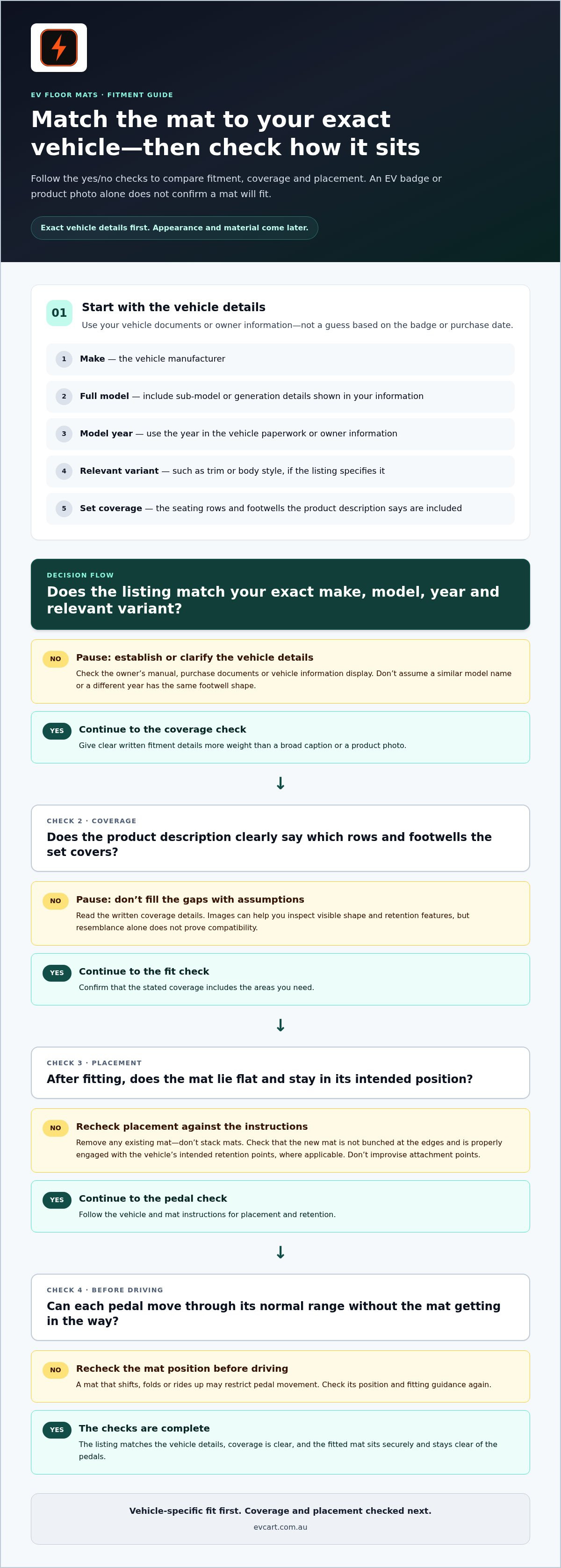
- 1. Make: Record the vehicle manufacturer.
- 2. Model: Note the full model name, including any sub-model or generation detail shown in your documents.
- 3. Model year: Use the year identified in the vehicle paperwork or owner information, rather than guessing from when it was purchased.
- 4. Variant details: Record the trim, body style or other distinction if the listing uses it to specify fitment.
- 5. Set coverage: Check which seating rows and footwells the product description says are covered.
Match the make, model, year and variant
Start with the owner’s manual, purchase documents or vehicle information display to establish the exact model and relevant year. If the product listing separates trims or body styles, compare those details as well. A brand name alone is too broad, and a model-family name may include versions with different interiors.
Compare each detail directly with the listing’s fitment information. Don’t treat similar model names as equivalent or assume successive model years share the same floor shape. A vehicle update can change interior details, so the listing should identify the version it is intended to fit.
Read fitment descriptions and product images carefully
Check what the described set covers. A listing may refer to particular rows or footwells, so don’t assume a set includes every seating area. Read the written fitment details first, then use product images to inspect visible contours and any retention features.
Compare those visual cues with your vehicle’s interior, but don’t rely on resemblance alone. A photo can help you understand the mat’s shape; it doesn’t prove compatibility with your exact year or variant. Give more weight to clear written fitment information than to a broad caption or generic image.
If key details conflict, or the listing leaves the intended model year or coverage unclear, pause before choosing. Don’t fill gaps with assumptions based on appearance. This check helps narrow down floor mats for electric cars to options whose stated fitment matches your vehicle details.
Keep your vehicle information handy while browsing EV accessories, so you can compare it with product descriptions before deciding.
Compare coverage and everyday usability without guessing
Once the listing matches your vehicle, check what the set covers and whether that coverage suits your routine. Two listings can both describe floor mats for the same vehicle yet differ in the footwells they include. Don’t assume a product image shows every piece in the set. Read the coverage description and compare it with the images before deciding.
Check which parts of the cabin the set covers
Look for clear wording about the driver’s area, front passenger footwell and rear row. Some descriptions specify only front mats; others identify additional pieces. Check whether the images show each mat separately, including its edges and contours. If rear coverage isn’t clear in the images, don’t infer that it’s included. Use written coverage details and product images as complementary checks.
| What to check | Question to ask |
|---|---|
| Front coverage | Are the driver and front passenger areas both described? |
| Rear coverage | Does the listing identify the rear footwell or row as included? |
| Edges and contours | Do the images show the shape and boundaries of each mat? |
| Set contents | Can you tell how many cabin areas the described set covers? |
Compare the listing’s stated coverage with the areas you want protected. A photo can clarify shape, but it can’t reliably show what’s included if the set contents aren’t explained. Pause if the description and images leave you unsure which rows or footwells are covered.
Assess practical use for your regular driving
Think about who usually travels in the vehicle and which seats are used most. If passengers regularly sit in the rear, rear-footwell coverage may matter more than it would in a vehicle usually driven alone. Then consider your clean-up routine. Look for care instructions that suit how you prefer to remove, clean and refit mats. Keep this assessment separate from material choice.
Fit and coverage tell you where a mat belongs and what it protects. Material comparisons answer different questions, such as whether a surface suits your cleaning preferences. Don’t let a material description stand in for clear information about set contents or cabin coverage. For more on these considerations, consult the EV floor mats guide to fit and materials.
A suitable fit is supported by clear vehicle fitment, stated coverage for the cabin areas you need, and images that let you assess each mat’s shape. Compare options on those details, not assumptions.
Use this checklist when placing and checking your floor mats
A careful fit check doesn’t end when the mat is in the cabin. Follow the mat’s instructions, position each piece in its intended footwell and check the driver’s area before setting off. Vehicles can use different retention arrangements, so use the points provided for your vehicle rather than assuming how the mat attaches.
Check position before driving
With the vehicle stationary, place each mat in its intended footwell and align it without forcing the edges into place. Check the driver’s mat against the vehicle’s intended retention points, where provided. Look for folds, overlap or edges that could catch against a pedal. Press each pedal through its normal movement to confirm nothing restricts it before driving.
- Prepare the footwell. Remove loose items and any existing mat. Clear the area so you can see how the replacement sits.
- Position each piece. Match it to its intended footwell and orient it according to the mat instructions. Don’t force it into place if the shape or position appears wrong.
- Check retention. Engage only the vehicle’s intended mat-retention points, if fitted. Don’t attach the mat to improvised points or leave it resting over a fitting.
- Inspect the driver’s area. Check that the mat lies flat, doesn’t catch or overlap, and leaves the pedals unobstructed through their normal movement.
- Review the other footwells. Confirm each mat sits as intended and doesn’t interfere with seat movement or other cabin features.
Keep the driver’s pedals completely unobstructed. If the mat shifts, bunches or restricts pedal movement, correct the issue before driving.
Keep mats clean and re-check their position
Follow the care instructions supplied with the specific mat. Remove it as directed, clean it using the stated method, and let it dry as instructed before putting it back. Refit it in the intended footwell and repeat the position and retention checks, especially in the driver’s area.
Build a quick visual check into your routine after cleaning or whenever a mat appears to have moved. Look for curling, worn areas, damage or a change in how it sits. Don’t ignore a fit concern; pause using the mat until it can be positioned correctly. Avoid modifying a mat to make it sit flat, as this can change its shape or placement.
Floor mats for electric cars need to remain correctly positioned during everyday use. For a suitable next step, explore EV accessories and compare product details with your vehicle before choosing.
Turn your EV floor-mat checklist into a confident next step
A sound choice starts with matching product information to your vehicle, then checking how the mats sit once placed. Confirm the make, model, year and relevant variant. Compare those details with the listing, check which footwells are covered, and make sure the driver’s mat stays secure and clear of the pedals.
A quick decision checklist before choosing
Use this final review before selecting floor mats for electric cars. If an essential detail is missing or unclear, pause rather than treating a similar model name or product photo as proof. Fitment wording, set coverage and a placement check each answer a different question.
- Vehicle: Have you recorded the exact make, model, model year and relevant variant or trim?
- Listing: Does the stated fitment match those details, rather than only the brand or model family?
- Coverage: Does the description specify the footwells and seating rows you want covered?
- Placement: Can the mats sit in their intended positions and use the vehicle’s designated retention points, where applicable?
- Driver’s area: Once fitted, is the mat secure and clear of the pedals throughout their normal movement?
Keep the vehicle documents and product details side by side while checking. If the listing names a particular year or variant, compare that information directly with your vehicle rather than relying on the date you bought it. Treat images as a useful way to assess shape and visible contours, not as a substitute for written fitment information.
Choose with clear information, not assumptions
An EV badge identifies the vehicle as electric; it doesn’t establish the shape of its footwells or confirm that a mat fits. Use the fitment details shown for your vehicle, then check the stated coverage and placement guidance. If those details don’t resolve a question, don’t fill the gap with an assumption based on appearance.
Keep product-specific decisions tied to the information in the relevant listing. Avoid generalising from a mat that looks similar or from fitment stated for another model year. This helps you separate what’s described from what a photo might suggest, giving you a clearer basis for comparing suitable options.
For broader context on choosing accessories for Australian EV ownership, explore the Australian EV accessories buyer’s guide. It can help you consider a floor-mat decision alongside your wider accessory needs, while keeping compatibility and practical use central to the choice.
Ready to browse? Explore EV Cart Australia accessories and use your checklist to assess the product details that matter for your vehicle.
Make your next accessory choice with confidence
Keep your vehicle details handy whenever you compare accessories. It’s a simple habit that helps you assess whether a product suits your car, rather than relying on a familiar badge or similar-looking interior. Apply the same careful approach to floor mats for electric cars and other additions you’re considering for your cabin.
Choose based on the information provided, and take the time to weigh what matters for your everyday driving. A considered decision is more useful than a quick guess, especially for an accessory that needs to sit properly in the vehicle.
Ready to explore options for your EV? Explore EV Cart Australia accessories and take your next step with confidence.
Frequently Asked Questions
Are floor mats for electric cars different from regular car mats?
An electric drivetrain doesn’t mean a car needs a fundamentally different type of floor mat. The key question is whether the mat suits the vehicle’s cabin, not whether it’s marketed specifically for EVs. Some drivers may prefer a low-odour material, but that preference doesn’t prove a mat will fit. Treat EV-specific wording as a product description, not confirmation of compatibility.
Can I use universal floor mats in an electric car?
Possibly, but “universal” doesn’t guarantee a suitable fit. Before using one, check that it lies flat in the footwell, can be secured as intended and stays clear of the pedals. Don’t trim a mat unless its instructions explicitly allow it, and don’t place it over another mat. If it shifts or bunches during a position check, don’t use it in the driver’s area.
How do I know which floor mats fit my electric car?
Compare the vehicle details in your owner information with the fitment details shown for the mat. Pay attention to distinctions such as trim or body style, rather than relying on a broad model-family name. If the listing uses unfamiliar terms, use the vehicle’s documentation to interpret them. Keep a note of the details you matched so you can compare options consistently.
Can floor mats affect an electric car’s driving range?
A floor mat doesn’t change the battery’s capacity or the vehicle’s electric drivetrain. Like other added weight, a mat contributes to the load the car carries, but it isn’t a practical way to manage driving range. Focus on choosing a suitable mat and keeping the cabin clear of unnecessary heavy items. Driving conditions and vehicle use are more relevant considerations for range.
How often should I clean electric car floor mats?
Clean them according to the care instructions and how quickly they collect dirt. A mat used through wet or muddy conditions may need attention sooner than one that stays mostly clean. Remove loose grit before it gets ground into the surface, and deal with spills promptly using the method specified for that mat. Don’t return a mat to the cabin while it’s still wet if its instructions require it to dry first.
When should I replace my car’s floor mats?
Replace a mat if damage or wear stops it sitting securely and flat. Look for splits, curled edges, worn backing or retention features that no longer hold it in position. Persistent movement or a shape that interferes with the driver’s pedals is a reason to stop using it. There’s no single replacement interval that suits every driver, so base the decision on condition and fit.