
Portable EV Chargers in Australia: Prices and Features
2026-10-29

A higher-output portable EV charger isn’t automatically the right fit for your car or power point. Choosing a portable EV charger in Australia starts with matching the charger to your vehicle’s connector and the available outlet, not simply picking the biggest output.
It’s reasonable to want a charger that’s easy to carry and straightforward to use, without paying for features you won’t need. This guide explains the main charger types and what affects their price, then compares cable lengths, smart features and portable models with an integrated Type 2 charging gun.
You’ll also need to consider how the power supply and charging current affect everyday use, and what to look for when comparing specifications. Use these details to narrow down options that suit your vehicle, charging setup and routine.
Key Takeaways
- Match the charger’s plug and current setting to the power outlet you can use, as well as your vehicle’s charging limits.
- Choose a cable length that reaches comfortably from the outlet to your car without creating an awkward or unsafe setup.
- Compare adjustable current and delayed-start functions to see whether they suit your charging routine.
- Check connector compatibility: Type 2 is used for AC charging, while CCS2 is used for DC fast charging in Australia.
- Compare products by power, cable length, portability and included safety features, not price alone.
Table of Contents
What Is a Portable EV Charger?
A portable EV charger connects an electric vehicle to a compatible power outlet without a fixed charging unit. Before using one, match the outlet, charger plug and vehicle connector, then follow the manufacturer’s instructions.
Household Power Point Charging
A household power point can supply a portable charger if the charger is designed for that outlet. Check the outlet type and plug before connecting anything. Your vehicle’s charging inlet and onboard charging system also determine whether the setup is compatible and how quickly it charges.
For regular home use, consider where the car parks and whether the cable can reach without being stretched or trapped. Use the charger as instructed, keep its connections accessible, and never force a plug into an incompatible outlet.
Power Output and Plug Compatibility
Power output depends on the charger, available supply and vehicle’s ability to accept power. A charger’s stated maximum doesn’t mean every vehicle or outlet will deliver that rate. Compare specifications for all three parts of the setup before choosing a portable unit.
Check the outlet plug separately from the connector that attaches to your vehicle. They serve different purposes: a suitable vehicle connector doesn’t guarantee that the supply-side plug will fit your power point. Consult your vehicle documentation and charger instructions to identify compatible connections.
Adjustable Charging Power
Some portable chargers let you select a lower charging current. This can help match operation to the available supply, but the setting must still suit both the outlet and charger. Read the instructions before changing settings, and don’t assume a higher setting is suitable just because it’s available.
Compare timing controls, such as a delayed start, too. These features can fit charging around your routine, but they don’t change the underlying capabilities of the outlet, vehicle or charger.
A portable power station also needs a careful compatibility check. Compare its stated output and socket with the charger’s requirements, then consider whether your vehicle can accept the resulting supply. A familiar-looking socket alone doesn’t establish that a power station is suitable for EV charging.
Before buying, check your vehicle connector, outlet type, charger plug, operating instructions and cable route. For practical use, connect only compatible equipment as directed by its manufacturer. This helps you choose a charger for your setup without making assumptions about a particular vehicle or outlet.
Cable length, smart features and portability
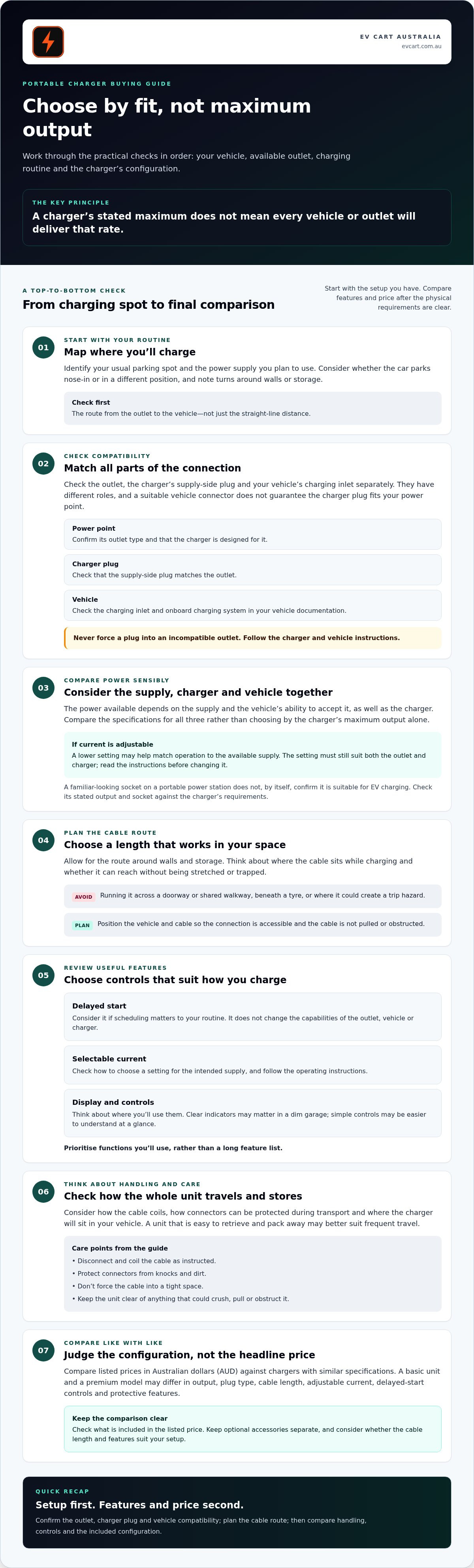
Think about how the charger will fit into your routine, not just whether it can travel in the car. Measure the route between your usual parking spot and power supply, including turns around walls or storage. A charger that reaches a driveway space, for example, may not reach the same vehicle when it’s parked nose-in.
Consider where the cable will sit while charging. A route across a doorway or shared walkway can obstruct access, while one beside a wall may keep it out of the way. Plan the connection before plugging in, and position the vehicle so the cable doesn’t run beneath a tyre or create a trip hazard.
Portability also depends on how you carry and store the whole unit. Check how the cable coils, whether you can protect the connectors during transport, and where the charger will sit in your vehicle. A unit that’s easy to retrieve and pack away may suit frequent travel better than one that’s awkward to handle.
Smart functions are useful only if they suit your charging habits. If a charger offers a delayed start, consider whether scheduling matters to your routine. If it has selectable current, learn how to choose a setting for the intended supply. Read the operating instructions before relying on either control.
Consider the display and controls in the context of where you’ll use them. A driver charging in a dim garage, for instance, may value clear indicators, while someone carrying the charger between locations may prefer simple controls that are easy to understand at a glance. Focus on functions you’ll use, not a long feature list.
Care can affect portability over time. Follow the instructions for disconnecting and coiling the cable before packing the charger. Protect connectors from knocks and dirt, and don’t force the cable into a tight space. At your charging location, keep the unit clear of anything that could crush, pull or obstruct it.
Use a practical comparison process: map your regular charging spot, plan the cable route, then assess how the unit stores and handles. Consider smart controls once those physical needs are clear. This grounds your choice in your actual routine rather than features you may not use.
Once your charging setup is clear, browse EV accessories that support everyday EV ownership.
Portable EV charger prices in Australia
Compare portable charger prices in Australian dollars (AUD), but weigh each price against the configuration. Output, plug type, cable length and controls all affect what’s included.
Prices in Australian Dollars
Use the listed AUD price as a starting point, then compare chargers with similar specifications. A basic unit and a premium model may differ in adjustable current, delayed-start controls, cable length and protective features. Check what each charger provides rather than comparing headline prices alone.
Start with the outlet you plan to use and your vehicle’s charging inlet. A charger with an incompatible plug won’t suit the socket, however attractive the price. Then compare maximum output and available current settings. Higher output helps only when the supply and vehicle can support it.
Next, consider the cable and included equipment. A longer cable or storage case may affect the overall cost, while a shorter configuration may suit your parking position better. Keep optional accessories separate in your comparison so you can see exactly what the listed price covers.
Solar energy is a separate part of the charging setup. A portable charger manages the connection between the supply and vehicle; it doesn’t generate solar power. If you already use solar energy, compare the charger’s operating settings with your routine rather than assuming a premium-priced unit will make better use of it.
Listed Product Pricing
A listed product price applies to the configuration shown on its product page. Before comparing prices, note the selected plug, cable length and included features. Products with several configuration choices may have different prices for each option, so compare the same setup rather than treating the lowest displayed amount as universal.
For a useful comparison, record each model’s listed AUD price alongside its power output, connector, cable and included controls. This makes differences clear without confusing accessory costs with the charger itself. Check whether a case or cable bag is included or sold separately, and factor it in only if you need it.
Finally, match the value to your needs. If you charge from one familiar socket, a simple portable unit may be enough. If you need different plugs, extra cable reach or selectable current, weigh those features against the added cost. Base your decision on compatibility and practical use, not the word “premium” alone.
Portable EV charging with an integrated Type 2 charging gun
An integrated Type 2 charging gun connects directly to an electric vehicle’s AC charging inlet. In Australia, Type 2 is the standard for AC charging, while CCS2 is used for DC fast charging. Check your vehicle’s port and the charger’s connector before choosing a portable unit.
Type 2 and CCS2 are related but serve different charging functions. A CCS2 vehicle inlet includes the Type 2 connection for AC charging, plus additional contacts for DC fast charging. A portable AC charger with a Type 2 gun uses the AC connection. It doesn’t provide DC fast charging simply because the vehicle also has a CCS2 inlet.
Power depends on the supply, charger and vehicle. Connected to a 32A outlet, a portable Type 2 charger can deliver up to 7 kW on single-phase power. On three-phase power, it can deliver up to 22 kW for compatible cars. The vehicle must support the relevant AC charging rate; the outlet rating alone doesn’t determine what reaches its battery.
Compare the full charging path before buying. Start with the vehicle’s inlet, then match the gun and charger to the available outlet and phase supply. A Type 2/CCS2 vehicle port does not mean every portable charger plug will suit your power point. Check the product’s plug configuration separately from its vehicle connector.
An integrated gun keeps the vehicle-side connector attached to the charger cable. That means you handle one charger assembly rather than pairing a separate Type 2-to-Type 2 cable with a charging unit. Check the cable length and connector arrangement against where the car parks, so the gun reaches the inlet without pulling tight.
Use this quick compatibility check before selecting a portable Type 2 charger:
- Confirm the vehicle uses a Type 2 AC connection, including vehicles with a CCS2 inlet.
- Match the charger’s supply plug to the outlet you intend to use.
- Compare the charger’s phase and maximum output with the vehicle’s AC charging capability.
- Check that the cable reaches the vehicle’s inlet from the chosen parking position.
For example, a compatible electric vehicle connected to a suitable 32A single-phase supply can use a charger rated up to 7 kW. A three-phase setup may support up to 22 kW, but only when the charger and car are compatible. Read each specification together; the Type 2 gun identifies the vehicle connection, not the complete charging performance.
Portable charger product comparisons
Compare chargers by output, plug, cable, weight and features, then match those specifications to your vehicle and power supply. The maximum rating is useful only when your car and outlet can support it.
Portable chargers suit drivers who need a movable unit and have a compatible outlet. A home wall charger stays in place and can deliver 7 kW on single-phase power or 22 kW on three-phase power. Public charging offers access away from home, while portable charging relies on the power supply where you park.
For a like-for-like comparison, consider two different portable examples. The Mini Portable Type 2 EV Charger weighs 3 kg, has a 6 m cable and supports 8A, 12A and 15A settings. The range added per hour varies with the charger, vehicle and charging conditions.
The Portable Charger Single Phase offers a different configuration. It has a maximum current of 32A and maximum single-phase output of 7.2 kW. Its adjustable settings range from 8A to 32A, and its available cable lengths are 5 m and 10 m. Compare the plug options with your intended socket.
Product specifications also distinguish the models. The Mini charger’s stated operating temperature range is -25°C to +55°C, and its warranty is 2 years. The Portable Charger Single Phase is stated to meet IEC 62752, CE and RCM requirements, and has an operating range of -45°C to +45°C. Those details help you compare rating and protection claims without treating two products as identical.
For an apartment, portability may matter if you need to carry the charger between storage and a parking space. Cable reach and the outlet available at that space can be more useful than maximum output. A 22 kW three-phase wall charger offers a different setup, and only suits a compatible vehicle and supply.
Use this comparison order: confirm the car’s connector, identify the available supply, then compare plug, current settings and cable length. Finally, weigh portability and stated safety features against your routine. Drivers travelling under about 50 km per day may find a portable charger on a standard Australian wall socket suitable for their use.
Choose the charger that fits your vehicle and charging location, rather than selecting by maximum output alone. Continue comparing your charging setup with those requirements in mind.
EV Cart Australia: EV accessories
EV Cart Australia offers EV accessories for drivers setting up their electric vehicles. Once you’ve compared charger compatibility, cable reach and charging controls, consider which accessories could make everyday ownership more practical. Start with the needs you’ve identified, such as keeping equipment organised or supporting your driving routine, and browse with those priorities in mind.
Use product details to guide your choice, keeping your vehicle’s requirements in view. When you’re ready to explore accessories that complement your EV setup, browse EV Cart Australia’s range.
Visit evcart.com.au to explore EV accessories or contact EV Cart Australia.
Make your next charging decision with confidence
Before choosing a portable EV charger in Australia, write down how you expect to use it: where you’ll charge, how often you’ll carry it and what matters most in day-to-day ownership. A clear list of priorities helps separate essential features from convenient extras and gives you a practical way to compare options without getting distracted by specifications that won’t affect your routine.
Think beyond the first charge, too. Consider how your setup might change if your parking arrangement, vehicle or travel habits change. A sound buying decision should suit your current needs while making clear the trade-offs you’re accepting.
If you’re ready to explore accessories for your EV setup, contact EV Cart Australia. Take the next step at your own pace and choose what works for you.
Frequently Asked Questions
Can I charge an EV from a standard household outlet every night?
Yes, an EV can charge from a standard household outlet each night when the charger, outlet and vehicle are compatible. The practical question is whether the charge added during your available hours meets your daily driving needs. For example, compare the vehicle’s energy use and next day’s trip with the charge gained overnight. Follow the charger instructions and avoid using an extension cable with a 15A charger.
What portable EV chargers are available in Australia and how do they compare?
Australian options include chargers for household outlets and higher-current outlets, with differences in plug, current settings, cable length and controls. For example, the Mini Portable Type 2 EV Charger has 8A, 12A and 15A settings; the Portable Charger Single Phase has settings up to 32A. Compare those options against your vehicle and regular charging location, rather than choosing by maximum rating alone.
How much do portable EV chargers cost in Australia?
Portable charger prices vary by output, plug configuration, cable length and smart controls. A basic outlet charger and a higher-output model with selectable current are different configurations, so compare like with like. Check whether storage accessories are included or optional, and assess the listed price for the exact plug and cable you need. Compare the total cost of a suitable setup, not just the lowest starting price.
Which Australian plug types and outlet ratings do portable EV chargers use?
Portable chargers can use plugs for 10A or 15A household outlets, as well as higher-current options such as 20A or 32A plugs. Configurations may include three-pin or five-pin plugs, and CEE three-pin plugs. Identify the outlet available at your charging location, then match the charger plug and current setting to it. A plug that physically fits is not enough; its rating must suit the supply.
How fast can a portable EV charger charge an electric car in Australia?
Charging speed depends on the charger output, supply and vehicle’s onboard charging capability. As a guide, a portable charger drawing 10A adds roughly 10 to 15 km of range per hour; a 15A charger draws around 3.5 kW. Treat range added as an estimate for comparison, not a fixed result for every vehicle, as driving efficiency and conditions affect usable range.
Are portable EV chargers compatible with different EV makes and models?
Compatibility depends mainly on the vehicle’s charging inlet and the charger’s vehicle-end connector. Type 2 is used for AC charging in Australia, while CCS2 vehicles can also use the Type 2 portion of their inlet for AC. Before buying, check the vehicle manual or inlet information, then compare the charger connector and supported charging rate. Make and model alone don’t establish connector or charging compatibility.
What safety standards and certifications should portable EV chargers meet in Australia?
Compare the standards and certification marks stated for the exact charger, rather than assuming every model carries the same claims. The Portable Charger Single Phase is stated to meet IEC 62752, CE and RCM requirements, and includes an integrated Type A residual current device with AC/DC protection. Read the manufacturer’s instructions and check that the listed specifications describe the model and configuration you intend to use.
Can you use a portable EV charger with a regular household power outlet in Australia?
Yes, a portable charger designed for a compatible household outlet can charge an EV from that outlet. A 10A household power point can supply a charger drawing about 2.2 kW, while the vehicle may limit the rate further. Match the plug and current setting to the outlet, and consider whether the charge gained during your parking period suits your next trip. Never force a mismatched plug.