
Portable EV Charging Options for Australian Renters
2026-11-05

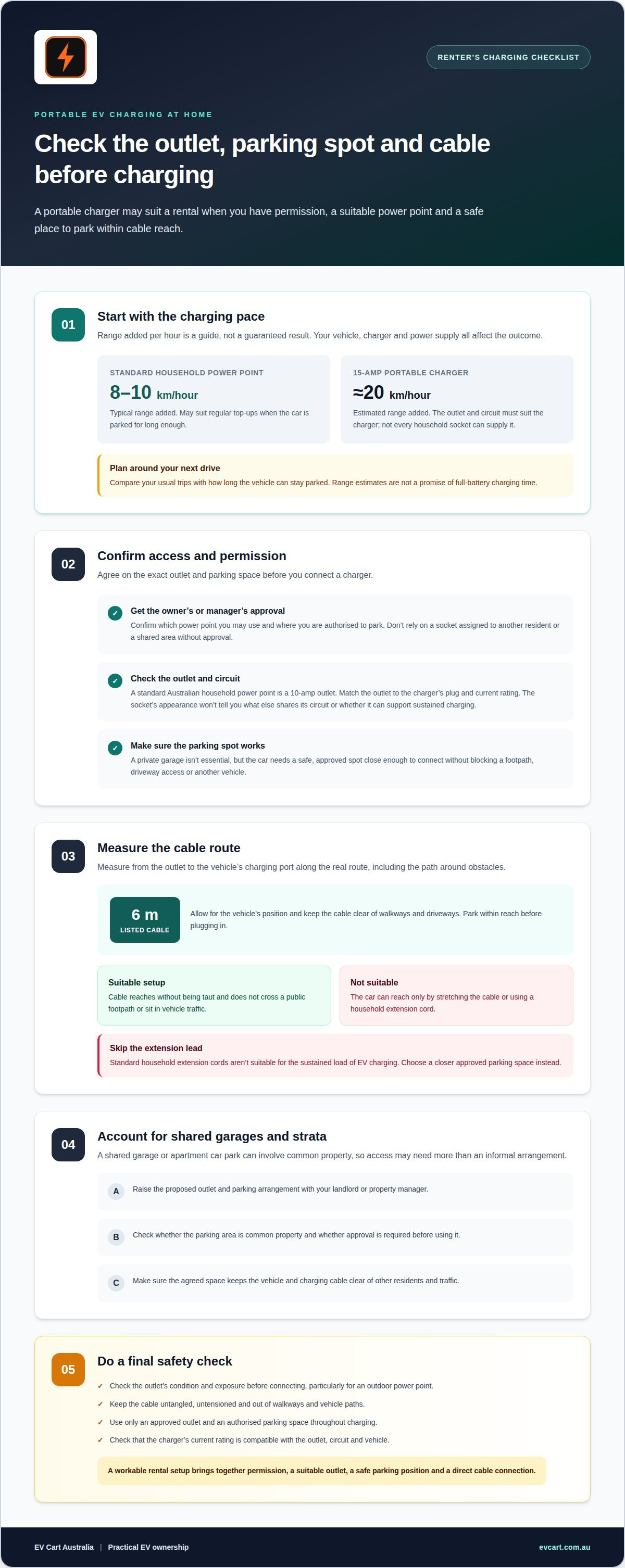
Renting doesn’t automatically rule out charging at home. A portable EV charger for renters can use a standard Australian household power point, which typically adds around 8 to 10 kilometres of range per hour. You’ll need permission from whoever owns or manages the power point, plus a safe parking spot close enough to connect without stretching the cable.
A portable charger can work if you have access to a suitable nearby outlet, but charging speed and safe access matter. A shared garage or apartment car park may also require approval, particularly when the parking area is common property.
This guide explains how to assess an outlet and charging setup, what to consider before using a portable charger, and how to approach shared garages and strata-managed buildings. You’ll be able to weigh the practical limits and choose an approach that suits your rental and vehicle.
Key Takeaways
- A standard household power point typically adds around 8 to 10 kilometres of range per hour, so consider your regular driving needs when planning charging.
- Get permission before using a rental property’s power point, and park close enough to connect without relying on an extension lead.
- Assess the outlet, charger and cable setup for safe, suitable use before charging.
- In a shared garage or apartment car park, raise the proposal with your landlord or property manager and account for common-property approvals.
- Portable charging can suit renters who have safe access to a suitable outlet; EV Cart Australia offers EV accessories to support practical EV ownership.
Table of Contents
Charging from a power point near a safe parking space
Yes. Renters in Australia can use a portable EV charger with a standard household power point if they have permission and a safe place to park nearby.
A standard power point typically adds around 8 to 10 kilometres of driving range per hour. This can suit regular top-ups, but the time needed depends on how far you drive and how long the car stays parked.
Power-point type and circuit capacity
Start by identifying the outlet and matching it to the charger’s plug and current rating. A standard Australian household power point is a 10-amp outlet, and a compatible charger can connect directly. The circuit’s capacity also matters: a socket’s appearance alone doesn’t show what else shares its circuit or whether it can support sustained charging. Get the property owner’s permission before using it.
Check the parking arrangement next. You don’t need a private garage if you can park safely in a driveway near the outlet. The car must be within reach of the charger cable, without blocking a footpath, driveway access or another vehicle.
For example, a renter with an approved driveway space can park beside an exterior power point and connect the charger directly. A power point inside a locked garage won’t help if the car must stay outside or the cable can’t reach safely.
Before charging, agree on how the property can be used with the person responsible for it. Confirm which outlet you may use and where you can park. This avoids relying on a socket that belongs to another resident or serves a shared area.
Charging cable length
Measure the actual route from the outlet to the vehicle’s charging port, not just the gap between the wall and car. A listed portable charger cable is 6 m long. Allow for the path around obstacles and the vehicle’s parking position, while keeping the cable clear of walkways and driveways.
Park within the cable’s reach before plugging in. Don’t pull the cable taut, leave it where people could trip, or run it across a public footpath. If the car can only reach the outlet with an extension lead, the outlet and parking position aren’t suitable for a direct connection.
Standard household extension cords aren’t suitable for the sustained load of EV charging. Choose a parking space closer to the outlet instead. That may mean arranging access to another approved space rather than running a cable across a shared driveway.
Then assess how charging fits your routine. At 8 to 10 kilometres of range per hour, a short overnight stay adds less than a long parked period. Compare that pace with your usual trips, and plan charging around the hours the vehicle can remain safely parked.
Keep the vehicle in an authorised space throughout charging. Don’t leave a cable exposed to vehicle traffic or use an outlet without the owner’s approval. A portable EV charger for renters works best when the outlet, circuit, parking position and cable route suit the same setup.
Level 1 charging speed and suitability
Level 1 charging uses a standard household power point, so the available charging rate is modest. A 15-amp portable EV charger is estimated to add approximately 20 kilometres of driving range per hour. Treat that as a guide, not a fixed result for every vehicle or charging setup.
Charging speed depends on the charger’s current, the power supply at the outlet and the vehicle’s charging capacity. The car’s energy use also affects how much driving range each hour of charging provides. Two EVs connected to the same charger can therefore gain different amounts of range.
To decide whether this suits your routine, start with your usual driving. Consider how far you travel between parking periods, then compare that with how long the vehicle can stay connected. A car parked at home overnight has more time to charge than one returned briefly between trips.
- Regular, shorter trips: A slower charger may keep up when the car has frequent, lengthy parked periods.
- Longer daily drives: Compare the charging time available with your vehicle’s energy use before relying on a power point alone.
- Irregular schedules: Think about whether your parking access is consistent enough to charge when the vehicle is stationary.
Use the charger’s stated current as a buying criterion. A 15-amp model and a lower-current portable charger don’t deliver the same charging rate. The outlet and circuit must also suit the charger. Don’t assume that a higher-current unit can draw more power from any household socket.
Range estimates describe the driving distance added per hour, not the time needed to fully charge a battery. The starting charge, battery capacity, vehicle efficiency and charging limits all affect total charging time. For planning, focus on the range you need before your next drive, rather than treating a full recharge as the only useful outcome.
A portable EV charger for renters can suit drivers whose cars stay parked long enough to build charge gradually. It may be less suitable if frequent long trips leave little time at home. In that case, consider whether public charging could provide occasional top-ups alongside any home charging access.
Keep expectations practical. A 15-amp portable charger’s estimated 20 kilometres per hour can help compare options, but your vehicle and supply shape the result. Review the charger’s current rating and the vehicle’s charging compatibility before choosing equipment. For a portable charging setup, browse EV accessories that support EV ownership.
Charger safety and certification
Extension leads add risk during EV charging. The charger seller advises against using one with the Mini Portable Type 2 EV Charger because it may overheat and create a fire hazard. An outdoor power point also needs careful assessment: check its condition and exposure before connecting, and don’t use a visibly damaged or wet outlet.
Connect the charger directly to a suitable power point. If the cable can’t reach the parked vehicle, change the parking position or use an outlet closer to the car. Don’t bridge the gap with a household extension lead. This keeps the setup aligned with the charger seller’s warning.
Look at the charger’s stated safety features, not just its plug or appearance. The Mini Portable Type 2 EV Charger includes Type A protection with 6 mA DC detection. Its product page also identifies IEC/EN standards in the heading about safety features. Treat these as details to understand when comparing equipment, rather than assuming every portable charger has the same design.
Before each charging session, inspect the plug, cable and vehicle connector for visible damage, looseness or wear. Keep the cable away from vehicle wheels and walkways. If you find damage, don’t use the charger until the issue has been addressed. These checks can help identify problems before a long charging session.
For outdoor use, check the area around the outlet. Consider whether the socket is exposed to rain, moisture, dirt or potential impact. Follow the charger’s instructions and avoid connecting equipment through a wet or damaged outlet. A weather-exposed location isn’t suitable simply because it has a power point.
- Use a direct connection: Don’t add an extension lead to make the charger reach.
- Inspect the equipment: Check the outlet, plug, cable and connector before charging.
- Review stated protections: Look for specific features, such as Type A protection and 6 mA DC detection.
- Keep the route clear: Position the vehicle so the cable doesn’t cross a walkway or sit under a tyre.
Renters should also consider who controls an outdoor socket. Get permission before using a power point at a rental property, especially in a shared area. For example, an outlet beside a common driveway may not be intended for one resident’s regular charging. Agree on the permitted socket and parking position before plugging in.
Safety depends on the complete setup: the outlet, charger, cable route and parking location. A feature listed for a charger doesn’t make a damaged socket or unsuitable connection safe. Follow the manufacturer’s instructions and avoid extension leads for sustained EV charging.
Charging in shared garages and condos
Discuss EV charging with your landlord or property manager and get approval for the arrangement. A portable charger may work in an apartment car park if you have permission, an appropriate outlet and a safe way to connect.
Landlord and strata approval
Start with the person responsible for your tenancy, then identify who controls the parking area. Ask about regular outlet use, your allocated space and any shared-property rules. Owners corporations and strata managers make decisions about common property, including parking areas. Charging arrangements that affect shared property may also require local council approval.
Apartment and shared parking use
A portable charger can be used in shared parking if the outlet and parking arrangement are approved and suitable. Access is key: a socket inside a common garage may be too far from your allocated bay, or its use may be shared with other residents. Don’t run a cable across a traffic route or obstruct access.
Get separate permission to use the outlet and the parking space. For example, an allocated bay doesn’t automatically give you permission to use a nearby common-area power point. Confirm who controls the socket and whether charging there could affect other residents or building operations.
Keep your proposal practical. Explain which outlet you intend to use, where the vehicle will be parked and how the cable can reach without crossing a walkway or vehicle route. Include when you expect to charge and how you’ll avoid interrupting other residents’ access. These details help property management and the owners corporation assess the arrangement.
A proposed fixed charger may involve more than the renter and landlord. The building’s owners corporation or strata manager may need to consider common property, parking access and council approval. Portable equipment avoids a fixed installation, but it doesn’t remove the need for permission to use shared infrastructure.
- Identify decision-makers: Contact your landlord or property manager, then establish whether the bay or outlet is common property.
- Describe the setup: Specify the outlet, parking position and cable route.
- Respect shared access: Keep the cable and vehicle clear of walkways, driveways and neighbouring bays.
Australian governments are developing programs to address retrofitting multi-unit dwellings, including in NSW and the ACT. Victoria has released a poster on EV-ready buildings for owners corporations. These developments reflect the challenge of planning charging in shared buildings, but they don’t replace approval for your specific parking space.
If you don’t have approval to use a power point, don’t use it, however convenient it may seem. A fast charge once per week can fulfil average distance travelled for EV owners in Australia who can’t charge where they live, including those without installation approval. Any alternative still needs to suit your driving and charging access.
Portable EV chargers for renters
Portable chargers can suit renters who need equipment they can take between properties. Compatibility depends on the vehicle’s charging inlet and the charger’s connector and electrical requirements. Check those details against your vehicle handbook before choosing a charger. A Type 2 connection, for example, is suitable only when it matches the vehicle and charging setup.
Separate the decision into two parts: whether the charger connects to your EV, and whether your parking location supports its use. A compatible connector doesn’t make every outlet suitable. Likewise, an accessible power point won’t help if the charger plug doesn’t match your vehicle.
Consider how you’ll store and move the equipment. A renter who changes homes may value equipment that can travel with the vehicle, while someone using shared parking needs a setup that can be packed away after charging. Store the charger safely, and don’t leave its cable where it could be driven over or become a trip hazard.
Before choosing a portable EV charger for renters, write down the details that shape everyday use:
- Vehicle: Record the connector type and charging requirements for your specific model.
- Parking: Note whether the space is private, allocated or shared.
- Permission: Establish who controls the outlet and whether regular use is approved.
- Routine: Consider when the vehicle is parked and how you’ll manage charging access.
For example, a renter moving between properties could take their charging equipment along, but must still arrange suitable outlet access at each address. In an apartment, the key question is whether the approved parking space and outlet can be used together. A portable charger doesn’t grant permission to use a landlord’s or building’s power point.
Compare equipment by its stated connection requirements and intended use, not just by the broad “portable” label. A charger designed for one supply may not suit another. Match the specifications to your vehicle and available outlet, then consider how easy the equipment is to store and carry.
Base your choice on your actual arrangement. If you can’t use a suitable outlet where you live, portable equipment won’t solve the access problem. Workplace, public or shared charging may be more practical until your parking or property permissions change.
For broader EV ownership needs, explore EV accessories and choose items that fit your vehicle and routine.
EV Cart Australia
EV Cart Australia offers EV accessories for practical electric vehicle ownership, including vehicle-specific accessories and home charging hardware. Once you’ve established outlet access, vehicle compatibility and cable requirements, choose accessories that suit your setup.
Use these details to guide your decision. A renter with an approved power point has different needs from someone relying on shared parking or charging away from home. Keep compatibility and everyday use in mind as you compare options.
For help with EV accessories, contact EV Cart Australia.
Make your charging plan work day to day
Build a routine around your parking arrangement. Decide where the vehicle will sit, when it can charge and how you’ll keep access clear for other residents. If your rental or building arrangements change, revisit the plan before using a different power point or parking space.
A portable EV charger for renters is useful only when it suits your vehicle, outlet access and regular driving pattern. Consider all three together as you decide what equipment belongs in your setup. This helps you avoid choosing based on a connector or cable that doesn’t suit your parking arrangements.
EV Cart Australia can help with the accessories side of practical EV ownership. If you’re ready to consider your next step, contact EV Cart Australia to discuss your EV accessory needs.
Frequently Asked Questions
Home EV charger as a renter: what are your options?
Renters can use an approved household power point, arrange an approved fixed charger, or charge away from home. The right option depends on parking access, outlet location, driving routine and permission to use the property’s electrical infrastructure. For example, someone without home parking may plan around workplace access, while a renter with an allocated space may explore an approved home setup.
Can I charge an EV without a garage?
Yes. A garage isn’t essential if you can park safely near an approved power point, such as in a driveway. In an apartment, check whether your allocated space has access to a suitable outlet without a cable crossing a walkway or vehicle route. If home charging isn’t practical, consider workplace or public charging as part of your regular routine.
What portable EV chargers are available in Australia for renters?
Portable options include chargers designed for a standard 10-amp household outlet, as well as higher-current models that need a suitable compatible outlet. Some use a Type 2 vehicle connector, but the correct choice depends on your EV’s inlet and the power supply available. Compare the plug, current rating and cable length, then match them to your vehicle and parking arrangement.
What charging speed and range per hour can portable chargers provide?
Charging speed varies by charger current, outlet supply and vehicle efficiency. As a guide, a standard Australian household power point typically adds around 8 to 10 kilometres of range per hour. A 15-amp portable charger is estimated to provide approximately 20 kilometres per hour. Use these estimates to plan around your parked time, rather than treating them as guaranteed results.
What electrical safety requirements apply to portable EV charging?
Use a charger suited to the outlet and vehicle, and connect it directly without a household extension lead. Before charging, inspect the socket, plug and cable for visible damage. Keep connections away from wet or damaged outlets, and route the cable clear of foot traffic and vehicle wheels. Follow the charger’s operating instructions and get permission before using a power point at a rental property.
How does a portable charger compare with a fixed home charger?
A portable charger can move with you and avoids needing a charger fixed to the property. Its charging rate depends on the outlet and charger rating. A fixed Level 2 home charger requires an approved installation, which can make it less straightforward in a rental or shared building. It can allow most vehicles to recharge fully overnight, depending on the vehicle and setup.
What alternatives can renters use, such as workplace, public or shared charging?
Workplace charging can suit drivers whose vehicles remain parked during work hours. Public chargers are another option, while shared building charging may work where access and approvals are arranged. Public DC fast chargers can recharge an EV in as little as 10 minutes to an hour. Plan around charger location, your parking time and the distance you need before your next trip.