
Solar EV Charging Without Grid Export: Use Your Surplus Power
2026-11-15

Your rooftop solar can help charge an EV without sending surplus power to the grid. Charging an EV from solar without exporting to the grid relies on equipment that measures household power flow and adjusts charging to use available solar surplus.
If you already have solar, you may be able to add EV charging without changing how the rest of your system operates. The key is matching the charging method to your solar output and household electricity use, particularly if you also have a home battery.
This guide explains how solar charging works, how smart chargers use surplus generation and how to avoid drawing from your battery when solar output falls. It also covers the factors that affect potential savings, helping you compare daytime solar charging with grid electricity.
Key Takeaways
- A solar-aware charging setup can track household power flow and use surplus generation to charge your EV instead of exporting it.
- To avoid drawing from a home battery, charging controls need to account for battery use as well as solar output and household demand.
- Your existing solar system may support EV charging, but available surplus and charging speed depend on the system and your home’s electricity use.
- A smart charger can adjust charging to match solar surplus; a standard portable cable does not show how much solar power is going into the car.
- Compare the value of using surplus solar with the electricity you would otherwise buy, and consider EV accessories from EV Cart Australia for practical ownership needs.
Table of Contents
- Charge EV with surplus solar without draining home battery
- Can I add solar EV charging to my existing setup?
- Savings from using excess solar instead of grid electricity
- Can Any EV Charger Use Excess Solar, Or Do I Need A “Smart” Charger?
- Using surplus solar to charge an EV without exporting power
- EV Cart Australia
Charge EV with surplus solar without draining home battery
A home battery shifts solar energy from daylight into evening use. It can also supply an EV after sunset, but that energy then isn’t available for other household loads. Australian domestic battery systems average around 10-13.5 kWh of storage. That capacity is shared, not reserved automatically for driving, so overnight charging can reduce the energy left for the home.
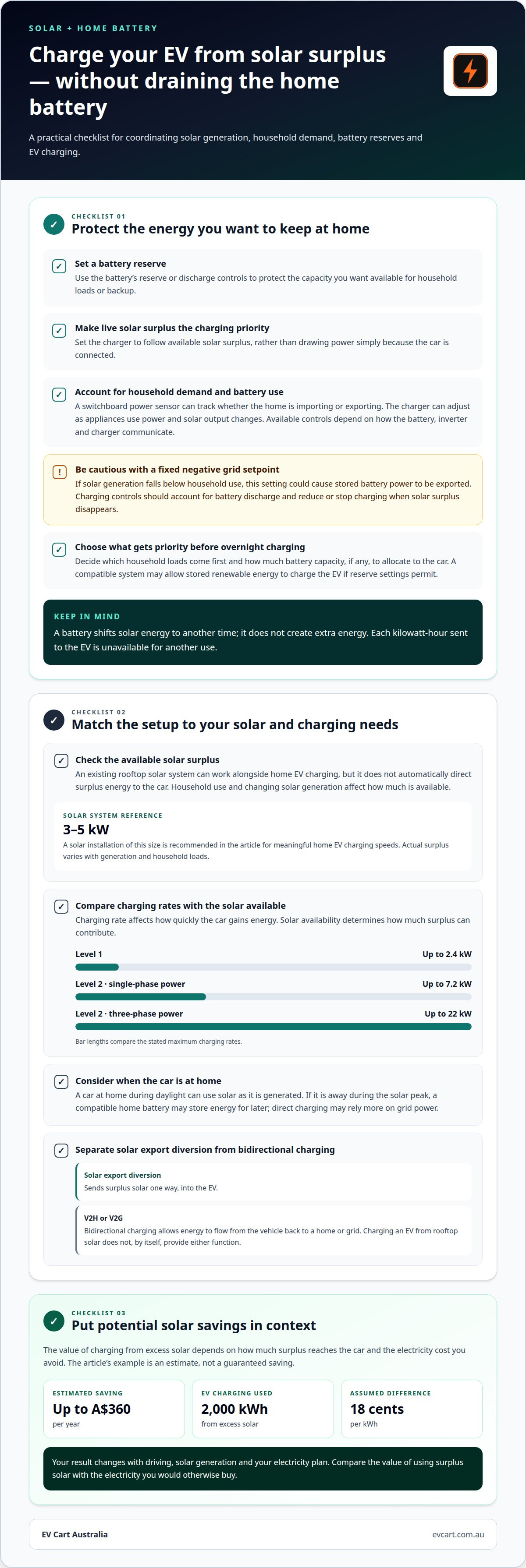
To prioritise household backup, use your battery’s reserve or discharge controls alongside the charger’s solar settings. Set the charger to respond to solar surplus rather than draw power whenever the car is connected. Where supported, a minimum battery reserve can limit discharge. The available controls depend on how the battery, inverter and charger communicate.
A switchboard power sensor can track whether your home is importing or exporting electricity. The charger can use this reading to adjust the charging rate as household demand changes. When solar output falls or appliances draw more power, the available surplus shrinks. A solar-following setting helps the charger respond, rather than treating the battery as an unlimited supply.
Be cautious with a fixed negative grid setpoint. If solar generation drops below household use, the setting could cause the battery to export stored power. The EV may then use energy reserved for evening appliances or backup. A better approach accounts for battery discharge as well as grid flow, reducing or stopping charging when solar surplus disappears.
Before overnight charging, decide which loads take priority and how much battery capacity, if any, to allocate to the car. For example, you could preserve your chosen reserve and charge from surplus solar, using grid electricity if the car needs more energy. Alternatively, a compatible system may let stored renewable energy charge the EV, if your reserve settings allow it.
A home battery can make solar energy available outside generation hours, but it doesn’t create extra energy. Every kilowatt-hour sent to the EV is unavailable for another use. Compare your driving needs with expected solar generation, household consumption and usable battery storage. If demand regularly exceeds available solar, a battery may shift charging to a more convenient time without covering all EV use.
To avoid draining storage, set a clear control goal: use live solar surplus first, protect the battery reserve and allow battery charging only when intended. The available energy for overnight driving depends on battery capacity, evening household loads and the car’s charging demand.
Can I add solar EV charging to my existing setup?
An existing rooftop solar system can often work alongside home EV charging. The key is matching charging behaviour to available solar generation and your car’s needs.
Compatibility with Existing Home Solar
Compatibility means coordinating an existing solar system with an EV charger so the car can use available excess solar. A system doesn’t automatically direct surplus energy to the vehicle; the charging method and household demand affect how much solar reaches it. A solar installation of 3-5 kW is recommended for meaningful home EV charging speeds. Your actual surplus changes with generation and other loads.
How Solar and EV Charging Work Together
Solar supplies household electricity first, and an EV can use surplus generation while it’s available. A smart charger can schedule charging around midday solar peaks and adjust its rate as generation changes. If solar output falls short, grid electricity can make up the difference, depending on the setup. This lets you charge at home without assuming your panels produce a fixed amount throughout the day.
Home Charging Options
Home charging provides a regular place to charge, while public chargers can support longer trips or occasions when home charging doesn’t suit. A Level 1 charger reaches up to 2.4 kW; a Level 2 charger can reach up to 7.2 kW on single-phase power or 22 kW on three-phase power. The charging rate affects how quickly your car gains energy, while solar availability affects how much excess solar can contribute.
Solar export diversion is different from vehicle-to-home (V2H) or vehicle-to-grid (V2G) charging. Export diversion sends surplus solar one way, into the EV. V2H and V2G involve bidirectional charging, where energy can also flow from the vehicle back to a home or grid. They are separate functions, so an EV charging from rooftop solar doesn’t, by itself, provide either one.
Timing matters. If your car is home during daylight, it can use solar as it’s generated. If it’s away during the solar peak, a compatible home battery can store energy for later, while direct charging may rely more on grid power. The right setup depends on when you drive, how much surplus your panels produce and the charging rate your equipment supports.
Think of the solar system, charger and vehicle as connected parts with different roles: panels generate electricity, the charger manages the flow, and the vehicle stores energy for driving. For practical ownership needs beyond the charging setup, browse EV accessories.
Savings from using excess solar instead of grid electricity
Using excess solar can reduce the grid electricity needed to charge an electric vehicle. The value depends on how much surplus reaches the car and the price of electricity you avoid buying. One example estimates savings of up to A$360 per year when 2,000 kWh of EV charging uses excess solar instead of grid power. That estimate assumes an 18 cents per kWh difference between the electricity rate and the value of exported solar. Your result changes with driving, solar generation and your electricity plan.
Solar panels supply the home first, so EV charging competes with appliances for available generation. When household consumption is high, less solar may remain for the battery. If solar production falls below total demand, grid electricity can make up the shortfall, depending on the charger settings. The practical saving depends on how much EV energy comes from surplus generation, not the system’s total solar output.
Cloud cover and changing household loads affect available surplus throughout the day. A smart charger can adjust its rate as solar generation rises or falls, helping the car use excess energy. For example, when a kettle or another appliance switches on, the remaining surplus may shrink. The charger’s settings determine whether it slows, pauses or draws some grid electricity.
Wholesale electricity prices can change, but households generally pay according to their retail plan, not the wholesale price directly. A time-of-use plan may have different rates at different times, and a suitable smart-charging schedule can align charging with solar peaks or a lower-price period. Compare the retail rate avoided by using solar with the value of exporting that electricity. This gives a clearer picture than treating all solar energy as free.
Consider a household using 2,000 kWh annually for EV charging. At an 18 cents per kWh difference, the example reaches A$360 in potential annual savings. It’s an illustration, not a universal result: the calculation depends on the tariff, export credit, solar surplus and amount of charging shifted from the grid. If the car is away during daylight, less direct solar may reach it. A home battery can shift some generation to later, but stored energy also has other household uses.
To assess your situation, compare three figures from your electricity account and energy monitoring: your import rate, export credit and solar energy available during charging hours. Then estimate how much EV charging you can shift into those hours. This helps distinguish savings from energy that would otherwise be exported or used elsewhere, and shows whether smarter timing can reduce grid consumption.
Can Any EV Charger Use Excess Solar, Or Do I Need A “Smart” Charger?
In Australia, solar-only charging and adjustable export limits require a compatible smart charger and power monitoring. A standard portable cable on a 3-pin outlet can charge an EV, but it won’t show how much solar electricity reaches the car.
Smart Chargers, Sensors and Export Tracking
A current sensor measures electricity flowing between your home and the grid, allowing a smart charger to track imports or exports. Installed at the main switchboard, it can give the charger a live view of household power flow. That matters because solar generation and household demand change as appliances switch on and off.
The described export-diversion arrangement uses a switchboard sensor and isn’t integrated with the solar inverter. The sensor tells the charger whether the home is exporting or importing. The charger can then adjust the current offered to the vehicle through its Type 2, Mode 3 control connection. This reading supports responsive charging without relying on inverter communication.
Smart Charging from Solar Surplus
A smart charger can vary its rate to use available solar surplus instead of charging at one fixed level. When solar generation rises, it can draw more current; when household demand increases, it can draw less. This adjustment directs excess generation to the EV while responding to changing household consumption.
Charging has a practical lower limit. The guidance in this article says most EVs won’t begin charging below about 6 A, and the stated technical standard sets charging at 6 A per phase. If solar export falls below the level needed to start charging, the charger may pause. When the home imports electricity, the described solar charger won’t start a session unless the user overrides it.
Solar Charging Support and Export Limits
For solar-only operation, look for a charger with a solar mode that responds to measured exports. Adjustable export limits let the charging system manage its power draw as solar generation changes. The sensor’s position at the switchboard matters because it measures overall grid flow, not just rooftop panel output.
Before choosing a charger, compare its solar controls with your intended charging behaviour. A standard 3-pin portable cable suits basic charging, but it doesn’t provide visibility of solar energy entering the car. A smart charger paired with current sensing can track that flow and adjust charging. Ask whether its controls support solar-only operation, grid-import response and adjustable export limits.
These features have distinct roles: the sensor measures grid flow, the charger controls current and solar mode determines the charging response. A compatible setup can pause when the home imports power, unless you override that setting. Understanding the difference helps you match charging behaviour to your solar generation and household use.
Using surplus solar to charge an EV without exporting power
A solar diversion charger prioritises household solar that would otherwise flow to the grid. Charging an EV from solar without exporting to the grid works best when the car is home during generation hours and can use the available power.
Minimum Solar Surplus for Charging
The minimum surplus is the amount of spare solar generation needed before EV charging can start. A single-phase charger needs roughly 1.4 kW of surplus, while a three-phase charger needs roughly 4.2 kW. These thresholds help explain why a three-phase vehicle may wait longer for enough excess generation, even when the rooftop system is producing power.
Imagine a home where appliances use most of the solar output. The remaining surplus might meet a single-phase charger’s starting threshold but fall below the threshold for three-phase charging. Whether charging starts depends on the connection type and surplus available at that moment. Understanding these limits helps set realistic expectations for how often solar-only charging can run.
Household Solar Surplus and Solar-Only Charging
Household solar surplus is the generation left after meeting immediate home electricity needs. Solar-only charging uses that remainder, so the energy available for driving varies with your household routine. Running high-demand appliances during strong solar production can leave less for the car, while lower daytime consumption can leave more.
Make better use of surplus by charging when your vehicle is home and household demand is lower. The aim isn’t to direct every unit of solar generation to the EV; the home still needs electricity. This balance matters especially when you want to use renewable energy only and don’t intend to rely on grid power as a fallback.
Charging Only from Surplus Solar
Solar-only charging uses surplus generation and doesn’t automatically draw on grid electricity to fill gaps. This can suit households that prefer to charge their vehicle with renewable energy, but timing becomes less predictable. Passing clouds, changing appliance use and the car’s availability all affect how much energy it receives.
For example, a car connected during a bright part of the day may get a useful charge, while the same car connected on a cloudy afternoon may get less. Charging an EV from solar without exporting to the grid is a trade-off between using available surplus and meeting your preferred departure time. If the car needs a fuller charge sooner, solar-only charging may not suit that trip.
How Solar Diversion Chargers Work
A solar diversion charger directs surplus rooftop solar to the EV instead of sending it to the grid. It makes the car an additional use for renewable generation. This differs from plugging in at a set charging rate, which can draw power whether or not solar surplus is available.
Solar output and household needs still determine the result. The charger can only direct energy the home doesn’t need at that time, and the EV must be connected while surplus is available. Treat solar diversion as a way to use available generation, not a guarantee of a particular charge by a particular time.
For practical EV ownership, browse EV accessories to support your charging routine.
EV Cart Australia
EV Cart Australia offers EV accessories for practical electric vehicle ownership. If you’re planning to charge with solar, accessories can support your driving routine, while your charger and home energy system manage solar use. Consider your vehicle model and everyday needs when choosing accessories, so they suit the way you use your EV.
Solar-only charging depends on your charger’s controls and home solar setup, not on an accessory alone. Choose EV Cart Australia for EV accessories that complement your vehicle and regular use.
For help with EV accessories, contact EV Cart Australia.
Make solar charging fit your everyday routine
Before changing your charging habits, decide what you want your home energy setup to prioritise: predictable charging, greater use of rooftop solar, or keeping stored energy for household needs. That choice gives you a practical basis for setting solar-only charging and deciding when grid power is acceptable. The best approach is one that works with your driving routine, not just the hours when solar generation is strongest.
Think of charging your EV from solar without exporting to the grid as an ongoing household setting, not a one-off decision. Revisit your preferences when driving patterns or household electricity use change. EV accessories can also support your wider ownership setup, so choose items suited to your vehicle and day-to-day needs.
For EV accessories to support your ownership routine, contact EV Cart Australia. Take the next step with a clear sense of how you want your vehicle and home energy to work together.
Frequently Asked Questions
So, how many panels do you actually need?
There’s no single panel count that suits every EV owner. Start with the energy your driving requires, then compare it with the solar generation your household uses and exports. Vehicle efficiency and local conditions affect the result. Treat any panel estimate as a planning guide, not a guarantee that rooftop solar will supply every kilowatt-hour of EV charging.
Can My Inverter Control When The Car Charges?
An inverter can coordinate charging only if it and the charger support a compatible control or data connection. Otherwise, charging decisions may rely on separate monitoring equipment rather than inverter commands. What matters is whether the equipment can act on information about household energy use. If it can’t, the inverter’s generation reading alone may not show whether spare energy is available.
How Many Solar Panels Do You Need To Support An Electric Vehicle?
Estimate the EV’s energy demand from your driving and the vehicle’s efficiency, then compare it with your system’s generation and household use. A household that already uses most of its solar output has less available for the car than one that exports regularly. Account for seasonal variation too, because panel output changes throughout the year.
What Is More Convenient, Charging With Stored Solar Energy or Surplus Solar Energy?
Stored solar offers more flexibility about charging time, while direct surplus charging depends on the car being connected during useful generation periods. Consider your usual departure time and whether the vehicle is home during the day. If your routine calls for charging outside those hours, stored energy may better suit the timing. If the car is often parked at home during the day, direct use may fit more easily.
How can I charge an EV from rooftop solar in Australia without exporting electricity to the grid?
Choose a charging setup designed to use spare household solar energy, then set its operating mode to match your preference. Consider when the vehicle is usually parked, whether charging can pause and how much control you want over grid use. If the car needs to be ready by a fixed time, allow for cloudy conditions and competing household demand when planning a session.
Can a standard EV charger charge from excess solar without a home battery?
When the car is connected during solar generation, some of that energy may be available for charging without being stored first. The key difference is control: a basic charger may not distinguish the electricity source, while solar-aware equipment can respond to available surplus. A battery matters when you want to shift solar energy to a time when the panels aren’t generating.
What minimum solar surplus is needed to charge an EV, including single-phase and three-phase charging?
The required surplus depends on the charger’s phase configuration and the vehicle’s charging behaviour. If your system’s exports often sit close to the charger’s starting requirement, charging may be irregular. Consider whether the car can stay connected as conditions change, rather than expecting one continuous session. A plan that allows pauses can make variable daytime generation more useful.
How do smart meters and export-control settings prevent solar power from being sent to the grid?
Export-control settings determine how a charging system responds when household generation exceeds demand. A compatible setup can direct available energy to vehicle charging instead of letting that surplus flow to the grid. Check the control behaviour you want, such as pausing when household demand rises or prioritising another load. These settings manage energy flow; they don’t increase the amount your panels generate.