
Tesla Wall Connector or Universal Type 2 for home and travel?
2026-11-17

The Tesla Wall Connector isn’t automatically the better choice just because you drive a Tesla. In Australia, it uses a Type 2 plug, the same AC connector used by EVs across the market, and most Tesla vehicles are limited to 11 kW AC charging.
It’s reasonable to focus on the plug, but compatibility is only part of the decision. The right Tesla charger versus universal Type 2 setup depends on your car’s charging limit, your home’s power supply and whether you want one charging option to suit different EVs.
This guide compares the Tesla Wall Connector with universal Type 2 chargers for home and travel. You’ll see how compatibility, plug options and charging rates affect your choice, and why your vehicle’s onboard charger and available power matter as much as the wall unit.
Key Takeaways
- Compare the Tesla Wall Connector with a universal Type 2 charger by looking beyond the plug to who else may use the charger.
- Understand why adding a Tesla later can depend on the charger’s connector and your home’s electrical setup.
- Choose mobile charging plugs and cables to suit the power source you’re likely to use while travelling.
- Match charging equipment to your vehicle’s onboard charging limit; a higher-rated charger won’t necessarily make your car charge faster.
- Use your home’s single-phase or three-phase supply to narrow down suitable charging options for home and travel.
Table of Contents
- Tesla Wall Connector vs Universal Type 2: Which Should You Choose in Australia?
- Will a universal charger suit a future Tesla without changing hardware?
- Universal Mobile Connector plugs, tails and charging rates
- Choosing charging equipment for home and travel
- Single-phase and three-phase power
- EV Cart Australia
Tesla Wall Connector vs Universal Type 2: Which Should You Choose in Australia?
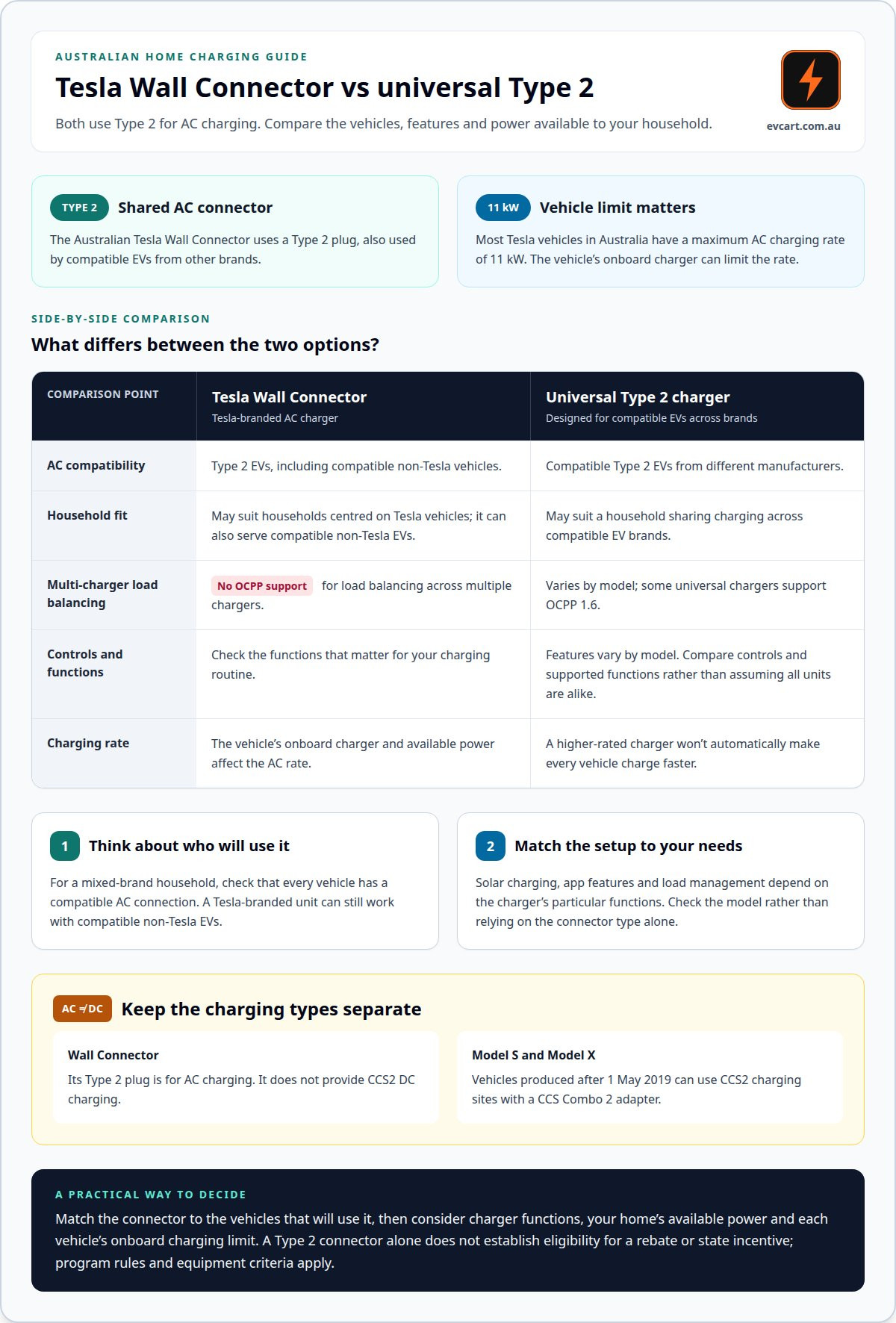
Both options use a Type 2 connector for AC charging in Australia. Choose by considering the vehicles that will use the charger, the features you need and how charging fits your household’s routine.
Tesla Wall Connector
The Australian Tesla Wall Connector uses a Type 2 plug and can charge compatible non-Tesla EVs with a Type 2 AC charge port. Its connector is therefore useful beyond Tesla vehicles. Most Tesla vehicles in Australia have a maximum AC charging rate of 11 kW, so the vehicle’s onboard charger can limit the rate even when the charging equipment supports more.
Model S and Model X owners should distinguish AC charging from DC fast charging. Vehicles produced after May 1, 2019 can use CCS2 charging sites with a CCS Combo 2 adapter. The Wall Connector’s Type 2 plug is for AC charging; it doesn’t provide CCS2 DC charging.
Universal Type 2 Charger
A universal Type 2 charger is designed for compatible EVs with Type 2 AC charge ports, including vehicles from different manufacturers. That can suit a household where more than one vehicle brand needs charging. Features vary by charger model, so compare controls and supported functions instead of assuming all universal units work alike.
Solar charging, app features and load management depend on the charger’s particular functions. The Tesla Wall Connector doesn’t support OCPP for load balancing across multiple chargers; some universal chargers support OCPP 1.6. A Type 2 connector alone doesn’t establish eligibility for an Australian rebate or state incentive. Eligibility depends on the relevant program’s rules and equipment criteria.
| Option | AC connector compatibility | Multi-charger load balancing | Potential fit |
|---|---|---|---|
| Tesla Wall Connector | Type 2 EVs, including compatible non-Teslas | No OCPP support | Households centred on Tesla vehicles |
| Universal Type 2 charger | Compatible Type 2 EVs across brands | Varies by model; some support OCPP 1.6 | Households sharing charging across EV brands |
Choose by matching the connector to the vehicles that will use it, then compare the controls and charging functions that suit your routine. The available power supply and each vehicle’s onboard charger affect the AC charging rate. A higher-rated unit won’t automatically charge every vehicle faster.
Australian EV owners should assess AC charge-port compatibility separately from DC charging compatibility. This distinction matters for Model S and Model X owners considering CCS2 sites. For a mixed-brand household, weigh shared vehicle compatibility against charger features. The choice comes down to practical needs, not the connector label alone.
Will a universal charger suit a future Tesla without changing hardware?
A universal charger may still suit your household if you add a Tesla, provided the charger and vehicle have compatible AC connections. Consider who may use the charger over time, not just which car is parked at home now. This makes compatibility across vehicles more important than the brand alone.
Planning for a Future Tesla
Start with the charger’s connector and the Tesla’s AC charge port. A universal unit with a compatible Type 2 connection can serve different EV makes, so a change of vehicle doesn’t automatically mean changing the charger. This is useful if one household member drives a Tesla while another uses a different compatible EV.
Keep AC and DC charging needs separate. A home AC charger does not replace the separate connection required at compatible DC charging sites. If you expect to use different charging options with a Tesla, consider the relevant accessories separately from the home unit. This helps distinguish a change of vehicle from a change of charging location or type.
The vehicle matters beyond its badge. Before relying on existing equipment, match the Tesla model’s AC connection to the charger and consider whether other household vehicles will use it too. A charger that suits one car may be less convenient if another needs a different connection or charging arrangement. Shared use is simplest when every vehicle and the charger have compatible AC connections.
Choosing Hardware for Long-Term Use
Compare chargers by the vehicles they can serve and the controls that suit your household’s charging habits. A universal charger is designed for compatible vehicles across brands, while a Tesla-branded unit may also work with compatible non-Tesla EVs. Focus on actual compatibility and functions, not the assumption that a brand name limits use to one manufacturer.
Consider how your household might change. A second EV, replacement vehicle or different driver’s routine can shift which car uses the charger most often. Choosing equipment for compatible vehicles can help keep your setup useful through those changes, rather than replacing working hardware simply because you bought a Tesla.
Keep a note of the charger model and the vehicles it supports. If you change cars, compare the new vehicle’s AC connection with the existing unit before buying replacement equipment. This helps distinguish a connector mismatch from a preference for different charger features, and shows whether your current hardware still suits the household.
In short, adding a Tesla doesn’t automatically mean you need different charger hardware. Check whether the Tesla and your existing charger have compatible AC connections, and whether the equipment still suits your household’s vehicles and charging routines.
Universal Mobile Connector plugs, tails and charging rates
A Tesla Universal Mobile Connector is portable charging equipment, unlike a fixed wall connector. Its charging rate depends on the compatible power source and the vehicle’s onboard charger. For Australian owners, the connector, power supply and car all matter when planning home or travel charging.
Keep AC charging separate from DC fast charging. A mobile connector or Type 2 cable serves an AC charging setup; adapters for DC sites address a different connection. Choosing equipment for the socket you’ll use helps avoid carrying accessories that don’t match your charging stop.
Universal Mobile Connector Plugs and Tails
The Gen 2 Tesla Universal Mobile Connector can charge at up to 7 kW using 32A single-phase power. Its plug-and-tail arrangement lets the portable unit connect through a suitable tail for the available outlet, rather than relying on a fixed wall connector.
Match the tail to the outlet and the vehicle before travelling. A different power source can change the available rate, and the car’s onboard charger may impose a lower limit. A Type 2 to Type 2 cable is a separate item for compatible public AC sockets, not a replacement for a mobile connector tail.
Universal Type 2 Chargers
A universal Type 2 charger is a fixed charging option for compatible EVs; the Tesla Universal Mobile Connector is portable. Compared with the Tesla Wall Connector, universal wall units vary in features and controls. Compare each model on the vehicle connections and charging functions you need, rather than assuming every unit has identical capabilities.
The Tesla Wall Connector can serve as a destination charger at home or another parking location. Type 2 outlets in Australia are generally 32A three-phase and can deliver up to 22 kW, while a rare 32A single-phase Type 2 outlet can provide around 7 kW. The vehicle still determines how much AC power it can accept.
For example, the Tesla Model 3 and Model Y can accept up to 11 kW on three-phase AC. A 22 kW outlet therefore won’t make those models charge at 22 kW. Older Model S vehicles can reach 22 kW AC, while newer Model S and Model X vehicles can reach 17 kW. The vehicle’s onboard charger explains the difference.
On the road, an 11 kW three-phase Type 2 to Type 2 cable is recommended for 99% of Teslas using public AC chargers in Australia. A cable’s rating is only one part of the setup; the outlet and car also affect the charging rate.
Choose a portable connector for access to suitable outlets while travelling. Choose a fixed Type 2 wall unit for regular charging at a parking location. Either way, match the plug, power source and vehicle before relying on a particular rate.
Choosing charging equipment for home and travel
Choose equipment around the household’s vehicles, regular parking and likely travel stops. A Tesla Wall Connector suits a Tesla-focused home setup, while a universal Type 2 unit can serve compatible EVs from different makes. Neither choice makes an EV charge beyond its own AC charging limit.
Start with the home supply and the vehicles that will use it. A Tesla Model 3 or Model Y can take up to 11 kW AC, so a higher-capacity charger won’t increase that vehicle’s maximum AC rate. If household vehicles have different charging limits, choose around the cars that will use the charger most often.
First, separate routine home charging from travel charging. A fixed wall connector suits regular parking at home or a destination. Portable charging can be useful where a suitable outlet is available, but the outlet, connection and vehicle all affect the charging rate. Match each accessory to the power source you expect to use.
- One Tesla at home: compare the Wall Connector’s home use with a universal Type 2 charger’s compatibility across vehicle brands.
- Different EVs in one household: prioritise a Type 2 option that suits each vehicle’s AC port and charging limit.
- Longer trips: plan around public AC and DC charging stops, and carry only adapters compatible with your Tesla model.
For travel, don’t confuse AC charging with DC fast charging. A Type 2 cable connects to compatible public AC charging points; a CCS2 adapter serves a different purpose at compatible DC sites. Tesla Model S and Model X vehicles produced after May 1, 2019 can use CCS2 charging sites with a CCS Combo 2 adapter. That distinction matters when planning which equipment to carry.
Charging habits matter too. Charging to 80% or 90% is often preferable unless you need the extra range, because charging slows as the battery approaches full. For a trip, allow for the extra time needed to charge near full, rather than expecting the same rate throughout the session.
Neither the Tesla Wall Connector nor mainstream universal Type 2 chargers currently supports bidirectional charging. So, if you want a home charger to send stored vehicle energy back to the house, these options don’t provide that function. Choose between them for charging compatibility and everyday use instead.
Use this order to decide: identify the household’s EVs, match their connectors, consider the home supply, then plan travel charging around compatible public networks. This helps distinguish a fixed home charger from the cables or adapters you may need on the road.
Single-phase and three-phase power
Your home’s phase supply affects the maximum AC power available to a charger. Three-phase supply can provide more power than single-phase, but the vehicle’s onboard charger may still set a lower limit. Compare phase types in practical terms: the charger, electrical supply and vehicle must all support the charging rate you expect.
In Australia, Type 2 outlets are generally 32A three-phase and can deliver up to 22 kW. A rare 32A single-phase Type 2 outlet can provide around 7 kW. These figures describe the outlet’s potential, not a guaranteed rate for every vehicle. The car’s onboard AC-to-DC converter determines how much power it can accept.
That limit matters for Tesla models. Model 3 and Model Y can accept up to 11 kW on three-phase AC, while older Model S vehicles can reach 22 kW. The vehicle’s onboard charger can limit the AC charging rate, even when paired with a higher-rated cable.
For a capable vehicle, Australian three-phase AC charging can reach 22 kW, compared with 7.3 kW on standard 32A single-phase charging. That can make three-phase up to three times faster when the vehicle supports it. A Tesla Model 3 or Model Y won’t reach 22 kW AC, so a three-phase supply doesn’t remove its onboard charging limit. Charger software can manage charging, but it can’t change the vehicle’s hardware limit.
Whether a vehicle can use three-phase AC charging depends on its onboard charger. Weigh the vehicle’s AC charging limit against the charging rate you need. A higher-capacity supply offers less benefit if the car cannot accept the additional power.
Use this sequence to assess the likely rate:
- Identify whether the home supply is single-phase or three-phase.
- Match the charger and cable rating to that supply.
- Compare the vehicle’s maximum AC rate with the supply’s potential.
For public AC charging, an 11 kW three-phase Type 2 to Type 2 cable is recommended for 99% of Teslas using public AC chargers in Australia. A higher-rated cable won’t make a vehicle accept more power, but choosing a cable suited to the charging points you use can avoid an unnecessary bottleneck.
Match equipment to the vehicle and supply, not the largest number printed on a charger. Browse EV accessories for charging on the go when you’re planning the cable and connector side of your setup.
EV Cart Australia
EV Cart Australia offers EV accessories for home charging and travel. Once you’ve matched your vehicle’s connector and charging limits to your routine, the right accessories can help you connect to compatible charging points on the road.
Use your vehicle model and the charging situations you encounter to narrow down the accessories that suit your setup. EV Cart Australia focuses on EV accessories, not charger installation or electrical work.
For help choosing EV accessories for your charging routine, contact EV Cart Australia.
Make your charging setup work for what comes next
Treat the Tesla charger-versus-universal Type 2 choice as part of your broader EV ownership plan, not a decision based only on the car in your driveway today. If your vehicle or travel routine changes, the accessories you rely on may need to change too. Keep your vehicle model and intended use in mind when selecting compatible equipment.
Start by noting which charging situations matter most, such as regular trips away from home or access to different charging points. Use that list to guide your accessory choices and avoid buying items that don’t match your vehicle or routine. The right setup is the one that fits how you actually drive.
EV Cart Australia offers EV accessories to support day-to-day ownership. Explore EV accessories at EV Cart Australia and take the next step with a clearer idea of what suits your needs.
Frequently Asked Questions
How fast can I charge?
Your charging speed depends on the car, power supply and charging equipment working together. For example, a Tesla Model 3 or Model Y can accept up to 11 kW from three-phase AC, even when the charger can supply more. Charging also slows as the battery approaches full. For a journey, plan around the vehicle’s limit and the time available at each stop, not just the charger’s maximum rating.
What cables do I need?
For public AC charging, a Type 2 to Type 2 cable connects your car to a compatible Type 2 socket. An 11 kW three-phase cable suits most Teslas using public AC chargers in Australia. Check the cable ends against the vehicle and charger sockets before travelling. A fixed wall connector with an attached cable has different requirements from a public socket charger, where you bring a separate cable.
The short answer: Which should you buy?
Choose a Tesla Wall Connector if its features suit your household and vehicles; choose a universal Type 2 charger if different compatible EVs will share it. In the Tesla charger versus universal Type 2 comparison, the connector alone doesn’t decide the better buy. Consider who will charge, the home supply and the controls you want. For occasional charging away from home, a portable setup may suit better than another fixed unit.
What about adapters?
Adapters solve particular connection needs, not every mismatch. A CCS Combo 2 adapter lets compatible Model S and Model X vehicles produced after May 1, 2019 use CCS2 charging sites. It’s for DC charging, not a substitute for a Type 2 cable at an AC socket. Compatible Model S and Model X vehicles can also use a CHAdeMO adapter for charging at up to 50 kW.
What is the difference between a Tesla Wall Connector and a universal Type 2 EV charger in Australia?
Both use a Type 2 connector for AC charging in Australia, but a universal charger is intended to serve compatible EVs across brands. The Tesla Wall Connector can also charge compatible non-Tesla vehicles, so it isn’t limited to Tesla cars. Compare individual units by their control features and charging capabilities. For a household with several EV makes, assess compatibility with each vehicle rather than relying on the charger’s name.
Can a Tesla vehicle use any Type 2 home charger in Australia?
A Tesla can use a home charger with a compatible Type 2 AC connection, but “any” doesn’t mean every setup will deliver the same result. The vehicle’s onboard charger and the home’s supply affect charging speed. For example, a charger’s higher maximum output won’t increase a car’s own AC limit. Check compatibility for the specific Tesla model, especially when choosing cables or charging equipment for mixed-brand use.
What charging speeds do Tesla Wall Connectors and universal Type 2 chargers support in Australia?
Charging speed varies by charger, supply and vehicle. Type 2 outlets in Australia can deliver up to 22 kW on three-phase power, but a Tesla Model 3 or Model Y accepts up to 11 kW AC. Some Model S and Model X versions have different limits. Treat the charger’s rating as its maximum capability, not a promise of the rate your car will receive.
What are the current prices of Tesla Wall Connectors and universal Type 2 home chargers in Australia?
A charger’s price depends on the model, its features and what the listed price includes. When comparing options, check the price for each specific model and compare like with like.