
Type 2 EV Charging Cable Pricing and Accessories in Australia
2026-11-07

A Type 2 EV charging cable in Australia can connect your EV to a public AC charging station with a Type 2 socket when the station requires you to bring your own cable. It supports AC charging up to 22 kW, but it isn’t for DC fast charging. Your EV’s socket and onboard charging capacity also affect how quickly it can charge.
Choosing a cable is about more than matching the plug. Length, current rating, construction and included accessories all affect how practical it is to carry and use, and why prices vary.
This guide explains how to tell whether a Type 2 cable suits your EV and public charging needs. You’ll also learn what its protection rating and construction mean, which features to compare, and what can affect the price and what comes in the package, so you can make a clear, informed choice.
Key Takeaways
- Use a Type 2-to-Type 2 cable at public AC stations that require drivers to bring their own cable. It won’t connect to a DC fast charger.
- Match the cable’s current and phase rating to your EV’s socket and onboard charging capacity; a higher cable rating alone won’t make the car charge faster.
- Choose a length that suits the distance between the charging socket and your vehicle, while keeping storage and handling in mind.
- Compare construction details and the stated protection rating to understand how the cable is designed for everyday use.
- Before buying, compare the cable’s specifications, length and included accessories so the package suits how you charge.
Table of Contents
Can I use this at public charging stations?
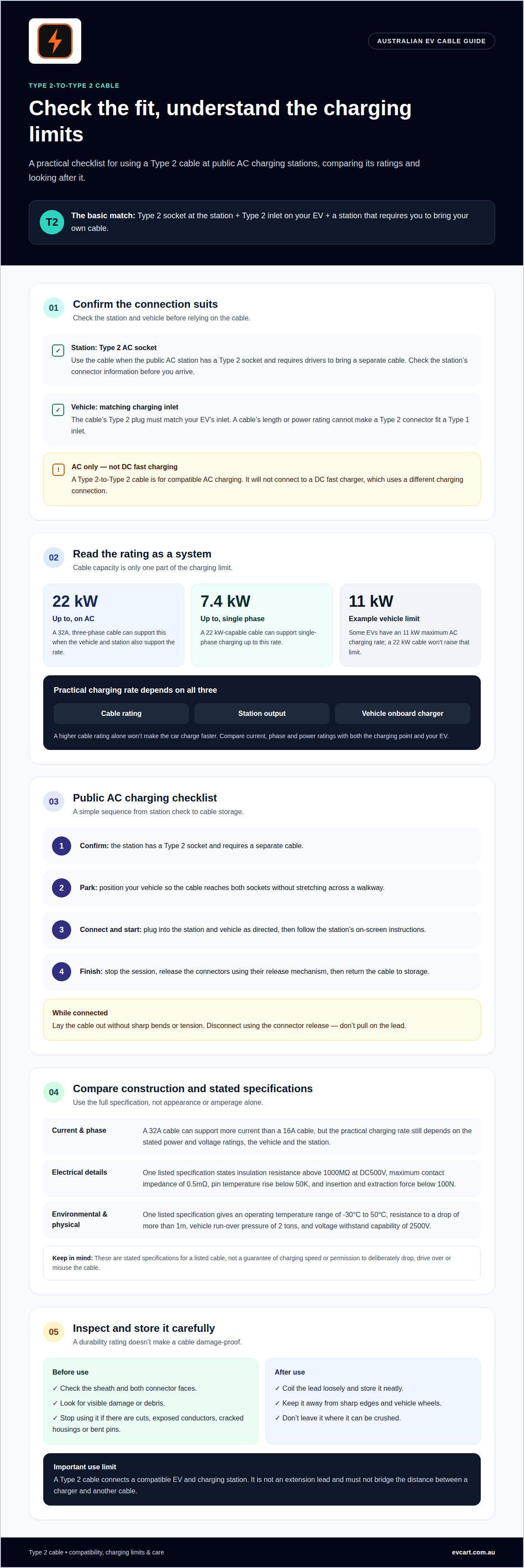
Yes, a Type 2-to-Type 2 cable works at public AC charging stations with Type 2 sockets when drivers must bring their own cable. One end connects to the station and the other to your EV. It won’t work with a DC fast charger, which uses a different charging connection. Check the station’s connector information before you arrive, especially if its listing distinguishes AC charging from DC charging.
In Australia, Type 2 is the relevant connector format for this cable. Type 2 connectors are associated with IEC 62196-2, while cable listings may also state conformity to IEC 62196-2 2016 2-llb. These references describe connector-related specifications; they don’t mean every Type 2 cable has the same electrical rating. Compare the cable’s printed or listed current, phase and power ratings with the charging point and your vehicle.
A cable rated for three-phase, 32-amp charging can support up to 22 kW AC, when the station and vehicle also support that rate. The same 22 kW-capable cable can support single-phase charging up to 7.4 kW. The car’s onboard charger and the station set practical limits, so a higher cable rating alone won’t increase charging speed.
Use the cable safely by checking its plugs and length before connecting, then following the charging station’s on-screen instructions. Lay it out without sharp bends or tension, and disconnect it using the connector release rather than pulling on the lead.
At a public AC charger, follow this sequence:
- Confirm the station has a Type 2 socket and requires a separate cable.
- Park so the cable reaches both sockets without stretching across a walkway.
- Connect the station and vehicle plugs as directed by the station, then start the session.
- When charging ends, stop the session, release the connectors and return the cable to storage.
Charging capacity can differ between vehicles. Some EVs have an 11 kW maximum AC charging rate, so a 22 kW cable won’t make those cars charge at 22 kW. A station’s output, the vehicle’s onboard charger and the cable rating all matter. For example, a three-phase station may offer more power than a vehicle can accept, while a single-phase connection can limit the available rate.
After use, check the cable sheath and connector faces for visible damage or debris. Store the lead neatly rather than leaving it under a vehicle wheel or in a place where it can be crushed. A Type 2 cable is a connection between a compatible EV and charging station, not an extension lead. It must not be used to bridge the distance between a charger and another cable.
Cable construction and materials
A Type 2 cable combines two connectors with a flexible, insulated lead designed for repeated charging use. Its current rating, electrical resistance and physical protection affect how it performs. Compare those specifications, rather than relying on a cable’s appearance alone.
The difference between 16A and 32A Type 2 cables is their rated current capacity. A 32A cable can support more current, but charging speed still depends on the vehicle, charging station and electrical supply; a higher rating alone won’t make an EV charge faster.
For example, a 32A, three-phase cable can support charging up to 22 kW when the car and station also allow it. A 16A cable has a lower current rating, but its practical charging rate still depends on its stated power and voltage ratings, alongside the other equipment. Read the full specification rather than treating amperage as the only measure.
Electrical specifications help describe how a cable handles its intended load. One Type 2-to-Type 2 specification lists insulation resistance above 1000MΩ at DC500V, maximum contact impedance of 0.5mΩ, and pin temperature rise below 50K. It also lists insertion and extraction force below 100N. These figures describe measured electrical or connector characteristics, not the charging speed you’ll receive in every situation.
Physical protection matters during transport and use. A listed cable specification states an operating environmental temperature range of -30°C to 50°C. It also states resistance to a drop of more than 1m, vehicle run-over pressure of 2tons, and voltage withstand capability of 2500V. Treat these as stated product specifications, not permission to deliberately drop, drive over or misuse the cable.
Compare the details that affect daily handling and performance:
- Current and phase: Match the cable’s rating to the charging setup and your vehicle’s charging capability.
- Insulation: Check the stated insulation resistance and voltage withstand specification.
- Connector performance: Contact impedance, temperature rise and insertion force describe connector characteristics.
- Environmental limits: Keep the stated temperature range in mind when storing or using the cable.
- Physical protection: Drop and run-over specifications describe stated durability tests, not routine handling instructions.
Inspect the sheath and both connectors before each use. Stop using the cable if you see cuts, exposed conductors, cracked connector housings or bent pins. Keep it away from sharp edges and vehicle wheels, and coil it loosely for storage. These habits help protect the cable’s insulation and connectors, but a durability rating does not mean it is damage-proof.
Is this cable compatible with my EV?
Start with your vehicle’s charging inlet. A Type 2-to-Type 2 cable suits an EV with a Type 2 socket and a charging station with a matching Type 2 connection. The plugs must match both ends of the charging setup. A cable’s length or power rating cannot make a Type 2 connector fit a Type 1 inlet.
Some older Australian EVs use Type 1 sockets, including the first-generation Nissan Leaf and earlier Mitsubishi Outlander PHEV. New EV models imported into Australia after 2020 typically have Type 2 sockets, but model year alone doesn’t establish compatibility. Check the inlet shown in your vehicle manual, or look at the socket itself before choosing a cable.
Charging rate is a separate compatibility check. A cable’s rating, the vehicle’s onboard charger and the charging point all affect the available AC power. For example, a 22 kW-capable cable may suit a vehicle with a lower maximum AC charging rate, but it won’t raise that limit. Match the connector first, then compare the cable rating with the car and charging equipment.
Length affects whether the cable reaches comfortably from the charging point to your vehicle. Available options include 5 m, 8 m and 10 m. A 5 m cable is the minimum length recommended for easier use. The right choice depends on where the charging inlet sits and how you usually park relative to the charger.
Measure the likely route, not just the straight-line gap. A front-side inlet and a charger beside the parked car may need less reach than a rear inlet facing away from the charging point. Allow enough slack to connect without pulling the cable tight, but avoid excess length that could cross a walkway.
Coiled and extended cable designs suit different handling preferences. A coiled lead retracts towards its compact shape after use, while an extended cable can lie along the route between charger and car. The Laser coiled cable is rated for 22 kW, showing that a coiled design can also carry a high stated charging rating. Shape alone doesn’t establish compatibility; check the connector type and electrical rating.
Use this quick selection sequence:
- Identify the inlet: Confirm whether your EV has a Type 2 or Type 1 socket.
- Match both ends: Choose a cable with connectors suited to the vehicle and charging point.
- Compare ratings: Consider the car’s onboard charger and the station’s output.
- Choose length: Compare 5 m, 8 m and 10 m against your usual parking position.
- Consider storage: Decide whether a coiled or extended lead better suits your routine.
These checks separate connector fit from charging speed and cable reach. A Type 2 cable is designed to connect an EV to a charging station, not to extend another cable. Make the connector match your first check, then choose a rating and length that suit your vehicle and regular charging setup.
Indoor and outdoor protection rating
An ingress protection rating describes how well a product enclosure resists dust and water entering it. Read the exact marking and the conditions it covers. A rating does not guarantee that every part of a cable can withstand every outdoor exposure, such as prolonged rain, pooled water or grit around connectors.
For a Type 2 charging cable, separate the lead from its connector housings when considering protection. A marking for one component should not automatically be treated as proof that every component has identical protection. Check the product information for which parts the rating covers and the conditions attached to it. If the information describes a specific test environment, use that context rather than assuming broader protection.
Indoor use still brings practical hazards. A garage floor can collect dust, moisture and debris, while a cable routed past a car may be exposed to pressure or abrasion. Choose a dry storage spot away from vehicle wheels, sharp edges and anything that could press against the connectors. Keep the route clear while charging instead of running the cable across a doorway or busy walkway.
Outdoor charging brings changing conditions. Rain, dirt and temperature can affect how you handle and store the lead, but outdoor use alone does not mean a cable is suitable for every exposure. Follow its stated instructions, keep connectors away from standing water, and do not connect a plug that is visibly wet or contaminated.
Use this practical check before and after charging:
- Read the marking: Match the ingress-protection information to the product’s stated use and conditions.
- Inspect the connectors: Look for moisture, dirt, cracks or other visible damage before plugging in.
- Manage the route: Keep the lead clear of puddles, sharp edges, vehicle wheels and pedestrian paths.
- Store it dry: Coil the cable after use and keep it away from damp floors or exposed debris.
- Stop if damaged: Don’t use a lead with a compromised sheath or connector housing.
A rating does not replace careful handling. For example, an outdoor-rated component should not be left with its connectors in a puddle. Similarly, a clean indoor garage does not remove the need to protect the cable from being driven over. Treat the marked rating as one part of your decision, alongside the charging location and the cable’s condition.
When comparing two Type 2 cables, look for protection details that identify the tested component and intended conditions. Don’t infer suitability from a photograph, a rugged-looking sheath or a general “outdoor” description alone. Clear product information helps you judge whether the cable’s stated protection matches your charging routine, whether that means a sheltered garage or a driveway exposed to the weather.
Price and included accessories
Compare what each cable package includes before deciding whether its price suits your needs. Product specifications and stated inclusions help you compare like with like.
Cable pricing
Prices can differ between Type 2 cables because products may have different specifications and configurations. Compare the details shown for each option, including its design and stated electrical ratings, rather than relying on the headline price alone.
Consider the package as a whole. A cable suited to your setup may offer better value than a cheaper option that does not meet your requirements. Check the product description for the features and configuration included in the listed price.
Included accessories
Package contents vary, so do not assume a storage bag, connector cap or wall holder comes with every cable. Count an accessory as included only when the product description names it. This keeps your comparison focused on what the package actually contains.
If an accessory is listed separately, treat it as an additional purchase, not part of the cable package. This helps you assess what you will receive and whether you need anything else for your storage routine.
Use this simple comparison:
- Product details: Compare each cable’s stated specifications and configuration.
- Package contents: Identify the cable and any accessories specifically named as included.
- Extras: Separate optional accessories from items supplied in the package.
Read the full product description before choosing. EV Cart Australia offers EV accessories for Australian drivers, so explore its accessories when you’re ready to consider your next purchase.
EV Cart Australia
EV Cart Australia offers vehicle-specific EV accessories and home charging hardware for Australian drivers. Use the guidance in this article to narrow your requirements: connector type, cable rating, length, storage and package contents. These details help you assess whether an accessory suits your setup, rather than choosing by price or appearance alone.
Turn to EV Cart Australia when you’re ready to explore EV accessories with those practical needs in mind. If you’d like help with your question, contact EV Cart Australia.
Make your next charging choice with confidence
Choosing a Type 2 EV charging cable in Australia is a practical step towards a charging routine that works for your vehicle and day-to-day plans. Give yourself time to make the decision, rather than buying in a rush before a trip or a change in routine. A considered choice can help you feel prepared when it’s time to charge.
Think about how you will use the cable over time, not just where you charge today. Your regular parking arrangements, travel habits and storage preferences can all affect what feels convenient. Keep your vehicle details and intended use in mind as you decide what suits you.
If you’d like to discuss your EV accessory needs, contact EV Cart Australia. Take the next step at your own pace, with a clear idea of what you want your cable to do.
Frequently Asked Questions
Which Type 2 charging cable is compatible with popular EVs sold in Australia?
Use your vehicle’s exact model year and variant to identify its charging inlet before choosing. Two vehicles from the same manufacturer can have different specifications, so the badge alone is not enough. The owner’s manual or vehicle specification sheet can help identify the inlet. For an imported model or a change between model years, use the details for that exact version rather than relying on a general model name.
How do I choose the right cable length, amperage, and phase for an Australian EV?
Start with the charging setup you actually use. Check the vehicle’s AC charging capability and the charging equipment’s available supply, then choose a cable rating that suits both. For length, consider where the charging point sits relative to the vehicle’s inlet in your usual parking position. Measuring this route can help you avoid a cable that falls short or leaves unnecessary slack.
What are the current prices of Type 2 EV charging cables in Australia?
There isn’t one price that applies to every Type 2 cable. The listed amount depends on the particular cable’s configuration and what its product listing says is included. For a useful comparison, note each option’s length, electrical rating and package contents before comparing its current listed price. Avoid treating different configurations as direct equivalents, and use the live listing for the item you intend to buy.
Can I use a Type 2 cable at public AC charging stations in Australia?
Check the individual station’s instructions before travelling, particularly whether its charging point has a socket or an attached lead. Instructions also explain how to start and end a session, which can vary between locations. If a station has a socket and requires a separate cable, bring a matching lead. Keep the instructions handy when using an unfamiliar charging network or site.
What Australian electrical safety standards and certifications should a Type 2 cable meet?
Read the cable’s product documentation for its exact model identifier, electrical ratings and any stated standards or certification marks. Check that those details match the cable being sold, rather than relying on a photograph or a general statement about a product range. Keep the documentation with your purchase details. It gives you a clear reference if you later need to identify the cable or discuss its specifications.
Can I use a Type 2 cable with a portable EV charger or home wallbox?
It depends on the connection design of the portable charger or wallbox. Some equipment accepts a separate cable through a socket, while other units have a lead already attached. Check the equipment’s manual or connection diagram to see which arrangement it uses. A separate cable only fits a setup designed to accept one, so identify the charger’s outlet before choosing.
What warranty, weatherproofing, and safety features should I look for in a Type 2 cable?
Read the warranty terms for the specific cable, including its coverage, exclusions and claim process. For weather protection, look for a rating linked to the components it covers and the conditions described in the product documentation. Keep proof of purchase and product details together. This makes it easier to identify the exact model and refer to its stated coverage if a problem arises.