
Type 2 EV Charging Cables for Australian Drivers
2026-10-27

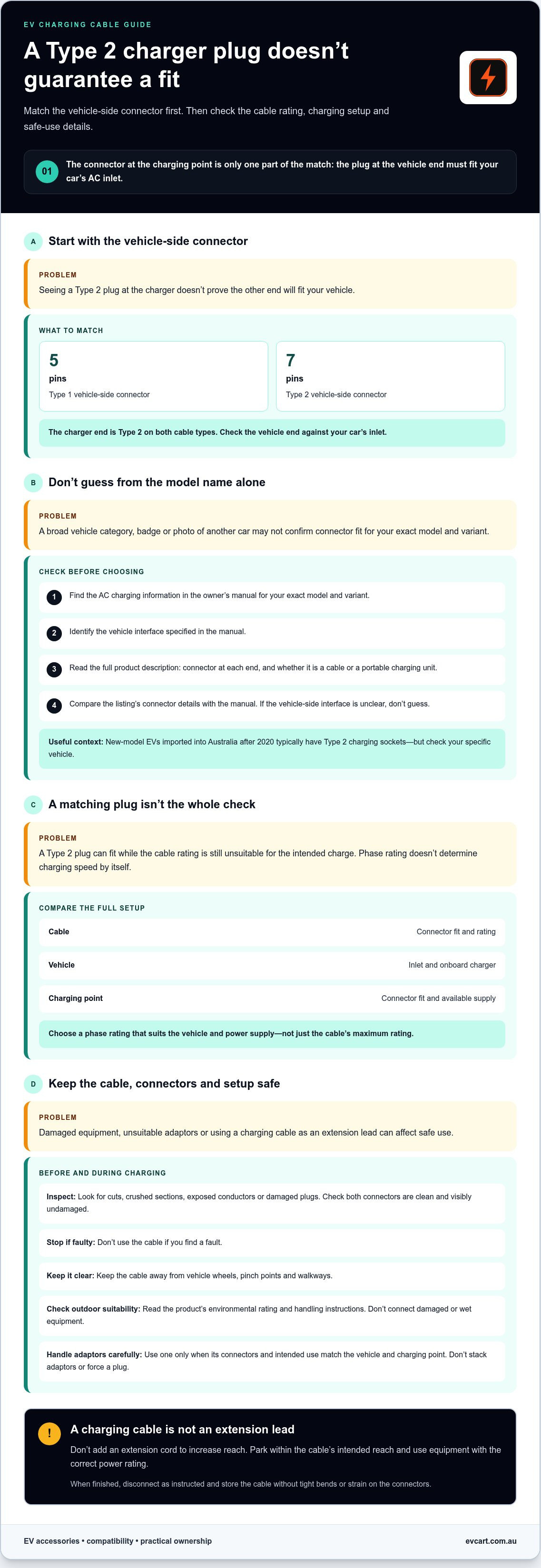
A Type 2 plug at the charger end doesn’t guarantee the vehicle-side connector will fit. Type 1 cables have a 5-pin vehicle connector, while Type 2 cables have a 7-pin connector; a type 2 EV charging cable suits a vehicle with a Type 2 socket. The charger end is Type 2 on both cable types.
Choosing between them comes down to your vehicle’s socket, not just the plug you see at the charging station. Get that match right first, then compare the cable’s phase rating and reach to suit how and where you charge.
This guide explains Type 1 and Type 2 connector fit, what single-phase and three-phase ratings mean, and how to choose a practical cable length. It also covers safe use, including why charging cables shouldn’t be used as extension leads and what to consider before using an adaptor.
Key Takeaways
- Match the cable’s vehicle-side connector to your car’s socket: Type 1 has 5 pins, while Type 2 has 7.
- Choose a phase rating that suits both the vehicle’s onboard charger and the power supply, not just the cable’s maximum rating.
- Measure the route between the charger and your vehicle, then allow extra reach for practical positioning.
- Inspect cables for damage and don’t use an EV charging cable as an extension lead.
- Compare portable charging options and accessories by connector fit, rating and intended use before choosing.
Table of Contents
- What are the safety considerations when using EV charger cables and adaptors?
- What is the difference between type 1 and type 2 EV charger cables?
- Single-phase and three-phase cable ratings
- Type 2 and Type 1 connector differences
- Cable lengths and choosing a suitable reach
- EV Cart Australia: EV accessories
What are the safety considerations when using EV charger cables and adaptors?
Safe charging depends on a cable in good condition, the correct rating and compatible connectors. In Australia, check both the vehicle inlet and the charging point before connecting.
Australian standards and compatibility
Standards help describe equipment and charging-system requirements. The International Electrotechnical Commission lists IEC 61851-1 for EV charging systems. Type 2 connectors and charging systems are also associated with the IEC 62196-2 and IEC 61851-1 standard family.
Use these identifiers as a guide when comparing cable details, but still check connector fit, rating and condition. The vehicle-side plug must match the car’s AC inlet, and the other end must fit the charging point.
Which Type 2 cable is compatible with my electric vehicle and charger in Australia? Choose a cable with a vehicle-side connector that matches your EV’s AC inlet and a charger-side connector that fits the charging point. For a Tesla, use the same inlet-and-charger-end check; the badge alone doesn’t establish cable fit.
New-model EVs imported into Australia after 2020 typically have Type 2 charging sockets. Treat “typically” as a useful starting point, not a substitute for checking your specific vehicle. Read the owner’s manual or inspect the inlet shape before buying.
Waterproofing and outdoor suitability
Are Type 2 EV charging cables waterproof and suitable for outdoor use? Don’t assume every cable is waterproof or suitable for every outdoor condition. Check the product’s stated environmental rating and handling instructions, then keep the plug contacts clean and avoid connecting damaged or wet equipment.
Outdoor use also depends on the charging location and cable condition. Keep the cable away from vehicle wheels, pinch points and walkways. After charging, disconnect it as instructed and store it without tight bends or strain on the connectors.
Handle adaptors as carefully as cables. Use one only when its connectors and intended use match both the vehicle and charging point. Don’t stack adaptors or force a plug into an inlet. A mismatch can prevent a secure connection or stop charging.
Before each session, follow a simple inspection routine:
- Look for cuts, crushed sections, exposed conductors or damaged plugs.
- Check that both connectors are clean and free from visible damage.
- Stop using the cable if you find a fault.
An EVSE cable is not an extension lead. Don’t add an extension cord to increase its reach, as this may affect charging efficiency and safety. Instead, park within the cable’s intended reach and use equipment with the correct power rating.
Match the cable rating to the charging setup rather than choosing by connector shape alone. A Type 2 plug can fit while the cable’s rating remains unsuitable for the intended charge. Check the vehicle, charging point and cable details together before connecting.
What is the difference between type 1 and type 2 EV charger cables?
Type 1 and Type 2 identify different vehicle charging interfaces. For a buying decision, the important question is whether the cable description matches the inlet on your actual vehicle. Don’t choose from a broad vehicle category or a photograph of another car alone.
Start with the owner’s manual for your exact model and variant. Find the AC charging information, then compare the connector details with the cable listing. Use the manual’s inlet description as your reference rather than relying on a general model description.
Distinguish a charging cable from a portable charging unit. A cable connects compatible charging interfaces; a portable unit includes charging equipment and connects to a suitable power source. Check what the product is designed to connect to before buying, so you’re comparing like with like.
Checking a cable listing
Read the full connector description, not just the product title. Check which end connects to the vehicle and whether the listing describes a complete cable or a portable charging unit. Product diagrams can help, but read the written compatibility details too.
If a listing gives several vehicle examples, treat them as examples, not proof that every variant fits. Compare the connector details with your manual. If the vehicle-side interface isn’t clear, pause before ordering rather than guessing from the brand name.
Use this check before selecting a cable:
- Find the AC charging information in your vehicle manual.
- Identify the interface specified for your exact model and variant.
- Read whether the product is a cable or a portable charging unit.
- Compare the listing’s connector description with the manual.
A type 2 EV charging cable should be chosen for the inlet it needs to connect to, not simply because its name appears familiar. This is especially useful when you’re comparing accessories for more than one vehicle. The same household can have different inlet requirements across different EVs.
The charging point’s design matters too. Some have a cable attached, while others require you to bring a separate cable. Work out which arrangement you use most often, then select equipment to suit it and your vehicle’s interface.
An adaptor is no substitute for checking connector compatibility. Identify the vehicle interface first, then choose a cable or charging unit that specifies the right connection. For a portable unit, check its intended power-source connection as well as its vehicle connection.
Before ordering, compare the vehicle manual with the product description. Confirm the interface, product type and intended use in both. This helps you avoid confusing a portable charging unit with a cable or choosing an accessory based on a model name alone.
Single-phase and three-phase cable ratings
Phase rating affects how much power a cable can carry, but it doesn’t determine charging speed by itself. Compare the cable, vehicle and available supply as one setup.
Single-phase cable ratings
A single-phase Type 2 cable is listed at 32 A and 7 kW. The listed voltage for single-phase Type 2 cables is 230 V. These figures describe the cable’s rating and electrical supply, not a guaranteed charge rate for every vehicle.
Check the vehicle’s onboard charger before choosing a 7 kW cable. If that charger accepts less power, the vehicle won’t use the cable’s full rating. The supply also affects the result, so compare all three details: cable rating, vehicle capability and charging supply.
For context, an estimate for a 7 kW single-phase cable is 8-12 hours to fully charge a 60 kWh battery. Treat this as a guide, not a fixed session time. The vehicle’s charging limit and actual charging conditions affect how long a full charge takes.
Three-phase cable ratings
Three-phase Type 2 cables are listed at 400 V. A 22 kW cable is a three-phase option, but the vehicle must also support the relevant charging rate. Many EVs have a maximum AC charging rate of 11 kW, so a 22 kW cable won’t necessarily deliver 22 kW to the car.
An estimate for a 22 kW three-phase cable is 3-5 hours to fully charge a 60 kWh battery. The vehicle’s onboard charger and the supply determine the rate the car can accept. A cable’s higher rating doesn’t override either limit.
Cable gauges are listed as 6 mm² or 16 mm², depending on phase. Read the cable specifications alongside its phase and current ratings. Don’t select by the kilowatt figure alone; the vehicle and charging point must support the intended setup.
Use these figures for comparison, not as interchangeable labels:
- Single-phase: 230 V, with a listed 32 A and 7 kW cable rating.
- Three-phase: 400 V, with 22 kW listed as a three-phase cable option.
- Vehicle limit: many EVs have a maximum AC charging rate of 11 kW.
For example, pairing a 22 kW cable with an EV limited to 11 kW AC won’t make the vehicle charge at 22 kW. The vehicle’s onboard charger sets its own limit, while the supply must also support the charging arrangement. Check both before treating the cable’s rating as the expected result.
Choose a cable rating that suits the charging point you use and the vehicle you drive. A 7 kW single-phase option may suit a single-phase setup; a three-phase option supports a different supply. The right comparison is the complete combination, not the largest number printed on the cable.
Type 2 and Type 1 connector differences
Count the pins on the vehicle-side connector to distinguish the designs. A Type 1 connector has 5 pins; a Type 2 connector has 7. The cable’s vehicle end must match the car’s charging inlet, while its charger end must fit the charging point.
The connector name refers to the plug at the vehicle end. A Type 1-to-Type 2 cable has a Type 1 vehicle-side connector and a Type 2 charger-side connector. A Type 2-to-Type 2 cable has Type 2 connectors at both ends. This distinction helps prevent choosing by the charger-end plug alone.
Type 2 connectors use a locking pin in the vehicle to secure the plug. That feature is part of the connection design, not a substitute for checking compatibility. Confirm the vehicle inlet type first, then make sure the cable’s vehicle-side plug matches it.
Use this simple comparison when checking a cable or its product description:
- Type 1 vehicle end: 5-pin connector, matched to a Type 1 inlet.
- Type 2 vehicle end: 7-pin connector, matched to a Type 2 inlet.
- Charger end: Type 2 for both cable types.
For example, a Type 2 charging point doesn’t mean every vehicle needs a Type 2-to-Type 2 cable. If the vehicle inlet is Type 1, the cable needs a Type 1 vehicle end. If the inlet is Type 2, a Type 2 vehicle end is the match. The plug at the charger end remains Type 2 in both cases.
Check the vehicle manual or inspect the inlet before choosing a cable. Compare the socket’s pin arrangement with the connector description instead of relying on a vehicle badge or model name. If the cable label identifies both ends, check which is vehicle-side and which is charger-side.
Pin count identifies connector type, but it doesn’t describe every cable specification. Check the cable’s current and phase rating separately. For instance, a 7-pin Type 2 connector alone doesn’t tell you whether a cable is rated for single-phase or three-phase charging.
A secure fit matters. Align the connector with the inlet and insert it without force. The Type 2 locking pin helps secure the vehicle-side plug, but a forced or mismatched connection isn’t the right fit. Stop if the connector won’t seat properly, then recheck the vehicle inlet and cable ends.
Keep the distinction clear: Type 1 means 5 pins at the vehicle end; Type 2 means 7. The charger-side plug is Type 2 for either cable. Match both ends to the vehicle and charging point, then assess the cable rating as a separate choice.
Cable lengths and choosing a suitable reach
A 5-metre cable is listed as suitable for most charging stations, while 7-metre and 10-metre options provide more flexibility. Measure the route your cable must follow before choosing. The shortest workable length keeps charging practical without buying more reach than your parking setup needs.
Start with the charging point and the vehicle’s inlet. Measure the cable route between them, accounting for where the car parks and where its inlet sits. A straight-line measurement across a driveway can underestimate the reach needed if the cable must go around the vehicle.
Add a 0.5-1 metre buffer to your measurement. That allowance helps accommodate small differences in parking position and connector placement. For example, if your measured path is close to 5 metres, choosing exactly 5 metres could leave little room to position the car comfortably.
Use these listed lengths as practical reference points:
- 5 metres: a common reach, listed as covering most charging stations.
- 7 metres: adds flexibility where the charger and parking position are further apart.
- 10 metres: suits setups needing greater reach between the charging point and vehicle.
Choose 5 metres when the charging point sits close to your usual parking position and the measured route leaves adequate slack. A 7-metre cable may suit a driveway where the inlet sits further from the wall-mounted charging point. A 10-metre cable offers more reach when the vehicle’s position varies.
Consider your usual parking routine, not just one ideal position. If you sometimes reverse in and sometimes drive in, the inlet may end up on different sides of the charging point. A longer cable can make both arrangements easier, provided you can manage and store the extra length neatly.
Cable length doesn’t determine charging speed. That depends on the vehicle’s onboard charger and the supply. Choose a length that suits your parking position, then compare the cable’s phase and power rating with your vehicle and charging setup.
Before buying, measure the full route and check the options against your result. A 5-metre cable is a practical starting point, while 7 metres or 10 metres may better suit a longer or less predictable route. Avoid relying on an extension cord to make a short cable reach.
For an easier choice, compare the EV charging cable options against your measured distance, connector fit and required rating. Keep the measurement and parking position in mind as you assess the reach each cable provides.
EV Cart Australia: EV accessories
EV Cart Australia offers EV accessories for Australian drivers, including home EV charging hardware. Explore its range when comparing charging options or practical additions for your EV setup.
Use the checks in this guide to narrow your choice: match the vehicle inlet, compare the cable rating with your charging setup, and measure the reach you need. This helps you focus on suitable accessories instead of choosing by connector shape alone.
Explore EV Cart Australia’s EV accessories to continue comparing options for your setup. Visit EV Cart Australia online or contact the team to find out more.
Make your next charging choice with confidence
Choose a cable based on how you actually use your EV. Consider where you usually park, which charging points you use and whether your routine may change. This practical approach helps you choose equipment for everyday use rather than focusing on a single specification.
Before you browse, note your vehicle model and the charging setup you want to support. Keep those details handy as you compare EV accessories. A type 2 EV charging cable should make sense for your vehicle and your routine, not simply look like the most capable option.
EV Cart Australia offers EV accessories for Australian drivers. Explore EV Cart Australia’s accessories and take the next step towards a charging setup that suits you.
Frequently Asked Questions
Can I use an extension cord with my EV charging cable?
No. An EVSE cable isn’t designed to act as an extension lead, and adding an extension cord may affect charging efficiency and safety. If the charging point can’t reach your parked vehicle, reconsider the parking position or use a cable with suitable reach. Don’t connect multiple cables or adaptors to bridge the gap. Keep the cable clear of walkways and vehicle wheels.
Need Help Choosing?
For help choosing an EV accessory, contact EV Cart Australia with your vehicle’s make, model and year. Include the charging point details and the cable rating you’re considering. This gives the team useful context for discussing your accessory choice. You can email hello@evcart.com.au or call 0469 067 230.
Type 2 Cable Compatibility: Which Vehicles Use Type 2?
Many newer EVs use Type 2 inlets, but check the specific vehicle before choosing a cable. New-model EVs imported into Australia after 2020 typically have Type 2 charging sockets. Tesla compatibility also depends on the inlet fitted to the particular vehicle. Check the owner’s manual or inspect the socket, then match the cable’s vehicle-side connector to that inlet.
Type 2 Cable Lengths: Which Size Do You Need?
Choose a length that reaches the vehicle inlet from the charging point in your usual parking position. Consider whether you reverse in or drive in, as that changes the distance and cable route. Measure around obstacles rather than in a straight line. A charging point near the front of a bay may require a different reach from one beside the vehicle.
Which cable rating should you buy?
Choose a cable rating that matches the vehicle’s onboard charger and the charging supply. A 32 A, 7 kW cable is listed for single-phase charging, while 22 kW is a three-phase option. A higher cable rating doesn’t make a vehicle charge faster than its onboard charger or supply allows. Compare all three ratings before selecting your cable.
What is the difference between single-phase and three-phase Type 2 cables?
Single-phase Type 2 cables are listed at 230 V, while three-phase cables are listed at 400 V. The listed single-phase cable rating is 32 A and 7 kW; 22 kW is a three-phase option. The vehicle’s onboard charger and the available supply affect the charging rate. Check those details alongside the cable rating, rather than choosing by kilowatts alone.
What cable amperage and charging speed should I choose: 16A or 32A?
Choose the amperage that suits your vehicle and charging supply, not simply the higher number. A 32 A, 7 kW cable is listed for single-phase charging, but the vehicle and supply still affect the rate. Compare the cable’s stated current rating with your vehicle’s charging capability and the charging point’s output. Don’t assume a 32 A cable will make every setup charge at its maximum rating.
What cable lengths are available, and how do I choose the right length?
Listed cable lengths include 5 metres, 7 metres and 10 metres. Measure the route from the charging point to the vehicle inlet in your usual parking position, including any turn around the car. Add a 0.5-1 metre buffer for positioning. If your parking direction changes often, allow for the inlet to sit further from the charging point on some days.