
Type 2 to Type 1 EV Adapter Cable Specs in Australia
2026-11-13

A mismatched plug or overloaded cable can turn a simple charge into a safety problem. Choosing a Type 2 to Type 1 EV adapter in Australia means matching the vehicle socket and charging equipment, then checking the adapter’s current, power, length and ingress protection before use.
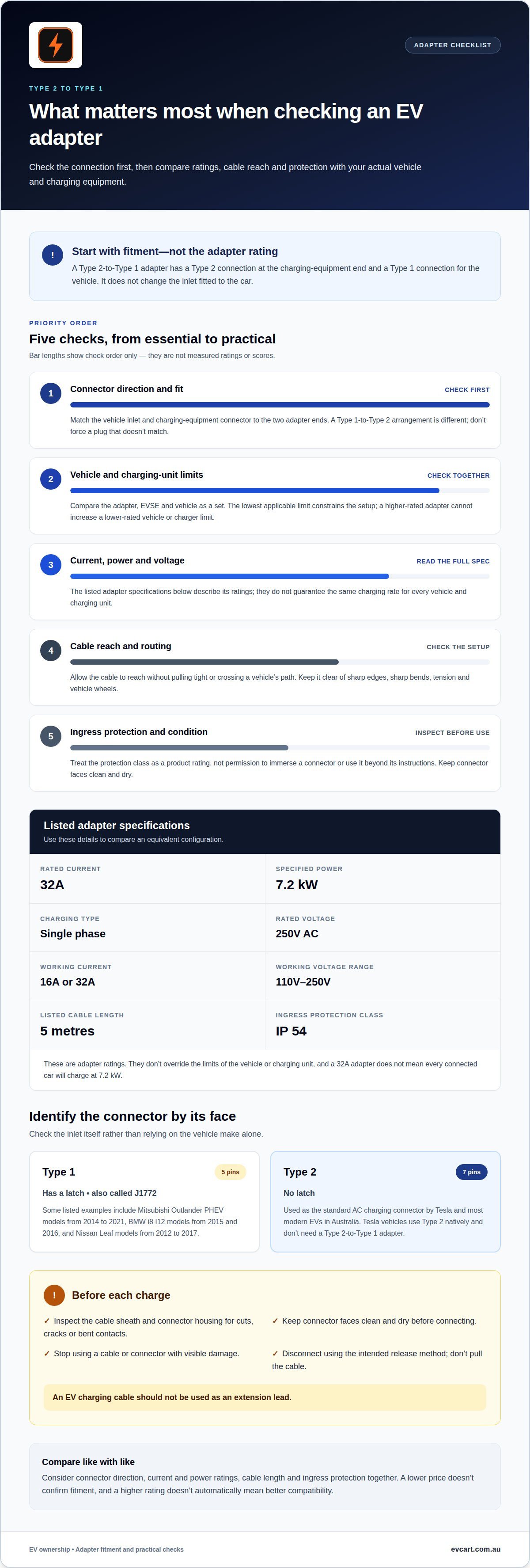
A 32A Type 2-to-Type 1 adapter is rated at 32A, 7.2 kW and single phase. The listed cable length is 5 metres, and its protection class is IP 54. These figures describe the adapter’s ratings; they don’t override the limits of the vehicle or charging unit.
It’s reasonable to expect an adapter to bridge different connector types, but compatibility alone doesn’t settle safe use. This guide explains the difference between Type 1 and Type 2, how to compare power and current ratings, what cable length and ingress protection tell you, and when an adapter isn’t suitable. It also covers practical cable checks and why an EV charging cable shouldn’t be used as an extension lead.
Key Takeaways
- Compare the adapter’s power and current ratings with the limits of both your vehicle and charging equipment.
- Use the listed 5-metre cable length and IP 54 protection class to assess practical fit and ingress protection.
- Recognise the connector difference: Type 1 has a 5-pin design and latch, while Type 2 has a 7-pin design.
- Most Australian public AC charging stations use Type 2 connectors, but an adapter still needs to suit your vehicle and charging setup.
- Learn which safety markings and product details help you assess an adapter, and why a certification claim needs to match the product documentation.
Table of Contents
- Cable power, current, length and ingress protection
- What is the difference between type 1 and type 2 EV charger cables?
- Can a Type 2 to Type 1 adapter be used at Australian public AC charging stations?
- What Australian electrical safety standards or certifications should an EV adapter meet?
- EV Cart Australia
Cable power, current, length and ingress protection
Compare the adapter’s ratings with your vehicle and charging equipment before connecting them. Power, current, cable reach and ingress protection describe different parts of the setup. A mismatch in any of these can make an adapter unsuitable for the intended charging arrangement.
Cable power and current
A Type 2-to-Type 1 adapter rated at 32A is specified for 7.2 kW, single-phase charging, with a rated voltage of 250V AC. Its stated working current is 16A or 32A, and its working voltage range is 110V to 250V. Read these values together: the adapter’s 32A rating alone doesn’t establish the charging rate for every vehicle and charging unit.
Look at the ratings for the adapter, EVSE and vehicle as a set. The lowest applicable limit constrains the charging setup, so a higher-rated adapter can’t make a lower-rated vehicle or charger deliver more power. For example, a 32A adapter doesn’t mean every connected car will charge at 7.2 kW.
Confirm the connector direction as well. A Type 2 inlet-to-Type 1 outlet cable connects equipment with a Type 2 connector to a vehicle with a Type 1 inlet. Check that both ends match the actual ports and cable arrangement; a Type 1-to-Type 2 cable is a different configuration.
Cable length and ingress protection
The listed cable length is 5 metres. Consider the distance between the charging socket and vehicle inlet, and allow the cable to reach without pulling tight or crossing a vehicle’s path. Keep the lead arranged without sharp bends or strain at either connector.
The adapter’s stated ingress protection class is IP 54. Treat this as a product rating, not permission to immerse the connector or expose it beyond its instructions. Keep connector faces clean and dry before mating them, and store the cable so dirt and moisture don’t collect around the contacts.
Use the same careful routine each time. Inspect the cable sheath and connector housing for cuts, cracks, bent contacts or other visible damage. Don’t use a damaged cable, cover a fault with tape or force a connector that won’t seat properly. Follow the vehicle and EVSE instructions, and disconnect using the intended release method rather than pulling the cable.
- Match Type 2 and Type 1 ends to the equipment and vehicle.
- Keep the cable clear of sharp edges, tension and vehicle wheels.
- Don’t use an EV charging cable as an extension lead.
- Stop charging if a connector or cable shows visible damage.
Compare prices for equivalent configurations. Consider the listed price alongside current rating, power, cable length, ingress protection and connector direction. A lower price doesn’t show whether the cable fits your vehicle or charging equipment, and a higher rating doesn’t automatically mean better compatibility. Product details make it easier to compare like with like.
For a Type 2-to-Type 1 adapter in Australia, prioritise clear specifications and the correct connection direction. Then assess cable reach and protection rating against the intended setup. These checks help distinguish a suitable adapter from one that only appears to fit.
What is the difference between type 1 and type 2 EV charger cables?
Type 1 and Type 2 connectors differ in pin layout, latching design and the vehicles they serve. Identify the connector at the vehicle inlet first, then match the cable ends to the charging equipment and car.
Type 1: five pins and a latch
A Type 1 connector has a five-pin design and a latch mechanism. It is also called J1772, and is an older standard used by some non-Tesla electric vehicles. The latch is a visible feature of the plug, but the pin pattern is also important for identification.
In Australia, some listed examples with Type 1 inlets include Mitsubishi Outlander PHEV models from 2014 to 2021, and BMW i8 I12 models from 2015 and 2016. Nissan Leaf models from 2012 to 2017 are also listed as suitable for a Type 2-to-Type 1 cable. Model year and connector type matter: don’t assume every vehicle from one manufacturer uses the same inlet.
Type 2: seven pins and no latch
Type 2 connectors use a seven-pin design and do not include latches. The pin count offers a straightforward visual distinction from Type 1’s five-pin layout. Check the full connector face rather than relying only on the plug’s overall size or appearance.
Type 2 is the standard AC charging connector used by Tesla and most modern EVs in Australia. It is also described as a standardised connector compatible with most electric vehicles. Tesla vehicles use Type 2 natively, so they don’t need a Type 2-to-Type 1 adapter.
These design differences explain why connector direction matters. A Type 2-to-Type 1 adapter provides a Type 2 connection at the charging-equipment end and a Type 1 connection for the vehicle. It doesn’t change the inlet fitted to the car. A Type 1 vehicle still needs a compatible Type 1 connection at its end.
Use this identification sequence before choosing a cable:
- Find the charging inlet on the vehicle, rather than relying on its make alone.
- Count the pins: Type 1 has five, while Type 2 has seven.
- Look for the Type 1 latch; Type 2 connectors have no latch.
- Match the vehicle inlet and charging-equipment connector to the cable ends.
Don’t force a plug that doesn’t match the inlet. A similar-looking connector is not enough to establish compatibility. If the latch or pin pattern differs, stop and identify the connector before connecting equipment. For example, a Type 1 inlet on a listed Outlander PHEV needs the Type 1 connection at the vehicle end, not a Type 2 vehicle plug.
Distinguish the connector’s latch from a pin in its electrical layout. Type 1’s latch is a mechanical feature; its five-pin design identifies the connector family. Type 2’s seven-pin arrangement has no latch, so don’t look for a Type 1-style latch when identifying it.
For a practical next step, compare EV charging accessories with the connector details for your vehicle and charging equipment.
Can a Type 2 to Type 1 adapter be used at Australian public AC charging stations?
Yes, a Type 2-to-Type 1 adapter can connect a Type 1 vehicle to compatible Type 2 AC charging equipment. Most public AC charging stations in Australia use Type 2 connectors. The adapter bridges the connector mismatch, but it doesn’t make every public charger or charging mode compatible.
Start with the vehicle inlet and the station’s actual connection. The adapter’s Type 2 end must suit the station equipment, while its Type 1 end must suit the car. A Type 1 vehicle and a Type 2 public AC connection are the relevant combination. Don’t assume the station has the required connector just because it offers EV charging.
Also identify the charging mode before using an adapter. This adapter is not suitable for super-fast chargers. A Type 2 connector does not, on its own, tell you whether the equipment is AC or super-fast. Follow the station’s labels and instructions, and don’t use the adapter where the charging type is unsuitable.
At a public charging point, use this decision sequence:
- Confirm that the vehicle inlet is Type 1.
- Identify a Type 2 connection on compatible AC charging equipment.
- Make sure the adapter’s two ends match the vehicle and station arrangement.
- Follow the operating instructions supplied with the vehicle and charging equipment.
Public charging equipment may have different connection arrangements. A Type 2 socket and a cable attached to the station are not the same physical setup, so match the adapter to the connection you’ll actually use. The connector’s appearance and direction matter at both ends. If the station connection and adapter don’t match, don’t force them together.
Keep the adapter’s purpose clear. It changes the connector arrangement between Type 2 equipment and a Type 1 vehicle. It doesn’t change the vehicle’s inlet, convert charging equipment into a different type, or make an unsuitable station appropriate. A connector mismatch can be solved only when the adapter is designed for those ends and that charging use.
Charging speed still depends on the vehicle, adapter and station. A public Type 2 AC connection does not promise a particular rate for a Type 1 car. Each part of the setup has its own limits, and the adapter cannot raise a lower limit elsewhere. Use the equipment instructions to understand the connection and charging process for that station.
Plan where to park based on the station’s connection point and your car’s inlet. The cable should reach without pulling on the adapter or obstructing access to the vehicle. If the connection requires a different adapter arrangement or an unsuitable charging mode, choose a compatible option instead of improvising.
A Type 2-to-Type 1 adapter can therefore be useful at an Australian public AC station when the vehicle, connection and charging mode align. Keep the decision specific: identify the Type 1 inlet, match the Type 2 station connection, and exclude super-fast chargers. If any part of that arrangement doesn’t fit the adapter’s intended use, don’t proceed with it.
What Australian electrical safety standards or certifications should an EV adapter meet?
Separate a connector-standard claim from evidence about the complete adapter. A Type 2-to-Type 1 adapter listing may state compliance with SAE J1772, but that claim alone doesn’t establish every aspect of the product’s safety or suitability for Australian use. Read the product markings and supporting documentation together.
Read the claims in context
SAE J1772 identifies the connector standard named for the adapter. It isn’t the same information as a current rating, voltage rating or ingress protection class. For example, a listing may state SAE J1772 compliance alongside 32A, 250V AC and IP 54. Each detail describes a different characteristic, so don’t treat one as proof of the others.
Likewise, a fire-rating claim describes a material property, not the complete charging system. One adapter specification gives its plastic enclosure a UL94 V-0 fire rating. That figure does not by itself establish connector compatibility, electrical performance or an Australian approval. Keep those claims distinct when comparing products.
What to inspect in the product information
Check the product documents before choosing an adapter. Look for the manufacturer’s name, model identification, connector type, electrical ratings and any stated standard or certification. Make sure the details apply to the exact adapter you’re considering, not a related cable or another product in the range.
- Match the product label to its listing and instructions.
- Check that Type 2 and Type 1 ends are clearly identified.
- Compare stated current and voltage ratings with the intended setup.
- Read the conditions and scope of any compliance or certification claim.
- Check that the adapter’s warnings and use limitations are provided.
A certificate or marking is useful only if it relates to the specific product. A generic logo, an unsupported claim such as “compliant” or a document naming another model leaves the product identity unclear. Look for matching model details and a clear explanation of what the evidence covers.
Specifications can help you assess an adapter, but they don’t replace careful handling. Inspect the housing and contacts before use. Stop if the casing is cracked, pins are bent or the connector doesn’t fit securely. Follow the vehicle and charging equipment instructions, and don’t use the adapter outside its stated conditions.
For example, a 32A rating and SAE J1772 claim should be read separately from the adapter’s IP 54 protection class. The current rating concerns electrical capacity; the connector standard concerns the interface; the IP rating describes ingress protection. None should be used as a substitute for the others.
Choose a Type 2-to-Type 1 adapter with identifiable product information and claims that match its documentation. Avoid relying on a single badge to judge the whole product. For more EV charging accessories, browse EV charging accessories and compare the available product details with your vehicle and charging equipment.
EV Cart Australia
EV Cart Australia offers EV accessories and home charging hardware for Australian drivers. When comparing connector types or adapter specifications, use this guide to identify what needs to match: the vehicle inlet, charging connection and product ratings.
Choose accessories based on the connector arrangement and intended use, not appearance alone. Check the product specifications and instructions to assess whether an item suits your setup. Browse the EV accessories shop to compare options.
Make your next charging choice with confidence
Choosing a Type 2-to-Type 1 EV adapter in Australia is part of making your charging routine work with the vehicle you own. Before buying, bring together the details that shape your decision: your vehicle’s charging inlet, the equipment you plan to connect to, and the way you expect to use the adapter. Clear product information makes it easier to compare options without relying on connector appearance alone.
Keep those details in mind as you browse EV accessories. EV Cart Australia offers EV accessories for practical electric vehicle ownership, so you can take the next step with your requirements in view. If you’d like help considering adapter options, contact EV Cart Australia for adapter advice.
Start by identifying what your setup requires. Use those details to guide your next accessory decision and choose carefully.
Frequently Asked Questions
What are the safety considerations when using EV charger cables and adaptors?
Inspect the cable and adapter before charging, including after storage or transport. Look for damaged insulation, cracked housings, bent contacts or debris around the connector. Keep the connection free from strain and stop if a plug won’t seat correctly. Avoid using an extension cord with an EV charging cable, and don’t continue charging if the equipment or cable shows visible damage.
What does a Type 2 to Type 1 EV charging adapter do?
A Type 2-to-Type 1 adapter connects compatible Type 2 charging equipment to a vehicle with a Type 1 inlet. It bridges the connector mismatch; it doesn’t change the vehicle’s charging system or increase the charger’s output. For example, it may suit a Type 1 vehicle using compatible Type 2 AC equipment, provided the adapter is designed for that connection.
Which Type 2 to Type 1 adapters are compatible with EVs sold in Australia?
Compatibility depends on the vehicle’s inlet and the adapter’s connector arrangement. Listed examples include Mitsubishi Outlander PHEV models from 2014-2021, BMW i8 I12 models from 2015 and 2016, and Nissan Leaf models from 2012-2017. These examples don’t establish fitment for every variant or year. Match the vehicle’s actual inlet and the adapter’s stated fitment before use.
Can a Type 2 to Type 1 adapter be used with a home EV charger in Australia?
It may suit a home charger with a compatible Type 2 AC connection and a vehicle with a Type 1 inlet. The charger, vehicle and adapter must have matching connections and intended use. For example, a charger with a Type 1 connection at the vehicle end doesn’t need this adapter arrangement. Follow the equipment and vehicle instructions for connection and operation.
What charging speed and current limits do Type 2 to Type 1 adapters support?
A listed adapter specification gives 32A, 7.2 kW and single-phase charging, with working current stated as 16A or 32A. These are adapter ratings, not a promised charging speed for every vehicle. The vehicle and charging equipment also impose limits. Compare their specifications as a set, because the adapter cannot raise a lower limit elsewhere in the setup.
How much do Type 2 to Type 1 EV adapters cost in Australia?
Adapter prices vary by product and configuration, so compare listings with the same connector arrangement and electrical ratings. Check the product information for current, power, cable format and included components. Don’t judge suitability by price alone: a lower-cost option won’t help if its connectors don’t match your vehicle and charging equipment.
Where can I buy a certified Type 2 to Type 1 adapter in Australia?
Choose a product listing with documentation that identifies the exact adapter and explains the scope of any certification or compliance claim. Match the model details in the documents to the product itself, rather than relying on a generic logo or phrase. The listing should also make the connector arrangement and electrical ratings clear, so you can assess whether it suits your setup.
How do I safely connect and disconnect a Type 2 to Type 1 adapter?
Park so the cable reaches without tension, then check the connector faces for damage or debris. Align the adapter and plugs, and follow the vehicle and charging equipment instructions. Never force a resistant connection. To disconnect, use the equipment’s intended release method and hold the connector instead of pulling the cable. Store the adapter with its contacts protected from dirt and moisture.