
Weatherproof EV Charger Cover Pricing and Shipping for Australia
2026-10-31

The lowest-priced cover isn’t always the right fit for your charger or outdoor setup. In Australia, the cost of a weatherproof EV charger cover depends on its listed price and shipping terms. Check both, along with the cover’s fit and protection features, before choosing.
Buying online means weighing practical details, not just the headline price. Magnetic sealing, PVC construction, and tool-free fitting and removal can affect how a cover fits your charging routine. Delivery costs and timing also shape the final purchase.
This guide explains what to look for when comparing Australian pricing and shipping, and how to assess outdoor protection against rain, dust, insects and UV exposure. You’ll also learn how to judge compatibility, magnetic closure and material durability, so you can make a practical choice for your charger without overlooking the details that matter.
Key Takeaways
- Compare the listed item price with shipping to your Australian address to understand the total checkout cost.
- Assess whether the magnetic seal sits securely around your charger, especially in an exposed or windy location.
- Consider how the PVC material will suit your outdoor setup and the care you’re prepared to give it.
- Review the stated protection against rain, dust, insects and UV exposure against the conditions where you charge.
- Tool-free fitting and removal can make everyday access simpler; the cover is described as taking under 10 seconds to install or remove.
Table of Contents
Australian price and shipping
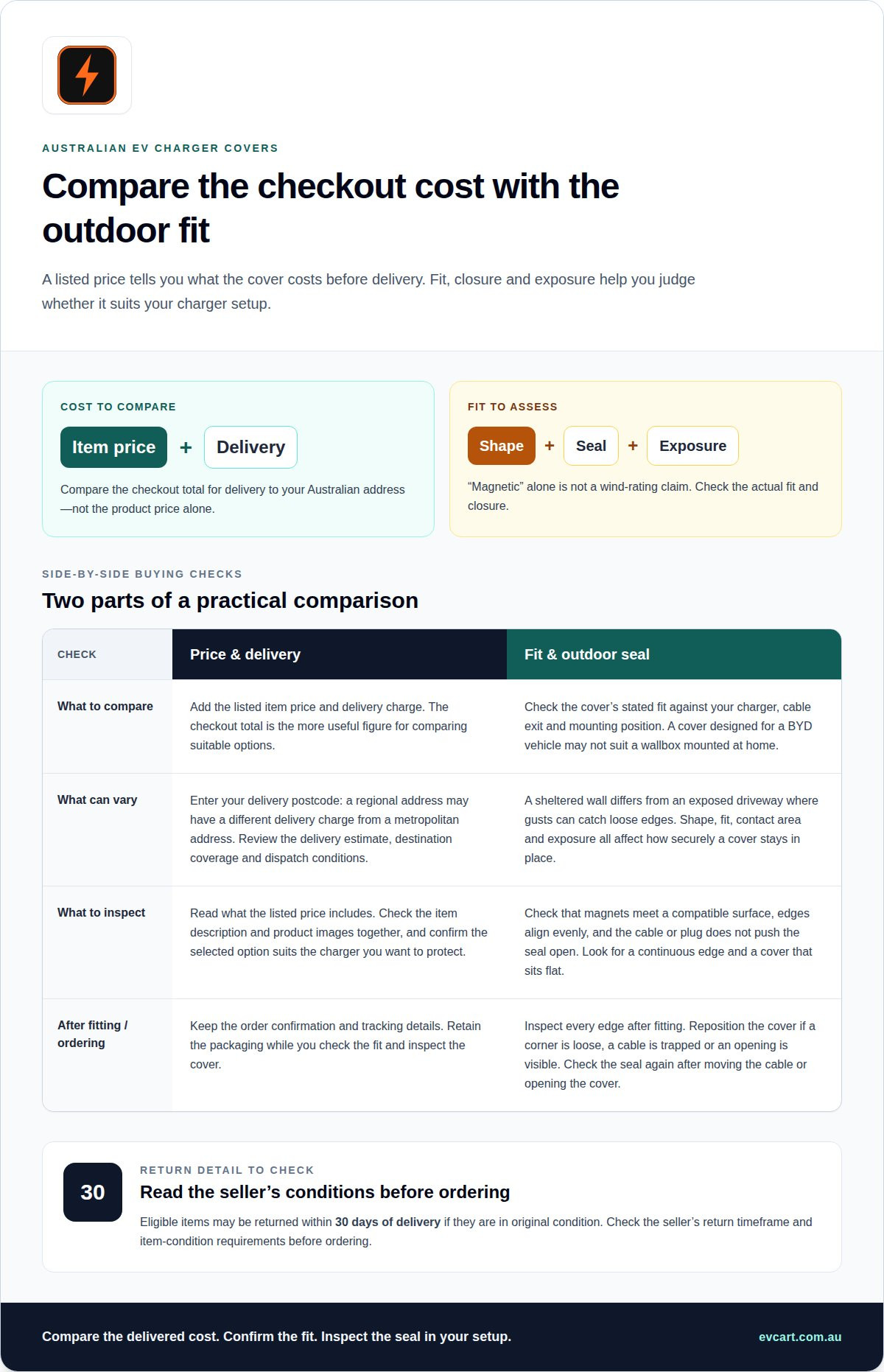
Compare the item price and delivery charge before placing an Australian order. The checkout total is more useful than the product price alone. Enter your delivery postcode, then review each amount shown before payment. A regional address may produce a different delivery charge from a metropolitan address. Treat the displayed total as the figure to compare across suitable options.
Check what the listing says the price includes. A cover may be sold on its own, while another listing may describe additional components. Read the item description and product images together, and confirm that the selected option suits the charger you want to protect. A listing designed for a BYD vehicle, for example, may not suit a wallbox mounted at home.
Shipping terms also matter. Review the delivery estimate, destination coverage, and dispatch conditions on the seller’s page. Keep the order confirmation and tracking details after purchase. If a parcel arrives damaged, photograph the packaging and item before discarding anything. This gives you a clear record of the order’s condition.
Returns can matter if the cover does not suit your setup. Read the seller’s return conditions before ordering, including the required item condition and return timeframe. Eligible items may be returned within 30 days of delivery if they are in original condition. Keep the packaging until you have checked the fit and inspected the cover.
Do Australian electrical standards or charger warranties restrict using an EV charger cover? The charger manufacturer’s instructions and warranty terms determine whether a cover is suitable for that model. Read the wallbox manual and warranty wording before fitting one, rather than assuming the same rule applies to every charger.
Can an EV charger cover trap heat or affect charging safety? Suitability depends on the cover’s design and the charger manufacturer’s guidance. Keep ventilation openings and operating controls unobstructed, and don’t use a cover that interferes with them.
Are EV charger covers compatible with different wallbox brands and models? Compatibility depends on the cover’s shape and the charger’s dimensions. Compare the stated fit with your wallbox model, cable exit, and mounting position before ordering. A cover designed for a BYD vehicle won’t automatically fit every wall-mounted charger.
Is a charger cover safe to use while the EV is plugged in and charging? Use a cover during charging only if its instructions and the charger manufacturer’s guidance allow it. Make sure the cable connects without pressure and that the cover doesn’t obstruct airflow or controls.
- Enter your postcode and compare the checkout total, not just the item price.
- Match the listing’s stated fit to your charger model and cable position.
- Read delivery and return terms before ordering, then retain the packaging.
- Follow the charger manual when deciding whether to leave a cover on while charging.
Magnetic seal and wind resistance
A magnetic seal is useful only if it meets a suitable surface and closes evenly. Magnets hold against compatible metal, while gaps can let in wind-driven rain or dust. Check where the magnets sit and whether your charger or vehicle provides consistent contact at those points.
Wind resistance depends on more than magnets. The cover’s shape, fit, contact area, and exposure all affect how securely it stays in place. A sheltered wall differs from an exposed driveway, where gusts can catch loose edges. Don’t treat “magnetic” as a wind-rating claim unless the listing gives a specific rating.
Check the seal against the surfaces it needs to cover. Look for a continuous edge, rather than isolated contact points, and make sure the cover sits flat without lifting at the corners. A cable crossing the seal can leave a gap or strain the closure. Route the cable as the cover’s design intends, without forcing the magnetic edge over it.
Use these checks when assessing a listing or fitted cover:
- Contact: Identify the surface the magnets are meant to attach to.
- Alignment: Check whether the edges meet evenly around the covered area.
- Clearance: Confirm the cable and plug don’t push the seal open.
- Exposure: Consider whether a wall, fence or other feature shields the charger from direct gusts.
After fitting, close the cover carefully and inspect every edge. A loose corner, trapped cable, or visible opening signals a poor seal. Reposition the cover before relying on it for outdoor protection. Check again after moving the cable or opening the cover, as either action can shift the magnetic contact.
Keep the closure clean. Dust or grit between the magnet and contact surface can prevent a close fit and mark the surface with repeated movement. Wipe both areas with a soft, dry cloth before refitting. Release the cover evenly instead of pulling it by one corner, to reduce strain on the seal and material.
A magnetic closure can make access straightforward, but it can’t compensate for an unsuitable shape or exposed gaps. Compare the stated fit and closure design with your setup, then browse EV accessory options while considering how your charger is positioned outdoors.
Treat listing details and your own fit checks as separate considerations when deciding whether to buy. The listed price identifies the offer, but doesn’t establish how well the cover will suit your charger’s surface, cable route, or exposure. Confirm the intended fit and closure against your setup, then assess the seal after fitting. A low price doesn’t resolve a poor practical fit. Focus on fit, closure, and outdoor conditions, rather than reading too much into the price or the word “magnetic”.
PVC material and durability
PVC can be suitable for a protective cover, but construction details affect performance. Check the material description, seams, and edges before choosing.
PVC construction
PVC is used in both flexible and firm products. A cover’s feel depends on its formulation and construction, so the material name alone doesn’t describe its full build. Read the listing for details about the sheet, seams, and closure. Don’t assume every PVC cover has the same thickness or flexibility.
Inspect how the material is assembled around openings and corners. A cover with a cable opening, for example, needs an edge that sits neatly around the cable route. Look at product images for stitching, joins, or folded edges, then compare those areas with your charger’s shape. Poor alignment can leave gaps or create pressure points during fitting.
Consider how you’ll handle the cover during regular charging. A flexible PVC panel may fold for access, while a firmer construction may hold its shape differently. Neither description proves suitability on its own. Check the cover’s dimensions and opening positions against the charger, plug, and cable before ordering.
Material durability
Durability depends on more than the word PVC. Repeated folding, rubbing against a wall, and pulling around cable openings can stress a cover. Inspect the seams and corners, where movement concentrates. If you’ll open it often, choose a design that allows access without stretching the material or dragging it over sharp edges.
Outdoor placement also affects wear. A cover under an eave faces different conditions from one exposed to direct sun and wind. Don’t treat a material label as proof of a particular service life or performance rating. Follow the product’s care guidance, and check for visible cracking, splitting, or loose joins during routine cleaning.
Keep grit from collecting between the cover and charger. Wipe the surface with a soft cloth and let it dry before refitting. Avoid harsh cleaners unless the care instructions allow them. A particle trapped near a fold, for example, can rub against the PVC each time the cover moves and gradually mark the surface.
Before each use, check the edges, cable opening, and closure. Replace the cover if damage prevents a neat fit or exposes areas it should cover. Matching the construction to your charger and handling routine helps you assess PVC as a practical material, not just a label.
Rain, dust, insect and UV protection
For an outdoor charger in Australia, match its IP rating to the actual exposure and follow the manufacturer’s instructions. An outdoor-rated charger doesn’t automatically need a cover. Use one only if the instructions allow it.
Protection from rain and dust
A cover can add a barrier between the charger and direct weather. The cover discussed here is advertised as providing 360° protection against rain, dust, insects and UV exposure. Treat that as a product claim, not proof that every opening stays sealed in every setup.
Check how the cover sits around the charger before relying on it. A cable routed across an edge, for example, may leave a gap where rain or dust can enter. Compare the cover’s shape with the charger, cable exit, and wall position. Look for openings, seams, and uncovered edges in product images.
After fitting, inspect the top, sides, and cable entry. Wipe away accumulated dust with a soft cloth, then check that the cover still closes neatly. A cover that shifts or leaves an opening may offer less practical protection than its listing suggests.
Insect and UV protection
Insects can settle in sheltered spaces around an outdoor wallbox, while sunlight reaches exposed surfaces throughout the day. A cover advertised for insect and UV protection may help shield the area it covers. Check that its edges meet the charger closely, as an open cable gap can remain an entry point.
Consider the charger’s position as well as the cover material. A unit beneath an eave has different sun exposure from one on an open wall. Inspect the cover after cleaning and refitting, especially around seams and folds. Look for fading, cracks, or loose edges that could affect the fit.
Keep the cover clean and dry before storing it. Brush away dust before folding, for example, rather than trapping grit against the surface. Follow the product’s care instructions and avoid cleaners they don’t recommend.
Outdoor ratings and cover use
What IP rating should an outdoor EV charger have in Australia? There isn’t one rating for every location. Match the charger’s stated IP rating to its exposure, then follow the manufacturer’s installation and use instructions.
An IP rating describes protection against specific forms of ingress, but it doesn’t describe every site condition. A sheltered wall and an exposed position face different levels of rain and dust exposure. Read the charger documentation and consider its stated rating in the context of the installation location.
Do outdoor-rated chargers need a cover? Not automatically. A cover can provide an additional barrier, but use one only if the charger’s instructions permit it and it leaves controls, ventilation, and cable connections unobstructed.
Before choosing a cover, compare its advertised protection with the charger’s guidance. Check the fit around the cable, inspect the edges after installation, and remove the cover if it interferes with normal charger operation.
Tool-free installation and removal
A tool-free cover avoids screws, drills and permanent changes to the charger. The cover described for this guide is advertised as installing and removing in under 10 seconds. Treat that as the stated fitting time, not a substitute for checking the cover’s shape against your charging setup.
Before fitting a cover, clear the area around the charger. Read the instructions and identify the top, cable opening, and closure. A cover designed for a vehicle-mounted charging point, for example, may sit differently from one intended for a wallbox. Check the product’s intended use before placing it.
Use a simple sequence to keep fitting controlled:
- Check the charger, cable and cover for dirt or damage.
- Position the cover in line with its intended opening.
- Guide the cable through the designated route without pulling it.
- Close the cover, then inspect its edges and contact points.
Don’t force the material around a plug, cable, or charger corner. Pressure can distort the fit and leave an opening. If the cover won’t sit naturally, remove it and reassess the alignment. A tool-free design shouldn’t require stretching, wedging, or tying the cover into place.
Remove the cover carefully, too. Release the closure evenly instead of pulling sharply at one corner. Keep the cable clear as you lift the cover away, then place it somewhere clean and dry. Avoid dropping it on a gritty driveway, where debris can cling to the material before refitting.
Check the fit again after moving the cable or opening the cover. Look for shifted edges, trapped material, and pressure on the charging connection. If you charge outdoors, make sure the cover doesn’t interfere with the charger’s controls or ventilation. Follow the charger manufacturer’s guidance about using a cover while charging.
Tool-free fitting can make regular access simpler, but it doesn’t prove compatibility. Compare the cover’s intended use, dimensions, and openings with your charger and cable layout. A neat fit should allow removal without tools while keeping the cover clear of connections and moving parts.
To compare options for your charging setup, review EV charging accessories and assess each item’s stated fit before choosing.
EV Cart Australia: EV accessories
EV Cart Australia offers EV accessories for practical electric vehicle ownership. If you’re comparing charger-cover options, use this guide’s advice on fit, material, and care to assess what suits your setup. Check the product description against your vehicle and charging arrangement before choosing an accessory.
Browse EV accessories through EV Cart Australia’s online store. Review each product’s intended use and fitment details, and choose an item that matches your needs. For questions about an order or accessory, contact EV Cart Australia through evcart.com.au.
Choose a cover that suits your charging routine
Before deciding, picture the cover in your regular charging routine. Consider where you’ll keep it when removed, whether you’ll need clear access to the plug, and how the charger sits against its mounting surface. These practical details can show whether a weatherproof EV charger cover will be straightforward to handle, not just suitable on paper.
Use your charger’s model details and the product description as your final comparison points. If the stated fit and intended use align with your setup, you can make an informed choice. If they don’t, look for an accessory that matches the way you charge.
For your next step, browse EV Cart Australia’s online range and explore accessories for your electric vehicle. Choose carefully, and make outdoor charging easier to manage.
Frequently Asked Questions
How much do EV charger weatherproof covers cost in Australia?
There isn’t one set price for every cover in Australia. Prices vary with the cover’s design and intended use, so compare products made for similar setups. Before buying, make sure the price is in Australian dollars and review the checkout total, including delivery. Don’t compare a vehicle-specific accessory directly with a cover designed for a different charging arrangement.
Where can I buy an EV charger cover in Australia?
Browse EV accessories through EV Cart Australia’s online store. Use the product information to identify each item’s intended use rather than relying on a broad “charger cover” label. When comparing listings, note the product name and stated use to distinguish covers for different charging arrangements. This helps narrow your options before ordering.
Can a weatherproof cover protect an EV charger from rain, sun, dust, and vandalism?
A cover may shield the surfaces it encloses, but it shouldn’t be treated as vandalism protection. A fabric or plastic cover isn’t a lock, barrier, or anti-tamper device. Don’t assume it will prevent impact damage or unauthorised access. If physical security is a concern, assess the charger’s location and access separately, rather than relying on a cover to secure the unit.
How do you install and maintain an EV charger weatherproof cover?
Keep the product instructions and packaging until you’ve finished fitting the cover and decided where to store it. Don’t drill, cut, or modify the charger or cover to force a fit. If the cover becomes torn or its closure stops working, stop using it until you can replace it. Keep the care instructions with the item for future maintenance.
What types of weatherproof covers are available for EV chargers in Australia?
The material describes an Oxford Cloth Standing EV Charging Station Cover and a magnetic waterproof EV charger cover for BYD vehicles.