
Zappi or Wallbox: Compare Charging Power, Warranty and Installation
2026-11-11

Choosing EV accessories starts with your vehicle and how you use it. A precise fit matters more than buying an item that may not suit your model or routine.
Check compatibility before adding an accessory to your setup. Compare the product’s fitment details with your vehicle’s make, model, year and variant.
This guide covers practical EV ownership, including how to assess accessory fit and choose items for everyday use. Use the product details to make an informed choice for your vehicle.
Key Takeaways
- Compare the full installation scope, not just the charger price: cable routing and switchboard requirements can affect the overall cost.
- Zappi can use solar surplus to charge an EV, but the benefit depends on when your car is at home and generating surplus is available.
- Match charger power to both your home’s electrical supply and your vehicle’s AC charging capacity; a charger’s maximum output does not guarantee the car can use it.
- In Victoria, a permanently connected EV charger must be installed by a licensed electrician, and a Registered Electrical Contractor must issue a Certificate of Electrical Safety when the work is complete.
- Compare warranty terms and operating conditions alongside charging features to find the better fit for your home and routine.
Table of Contents
Choosing a charger for a solar or Tesla setup
For a solar home, the key difference is how charging responds to surplus generation. The myenergi Zappi can use grid, solar, battery or wind-turbine energy. Its v2.1 model uses switchboard current sensors to detect household electricity exports, then adjusts EV charging to match available solar surplus. That makes energy management central to the choice, rather than an extra feature to consider later.
Solar diversion works best when the vehicle is home while the panels are producing power. A car that leaves at 7am and returns at 6pm misses much of that daytime generation; charging after work may draw from the grid instead. A Tesla used mainly for commuting faces the same timing issue as any other vehicle. Look at the car’s daily schedule alongside your household’s solar generation before prioritising solar-only charging.
Zappi’s energy modes give a household several ways to charge. Solar surplus can be directed into the vehicle battery, while grid, home battery or wind-turbine energy can also contribute. A 7 kW home charger provides a useful reference point for home charging, but the energy source still depends on generation, household use and the selected charging mode. A home battery may also be serving other loads, so it is worth considering how the household manages stored energy.
Three-phase supply affects how power is delivered, but it does not create solar surplus. In a three-phase home, the charger’s settings and measurement arrangement need to account for generation across the relevant phases. There is no single three-phase solar threshold that applies to every setup, so don’t treat a fixed export figure as universal. Assess the charger’s phase configuration and solar measurements together.
| Option | Solar energy management | Best fit to consider |
|---|---|---|
| Zappi | Grid, solar, battery or wind; v2.1 sensors detect exports | Homes prioritising solar-surplus charging |
| Wallbox | Compare the chosen model’s solar controls and measurement setup | Buyers weighing its charging features against their energy system |
| Either with a Tesla | Consider home generation and when the car is parked | Owners matching charger operation to their driving routine |
A Tesla charging setup depends on the vehicle and the home charging arrangement. Match the charger’s connection and operating settings to the car, then consider whether it is parked during solar production. The choice is not simply “solar charger versus Tesla charger”: solar use also depends on the household system and when the vehicle is available.
Choose Zappi if solar-surplus management is a priority and its energy modes suit your household. For a Wallbox, compare the specific model’s solar controls with your system rather than assuming all chargers manage exports alike. Before deciding, consider phase configuration, daytime vehicle availability and how you use your home battery.
Warranty, installation and Victorian electrical requirements
Vehicle-specific accessory fit
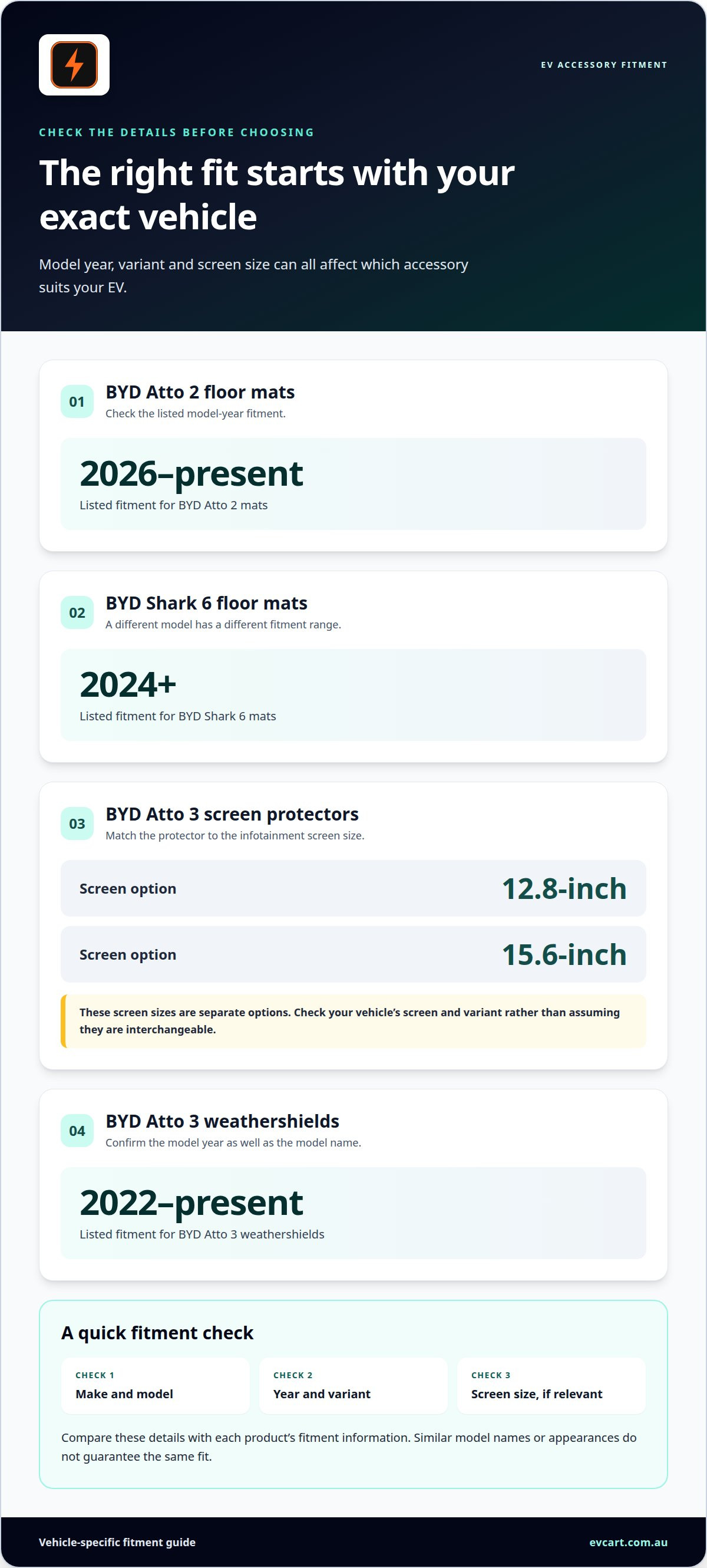
For EV accessories, start with the vehicle’s make, model, year and variant. Fitment can differ across versions of the same model, so match those details to the product listing before ordering. For example, the listed BYD Atto 2 mats fit 2026-present models, while the BYD Shark 6 mats fit 2024+ models.
Use product fitment details to narrow your options. An accessory designed for one model or year may not fit another correctly. If a listing asks you to check fitment, confirm your vehicle’s year and variant before ordering. This is particularly important when a model has changed between versions.
Different accessories meet different everyday needs. Floor mats help protect the interior, while a screen protector covers the infotainment screen. Weathershields are fitted to the vehicle’s exterior. Decide what you want to protect or make more practical, then check the product’s listed fitment.
Choosing accessories for everyday use
Consider how you use your vehicle before choosing an accessory. If you want to protect the interior, compare model-specific floor mats. If you want to cover the infotainment display, choose a protector made for that screen. Product names and fitment details distinguish options that may look similar but suit different vehicles.
For example, the BYD Atto 3 has listed screen protectors for 12.8-inch and 15.6-inch infotainment screens. Match the accessory to the screen size and variant rather than assuming the options are interchangeable. The BYD Atto 3 weathershields are listed for 2022-present models, so model year remains an important fitment detail.
Shortlist products based on your exact vehicle and the need each one addresses. Read the fitment details for every accessory, especially when comparing variants. If a listing requires fitment confirmation, resolve that before ordering. This is more reliable than choosing by appearance or a similar model name.
An Australian home EV charger installation may require a switchboard upgrade costing 800 - 2,500. Standard single-phase Melbourne residential installation prices are indicative and valid in April 2026, and the circuit must be safe to operate unattended for eight hours overnight.
Maximum charging power and three-phase supply
Single-phase and three-phase supplies affect the power available to a charger, but the vehicle sets its own limit. Compare your home supply, charger rating and car’s AC charging capacity together.
Three-phase charging
Three-phase charging can support higher power than a single-phase setup, provided the charger and vehicle can both use it. Zappi’s listed maximum on single phase is 7 kW. Its three-phase compatibility does not, by itself, establish a 22 kW charging rate.
A product listing showing 22 kW describes charger capability, not a guaranteed rate for every vehicle. Some EVs cannot accept 22 kW AC charging, even when the home charger can supply it. Check the car’s onboard AC charging limit against the charger rating before treating that figure as usable speed.
For Australian EV owners, the practical benefit of three-phase charging depends on the car and charging routine. If the vehicle accepts less AC power than the charger can provide, the car remains the limiting factor. A higher available supply won’t increase its charging rate.
Single- and three-phase compatibility
Zappi and Wallbox chargers are listed as compatible with single-phase and three-phase power. This gives owners options for different supply types, but does not mean every model has the same maximum output. The specific charger configuration and vehicle capacity determine the power available during charging.
For a single-phase home, Zappi’s listed maximum is 7 kW. A 7.4 kW charger is another common reference point for home charging, but that rating alone doesn’t establish which charger suits a particular car. Compare the charger’s phase arrangement with the home supply and the vehicle’s AC limit.
Daily driving helps put those ratings into context. A household driving 40 to 60 kilometres a day can replace that distance in about an hour and a half of charging at 7.4 kW. That example shows why the highest available rating may not be essential for every owner. A vehicle that spends longer parked at home can have more time to recharge at a lower rate.
Use these checks to compare charging power:
- Home supply: identify whether the property has single-phase or three-phase power.
- Charger rating: distinguish single-phase maximum power from three-phase capability.
- Vehicle limit: match the charger output to the car’s maximum AC charging rate.
- Routine: consider daily distance and how long the vehicle is usually parked.
A three-phase 22 kW-capable charger is most relevant when the vehicle can accept that AC rate and the home supply supports it. Otherwise, compare realistic charging needs, not the largest number on a listing.
What is the best EV charger for solar?
For a solar household, charging controls matter. Also consider the charger’s operating temperature limits and warranty terms. Compare its stated operating range with the planned location, and review the product’s warranty documentation for coverage details.
The listed operating range for Zappi is −25 to 40 °C. The Zappi and Wallbox Pulsar Plus are both identified with a maximum operating temperature of 40 °C. That gives a useful comparison point for Australian homes, where a charger’s mounting location can experience different conditions from a shaded indoor space.
Consider the proposed mounting position before choosing. An outdoor charger may receive direct sun, while one in a garage may be more sheltered. The listed maximum temperature is an operating limit, not a promise that every location will stay within that range. Account for exposure at the mounting point, particularly in hot weather.
Solar suitability still depends on more than temperature. Zappi’s solar-surplus controls can direct available household generation towards charging, while the Wallbox Pulsar Plus shares the stated 40 °C maximum operating temperature. Keep those criteria separate: the temperature specification describes operating conditions, while solar controls describe how charging can use surplus energy.
Warranty comparison needs the same care. Zappi has a 3-year warranty. For either charger, read the applicable warranty documentation for its coverage, exclusions, claim process and any conditions affecting repairs. Don’t assume two products offer identical terms because both are home chargers. A stated warranty period is only one part of understanding support.
Customer support is another practical consideration, but a product’s temperature rating or software features do not establish how local warranty support works. Review the documentation for the specific model to understand how a claim is handled. If software matters to charger operation, distinguish software support from hardware-fault coverage, as they may follow different processes.
- Operating range: compare the stated limits with the charger’s intended location.
- Solar controls: assess how the model manages surplus generation.
- Warranty: read the period, coverage and exclusions in the product documentation.
- Support: understand the documented claim process before choosing.
For example, a Zappi mounted in a sheltered garage and a Wallbox Pulsar Plus mounted outdoors may face different conditions, even though both models have a stated 40 °C maximum. Compare the proposed location, solar function and written warranty terms together. That gives a more useful decision than relying on a single specification or product comparison quote.
Zappi and Wallbox charger comparison
A Zappi vs Wallbox charger comparison is most useful when it reflects your home energy setup, vehicle and charging routine. Compare the exact model and installation configuration, not just the brand.
App scheduling and connectivity vary by charger model, so compare these functions using the product documentation. A tariff’s charging times and a charger’s scheduling controls are separate considerations. Don’t assume a particular app feature based on the brand alone.
Both Zappi and Wallbox chargers are listed as compatible with single-phase and three-phase power. However, not every Australian EV can use every charger’s maximum output: the vehicle’s AC charging capacity matters too. Zappi can use grid, solar, battery or wind-turbine energy. Assess solar-system suitability against the specific Wallbox model.
| Comparison point | myenergi Zappi | Wallbox |
|---|---|---|
| Power supply | Single-phase and three-phase compatible; listed single-phase maximum is 7 kW | Single-phase and three-phase compatible |
| Solar energy | Can charge using grid, solar, battery or wind-turbine energy | Compare the exact model’s solar controls with your system |
| Vehicle fit | Match charger output to the EV’s AC charging capacity | Match charger output to the EV’s AC charging capacity |
| App and scheduling | Assess features for the specific model | Assess features for the specific model |
| Higher AC power | A 22 kW-capable listing doesn’t mean every EV accepts 22 kW | Vehicle capacity still determines usable AC power |
For a solar household, Zappi has a defined energy-management advantage: its v2.1 sensors detect household electricity exports and adjust charging to available solar surplus. That can suit a vehicle parked at home during generation. If your car is away through the day, solar controls may be less useful for that vehicle’s charging routine.
For Wallbox, compare the exact model’s documented controls, connectivity and electrical configuration with your household setup. Don’t assume every Wallbox model offers the same functions. Apply the same approach to myenergi Zappi: identify the model, then compare its features with how you charge.
A 22 kW figure deserves particular care. Some vehicles cannot accept 22 kW AC, even if a home charger can supply that power. A higher-rated charger therefore doesn’t automatically mean faster charging for your car. Check the vehicle’s AC limit alongside the charger rating and home supply.
Use this decision sequence:
- Match the charger’s power and phase configuration to your home supply.
- Compare the vehicle’s AC charging limit with the charger’s output.
- For solar use, weigh Zappi’s stated energy modes against the chosen Wallbox model’s documented controls.
- Compare app, scheduling and tariff-related functions using exact model details.
Use a Zappi vs Wallbox charger comparison to find a model that fits your priorities. Choose Zappi if its solar-energy management suits your household, or compare models by compatible power, vehicle capacity and the features you’ll use.
EV Cart Australia
EV Cart Australia helps Australian EV owners choose accessories for their vehicles. After comparing charger power, solar use and vehicle compatibility, consider which accessories suit your everyday setup. Base the charger decision on your home’s electrical supply and the vehicle’s charging capacity; choose accessories separately to match how you use and care for your EV.
For questions about EV accessories, contact EV Cart Australia. Share what you’re looking to solve, such as making your regular EV routine more practical, and the team can help with accessory-related enquiries.
Plan the next part of your EV setup
A Zappi-versus-Wallbox charger comparison can help narrow your home charging choice, but it is only one part of EV ownership. Consider which accessories would make everyday use more practical, and choose them to suit your vehicle and routine.
EV Cart Australia offers EV accessories for Australian drivers. If you’re considering what else belongs in your setup, contact the team with an accessories enquiry. Keep the question focused on the vehicle or accessory you have in mind, so the conversation can start with what you need.
Contact EV Cart Australia for advice about EV accessories. Take the next step at your own pace and build a setup that works for you.
Frequently Asked Questions
How do I check whether an accessory fits my EV?
Select your vehicle’s make and model, then read the fitment details on the product page. Some items require confirmation against the vehicle’s year and variant, so check those details before ordering. For help interpreting a listing, email EV Cart Australia at hello@evcart.com.au. This helps you avoid choosing an accessory intended for a different version of your vehicle.
How should I clean EV floor mats?
The listed TPE mats can be cleaned by hosing them down. Remove the mats from the vehicle before cleaning and let them dry before refitting. Stick to the stated cleaning method rather than soaking or immersing them. For other accessories, follow the care instructions for that item, as materials and suitable cleaning methods differ.
Which BYD models is the dash cam cable compatible with?
The listed dash cam cable fits MY2025 BYD Seal, Sealion 6, Atto 2, Atto 3 and Dolphin models that are missing the factory blue dash-cam cable. It’s a replacement cable, so the vehicle’s model year and existing cable setup matter. Compare those details with the product fitment information before ordering to ensure the listed compatibility matches your vehicle.
What can I do if I order the wrong accessory variant?
Contact EV Cart Australia with your order reference for advice on next steps. Change-of-mind returns are available within 14 days for unused items in their original condition. You can choose store credit or a refund less the 20% handling fee; return postage is your responsibility, and original shipping is non-refundable. Faulty-product and statutory rights are unaffected by this change-of-mind policy.