
EV Key Case: How to Choose the Right Fit
2026-10-19

What if the EV key case you like does not fit your fob properly? Fit matters more than colour or finish: key fobs can differ in shape and button layout between models, and updates can change the design. A poorly matched case may sit awkwardly, cover a control or make everyday use less convenient.
A case can add a layer between your fob and the things it comes into contact with, but it also changes the key’s size and feel. The practical choice comes down to balancing fit, material, coverage and ease of use for your routine.
Start by identifying your exact vehicle and the fob you carry. Then compare the case’s stated fitment, shape and button positions with your key. This guide explains how to weigh up common materials and designs, check everyday usability and avoid choosing by appearance alone. By the end, you’ll have a clear checklist for finding a case that suits your key and the way you use it.
Key Takeaways
- Use your vehicle’s model year and the fob itself to narrow down the right fit.
- Compare material and construction for the balance of feel, bulk, care and protection that suits your routine.
- Choose an EV key case that keeps the fob comfortable to handle and practical to use.
- Set your priorities first, then assess fit, handling and finish before making a choice.
- Use the fitment details to guide your browse through EV Cart Australia’s EV accessories.
Table of Contents
What does an EV key case do, and who might find one useful?
An EV key case is a cover shaped to fit around a vehicle’s key fob. It adds an outer layer to the fob; it does not replace the key or change its purpose. A key ring attaches to the key or fob to hold it or make it easier to carry. Some accessories combine a cover and a ring, but they serve different functions.
A cover can help limit scuffs from everyday handling, such as taking the fob in and out of a bag or putting it down on a shared bench. A distinct colour or finish can also make your key easier to pick out among similar-looking fobs. Think of a case as an extra layer, not a guarantee against damage. Its coverage depends on the design and how you use the key.
EV fobs are part of the broader category of smart keys, which communicate with a vehicle’s access system. For background on how these keys work, see Smart Key Technology. A case sits around the fob; it is not a substitute for its electronics or the key itself.
Key case, key cover or key fob cover: what do the terms mean?
Retailers often use “key case”, “key cover” and “key fob cover” for products designed to fit over a fob. The terms overlap, but they do not guarantee identical construction. One design might be a flexible sleeve, while another uses a more structured shell. A decorative key ring or tag usually attaches to the fob without covering its surface, so it offers a different function.
When might a key case suit your everyday routine?
Consider how you carry and handle your key. A cover may suit you if you want more grip, a distinct look or an easier way to tell your fob apart from someone else’s. If the key often shares a pocket or bag with other items, an outer layer may help reduce surface marks from contact. It does not remove the need to handle the fob with care.
- For quick identification: A different colour or finish can make your fob easier to recognise at a glance.
- For handling: Consider whether the surface feels comfortable and whether added thickness suits your pocket or bag.
- For a simpler setup: If you prefer the original size and feel, a cover may add more bulk than you want.
Any added material changes the fob’s dimensions and feel, even if the case is slim. That can affect how it sits in your hand or pocket and how easily you reach its controls. Start with your daily routine, then weigh the benefits of coverage or easier identification against the extra size. The practical choice is one that suits your handling habits without making the key awkward to carry or use.
How should you compare EV key case materials and designs?
Compare construction before choosing a colour or finish. An EV key case may be soft and flexible, leather-look or fabric-like, or built as a more rigid shell. These are broad design categories, not guarantees of a particular material or level of protection. Consider how each case feels, how much space it adds and what care its maker recommends.
Use these broad trade-offs as a starting point, then read the details for the specific product:
Soft, flexible cover
Feel: Often pliable, with the fob’s outline still easy to feel. Bulk: May add less structure than a rigid design, though thickness varies. Care: Check the product’s care guidance. Trade-off: The flexible feel may suit your handling preferences, but it does not provide the firm structure of a shell.
Leather-look or fabric-like finish
Feel: Texture and finish vary, from smooth to more tactile. Bulk: Depends on how the case is made. Care: Follow the maker’s instructions for the specific finish. Trade-off: A distinctive surface can suit your style, but texture and visible wear may differ between designs.
Rigid shell or frame
Feel: More structured around the fob. Bulk: May add a firmer, thicker profile. Care: Check product guidance, especially for designs with separate pieces. Trade-off: Added structure can mean extra size and assembly steps.
Soft, leather-look and fabric-style cases
Flexible designs may feel less rigid in the hand, while a textured surface can feel different from a smooth one. Neither is automatically better. Think about how you handle the fob, where you carry it and whether you want a finish that stands out. Some surfaces may show marks more readily than others, so inspect product images and care details rather than assuming a material will hide wear.
Rigid frames and multi-part case designs
A rigid design may use two or more pieces that fit around the fob. This can feel more structured, but may add bulk and require assembly. Check that the design leaves the buttons and other openings accessible, and does not block the point where a key ring or attachment connects. A neat appearance matters less if the finished case makes the fob awkward to handle.
Colour and finish are personal choices, not evidence of fit or protection. Once you know which construction suits your routine, browse EV accessories for practical vehicle-specific guidance, then compare each item’s stated details before deciding.
What should you check before buying an EV key case?
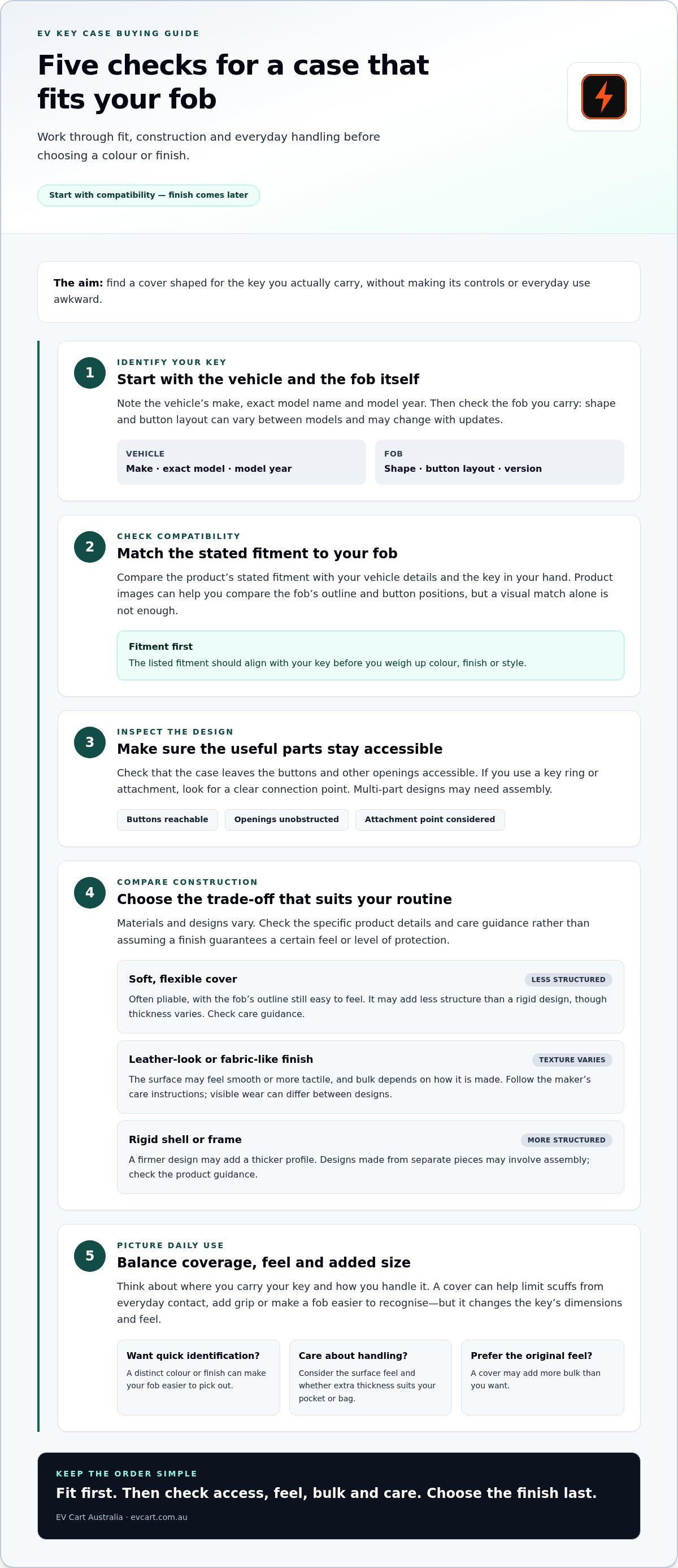
Start with compatibility, not colour or finish. A vehicle’s make and model may not identify every fob version: the key can vary by model year, trim or update. Identify the fob you actually carry and compare it with the product’s stated fitment and images. A close visual match is useful, but the listed fitment should align too.
Check compatibility separately from personal preference:
- Vehicle model: Record the make and exact model name.
- Model year: Note the year the vehicle was built or sold, as specified in the product fitment details.
- Fob version: Identify the generation or version if you can, using vehicle documents or the fob’s markings where available.
- Fob outline: Compare its shape, proportions and edges with the product images.
- Button layout: Check the number and position of buttons, along with any distinctive symbols.
- Style preference: Once fitment aligns, choose a finish and colour that suit your taste and routine.
Compare clear product images from more than one angle. Look at the fob’s front, sides and back, including openings, seams and attachment points. The product description and images should support the same fitment. Do not rely on a vehicle name alone. If two fobs look nearly identical, treat them as different until the listed fitment matches the details you can see on yours.
Match the case to the exact key fob
Identify your vehicle model and model year, then compare the physical fob with the case details. Check the outline, button positions, openings and points for attaching a key ring. Small differences can affect how a case sits or whether its cut-outs line up. Do not assume a case for a related model or similar-looking fob will fit. Use the stated fitment as your main reference.
Check access, handling and keyless operation
Check that the design leaves the buttons and any required openings accessible. Consider whether the case’s edges or added thickness could make the fob less comfortable to hold or the buttons harder to press. If you use keyless entry, rely on product-specific information about signal performance rather than assuming every material or design behaves the same. A matching exterior shape alone does not establish how the fob will operate while covered.
Before buying, compare the product details with your fob once more. Confirm vehicle and fob fitment first, check that controls and openings remain accessible, then consider appearance. This keeps a preferred colour or finish from distracting you from the practical match. If the fitment is unclear, do not treat a near match as confirmation.
How do you choose a key case for your driving habits?
Choose according to how you carry and use your fob. If you press its buttons throughout the day, easy access and a secure grip may matter more than a bold finish. If you carry several keys together, attachment points and combined bulk may matter more. Use this sequence to weigh those needs without letting appearance take priority over fit.
- Set your priorities. Decide whether protection, grip, appearance or compactness matters most. Choose your main priority before comparing styles, so a preferred colour does not distract from fit.
- Check fit. Match the stated vehicle and fob fitment to your key. Compare the outline, button positions and openings, and set aside any option that does not match.
- Assess handling. Think about how often you press the buttons, where you carry the fob and whether a case could make it harder to hold or use. If you carry other keys, consider the attachment point and how the whole set will sit in your pocket or bag.
- Compare the finish. Once fit and handling look right, choose a colour and surface that suit your taste and routine. Treat finish as a preference, not evidence of compatibility.
- Recheck the details. Read the full listing against your fob and intended use. Check what it says about included components and care before deciding.
Choose priorities before comparing styles
If you regularly unlock the car using the fob, clear button access may come first. If you keep a spare key tucked away, easy identification and appearance may matter more. If you carry a house key on the same ring, compactness and a suitable attachment point could take priority. Decide what matters for your routine, then compare options in that order.
Review the listing details before making a decision
Read the product description and inspect its images. Match the stated vehicle and fob fitment, check which components are included, and look for care information that applies to the specific finish. Use the details on the individual product page when comparing the item with your needs.
For a wider view of how different accessories fit your ownership needs, read EV Cart’s EV accessories buyer’s guide. Once you’ve identified the right fitment, browse EV Cart’s EV accessories and compare the relevant product details with your priorities.
Where can you find an EV key case that suits your vehicle?
Keep the decision in a clear order: identify your fob, match the fitment, assess how you’ll use the case, then compare designs. This helps you avoid choosing by appearance alone. A broad vehicle category can be a useful starting point, but the product’s stated fitment and specifications matter when deciding whether an EV key case suits your key.
As you browse EV Cart’s accessories, keep your vehicle and fob information nearby. Use each product page’s details to guide your decision, and treat images as a comparison aid rather than proof of compatibility on their own. If fitment is stated for a specific vehicle or fob version, compare it with the information you have before weighing up the finish or other preferences.
Use your vehicle and fob details to narrow the search
Write down your vehicle model and year, then note the fob’s shape and button layout. Use those details to assess whether a product page describes the same key, rather than relying on a broad make or vehicle category. The same principle applies to other accessories: the EV screen protector fit guide shows why matching an accessory to the relevant screen matters.
Once you’ve found a potential match, compare the written fitment details with the product images and your physical fob. Do not assume a similar-looking design is right if the listing does not clearly align with your key. Leave appearance decisions until you have a sound fitment match to consider.
Make a confident choice without overbuying
Separate essentials from preferences. The essential checks are whether the stated fitment suits your fob and whether the design leaves its controls usable. Grip, colour and finish are personal choices. Extra features or a more elaborate design may add little value if they do not meet a need in your daily routine.
Before deciding, read the product-page information for the specific item. Use its stated fitment and specifications, and review details about included components or care where provided. Base your choice on the information for that product rather than assumptions about its features.
Choose the simplest option that meets your needs and matches your key. If you’re comparing other practical additions for your vehicle, browse EV Cart accessories and use each product page to guide your choice. Take your time, check the fit and select what suits your vehicle and routine.
Make your next accessory choice with confidence
Before choosing an EV key case, notice how your key fits into your routine. Do you reach for it one-handed, keep it with other keys or prefer it tucked away? That small observation can help you decide what will feel convenient, rather than choosing a design based only on how it looks on screen.
Keep your choice practical. An accessory should suit the way you use your vehicle, not add complexity for its own sake. Compare the details and choose something that answers a real need. A considered choice is more likely to feel right beyond the first impression.
Ready to explore accessories for your vehicle? Browse EV Cart accessories and use the information on each product page to guide your next step.
Frequently Asked Questions
Will an EV key case fit every key fob for the same vehicle model?
No. A model can have different fob versions, so a case intended for one key may not suit another, even if both belong to the same vehicle range. This can matter if your household has two vehicles of the same model from different years. Compare the listing’s stated fitment with the fob you’ll cover, rather than choosing by the vehicle name alone.
Can an EV key case affect keyless entry or remote buttons?
It can affect how easily you press the buttons, depending on the case’s cut-outs and construction. Signal performance can differ between designs, so use product-specific information rather than relying on a general rule. After fitting a case, try each remote button and your usual keyless-entry routine. If a control feels obstructed or operation changes, remove the cover and reassess.
How do I identify which key fob version I have?
Check the vehicle handbook or other vehicle documents for key information, then compare your fob’s outline, button symbols and arrangement with the product listing. Look for a model-year or fob-generation reference in the listing. If you have a spare, compare both keys directly. They may look similar at a glance but have different shapes or control layouts.
Does an EV key case make the fob bulkier?
Yes, a cover adds material around the fob, but the amount varies by construction. A small increase may be unnoticeable on a desk yet feel different in a tight pocket or when the key shares space with a phone. Check the product images and stated dimensions if available, and consider how you usually carry your key before choosing a more structured design.
Can I attach a key ring to an EV key case?
Only if the case has an attachment point designed for a ring or similar fitting. Check the product images and description to see whether that point remains accessible once the case is fitted. Do not force a ring through a seam or opening that is not intended for it. If you carry several keys together, consider whether their combined weight and movement will feel comfortable.
How do I clean a key case without damaging its finish?
Follow the care instructions supplied for that specific case. Finishes can differ, so do not assume a cleaner or cleaning method that suits one cover will suit another. If no instructions are provided, avoid applying chemicals or soaking the case until you know they are appropriate for its material. Remove the cover from the fob before cleaning only if its instructions allow it.
Is a soft or hard-shell EV key case better for daily use?
Neither is automatically better. A soft case may feel more flexible, while a hard shell can feel more structured and add a firmer profile. Think about how often you handle the fob, whether you prefer flexibility or structure, and how much extra size you’re comfortable carrying. Prioritise comfortable everyday use and suitable fit over choosing a material based on appearance alone.